
Free Safe Operating Procedure (Hydraulic Lift Table) Template
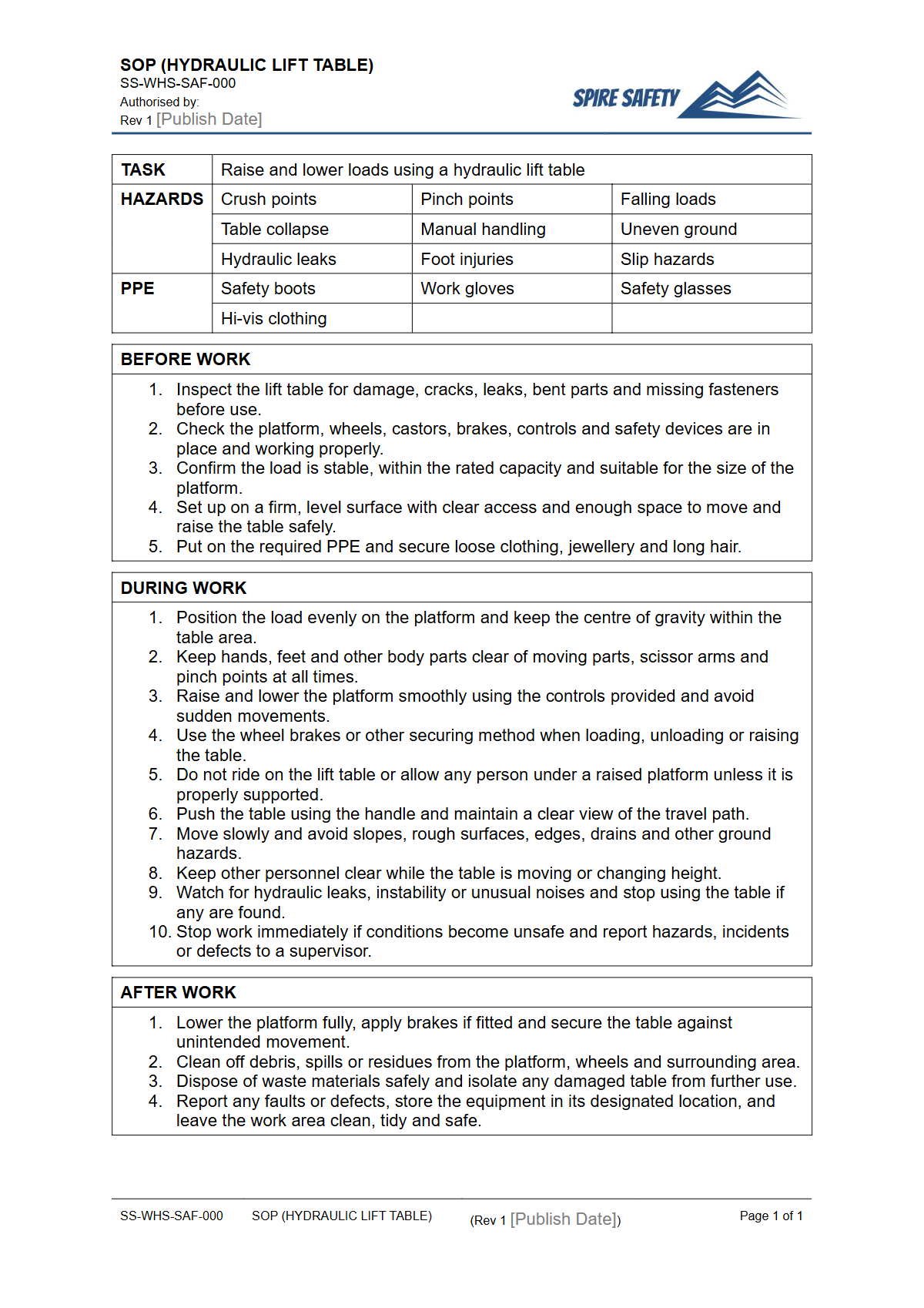
Download our free Safe Operating Procedure (Hydraulic Lift Table) template. This customisable document helps you outline step-by-step safety instructions.
Free Safe Operating Procedure (Hydraulic Lift Table) Template
DOCX • 126 KB + PDF
Updated Oct 2026
No signup required
Purpose of the Free Safe Operating Procedure (Hydraulic Lift Table) Template
Streamline your safety documentation with our free Safe Operating Procedure (Hydraulic Lift Table) Template. Designed for Australian workplaces, this customisable document provides a structured framework for outlining the safe use of hydraulic lift tables, helping you manage risks associated with manual tasks and plant operation.
Hydraulic lift tables are essential for reducing manual handling risks but introduce their own hazards like crushing, shearing, and hydraulic failure. An SOP documents the safe method for operating the equipment, ensuring workers understand the steps to control these risks.
This template serves as a critical administrative control measure, helping you formalise procedures and meet your duty of care under WHS legislation. Similar to how you would document procedures for other high-risk plant, such as with our free Hydraulic Press SOP template, a specific and detailed SOP is crucial for ensuring worker safety.
Video walkthrough
How to use the Free Safe Operating Procedure (Hydraulic Lift Table) Template
This template is a foundation, not a finished document. To make it effective, you must customise it for your specific workplace, equipment, and tasks.
We strongly recommend that you adapt this document to fit your unique operational context before implementation.
Effective customisation involves:
- Consulting with workers and supervisors who operate the equipment daily.
- Referencing the manufacturer's instructions and your workplace-specific risk assessment.
- Including details like the make and model of your lift table, its load capacity, its location, and the typical types of loads it handles.
- Incorporating feedback from your Health and Safety Committee or Representatives.
Once customised, the SOP should be integrated into a robust WHS management system, used for training, and made readily available to all relevant personnel.
What to Include in Your SOP
A comprehensive SOP for a hydraulic lift table should be clear, concise, and easy to follow. Key sections to include are:
- Hazard Identification: List all potential hazards associated with the lift table's operation, including crush points, pinch points, unstable loads, hydraulic fluid leaks, and electrical hazards.
- Personal Protective Equipment (PPE): Specify mandatory PPE, which may include steel-capped boots, gloves, and safety glasses.
- Pre-Operational Checks: Provide a detailed checklist for operators to complete before each use. This should cover inspecting the frame for damage, ensuring controls work correctly, checking for hydraulic leaks, and verifying safety features (like safety bars or skirts) are functional. Regular checks on associated equipment, as detailed in resources like our free Air Compressor SOP template, can also be part of a holistic safety program.
- Step-by-Step Operating Instructions: Outline clear, sequential instructions for positioning the load, raising and lowering the platform, and unloading. Emphasise key safety actions, such as keeping hands and feet clear of the mechanism and ensuring the load is stable and centred.
- Emergency Procedures: Detail the steps to take in case of power failure, equipment malfunction, hydraulic system failure, or injury.
- Maintenance and Cleaning: Outline requirements for scheduled maintenance, inspections, and general housekeeping around the unit to prevent slip and trip hazards.
When to Use This Safe Operating Procedure
The completed SOP should be a living document used consistently throughout your operations. It is essential for training and inducting new operators, serving as a reference for pre-start checks, and as a standard for operational conduct.
Supervisors should use it for competency observations and performance monitoring. The document should also be reviewed during incident investigations and as part of regular WHS compliance audits to ensure it remains current, accurate, and effective.
Who Should Use It
This SOP is intended for anyone who interacts with the hydraulic lift table. This includes trained and authorised operators, supervisors overseeing the work area, and maintenance personnel responsible for its inspection and upkeep.
It forms a critical part of worker induction and ongoing training, much like the procedures outlined in our free Telehandler SOP template for other materials handling equipment. The SOP ensures a consistent and safe method of work is communicated to all relevant parties.
For complex customisations or risk assessments, seeking expert WHS consulting can help ensure all risks are adequately addressed. Explore our entire free WHS resources library for more templates to support your safety management system.
Common mistakes
Common mistakes to avoid
- Exceeding the manufacturer's rated load capacity.
- Failing to perform and document daily pre-start inspections.
- Placing hands, feet, or any body part under the lift platform during operation.
- Not ensuring loads are stable, secure, and centrally positioned on the platform.
Legal references
Legal considerations
The following legal requirements may be relevant to this type of work.
- Work Health and Safety Act (Harmonised) — Provides the primary duties for protecting workers and other people from work health and safety risks.
- Work Health and Safety Regulations (Harmonised) — Sets out requirements supporting the management of workplace hazards and risks.
The following codes may be relevant to this type of work.
- Managing WHS Risks Code of Practice — Provides practical guidance on identifying hazards, assessing risks and applying effective controls.
- Work Health and Safety Consultation, Cooperation and Coordination Code of Practice — Provides practical guidance on consulting workers and coordinating with other duty holders.
- Managing the Work Environment and Facilities Code of Practice — Provides practical guidance on safe work environments, workplace facilities and related controls.
Did you know
Pascal's Principle
Hydraulic systems, including lift tables, operate on Pascal's Principle, which states that pressure applied to an enclosed fluid is transmitted undiminished to every portion of the fluid and the walls of the containing vessel.
Manual Task Injuries
According to Safe Work Australia, manual handling injuries are a leading cause of workplace injury. Using mechanical aids like hydraulic lift tables can significantly reduce the risk of musculoskeletal disorders by minimising lifting, lowering, and awkward postures.
FAQ
Frequently asked questions
01What should be included in pre-start checks for a hydraulic lift table?
02How often should a Safe Operating Procedure for a hydraulic lift table be reviewed?
03Is training required to operate a hydraulic lift table?
04Can this template be used for other types of lifting equipment?
Share this resource
Free Safe Operating Procedure (Hydraulic Lift Table) Template
Browse Categories
How To Use It
- 1Download and open in Word or PDF.
- 2Replace the placeholders with your business details.
- 3Get it reviewed by a WHS specialist before rollout.
Need it customised?
Our WHS consultants can adapt this template to your site, run a gap analysis, or audit what you already have in place.
Book a Free Consultation WHS consulting servicesor call 1300 156 382
Related templates
- Free Safe Operating Procedure (Hydraulic Nut Splitter) Template
- Free Safe Operating Procedure (Hydraulic Power Pack) Template
- Free Safe Operating Procedure (Hydraulic Spreader) Template
- Free Safe Operating Procedure (Hydraulic Torque Tool) Template
- Free Safe Operating Procedure (Hydro Excavation) Template
- Free Safe Operating Procedure (Hydroponic Cleaning) Template