
Free Safe Operating Procedure (Hydraulic Isolation) Template
Safely manage the risks of stored hydraulic energy with our free template. Download this customisable Safe Operating Procedure for hydraulic isolation today.
Free Safe Operating Procedure (Hydraulic Isolation) Template
DOCX • 126 KB + PDF
Updated Oct 2026
No signup required
Purpose of the Free Safe Operating Procedure (Hydraulic Isolation) Template
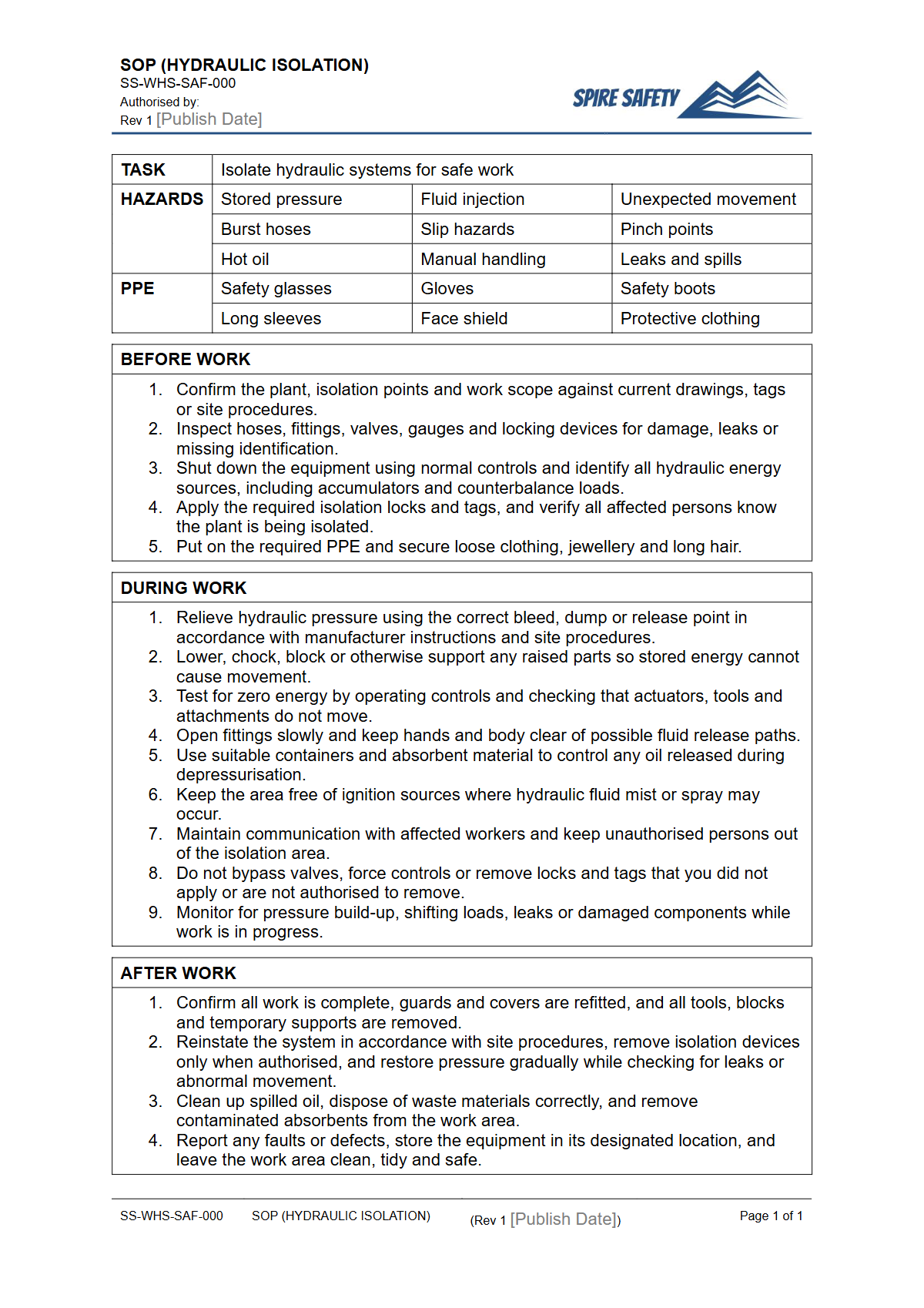
Effectively controlling hazardous energy is a critical part of workplace safety, especially when working on or near machinery. This free Safe Operating Procedure (Hydraulic Isolation) template provides a structured starting point for documenting the specific steps required to safely de-energise and isolate hydraulic systems before maintenance, cleaning, or repair work begins.
The primary purpose of this SOP is to prevent the unexpected release of high-pressure fluid or sudden machine movement, which can cause severe injuries. Using a formalised procedure helps ensure that every person follows the same tested, safe method every time. A documented SOP is also a key piece of evidence demonstrating how your organisation manages specific high-risk tasks, forming an important part of a holistic WHS management system.
Video walkthrough
How to use the Free Safe Operating Procedure (Hydraulic Isolation) Template
This resource is available for immediate download in both DOCX and PDF formats. The DOCX file is fully editable, allowing you to adapt the content to your specific operational needs.
To use the template, download the file and work through each section, replacing the placeholder text with information relevant to your equipment, personnel, and site procedures. It is crucial to conduct a thorough risk assessment for the task before finalising the SOP.
Important: This document is a template, not a finished safety document. We have provided a framework based on Australian WHS principles, but you must customise it to reflect the unique machinery, systems, and hazards in your workplace.
A competent person with specific knowledge of hydraulic systems should review and approve the final, site-specific Safe Operating Procedure before it is put into use.
Key Sections in the Hydraulic Isolation SOP
Our template guides you through documenting essential safety information, including:
- Scope: Defines which machinery or systems the SOP applies to.
- Responsibilities: Clarifies who is authorised to perform the isolation and what their duties are.
- Personal Protective Equipment (PPE): Lists the mandatory PPE required for the task, such as safety glasses, gloves, and protective footwear.
- Step-by-Step Procedure: Details the sequential process for shutdown, isolation, locking and tagging, dissipating stored energy (e.g., bleeding accumulators), and verifying a zero-energy state.
- Re-energisation Process: Outlines the safe sequence for removing locks and tags, restoring energy, and returning the equipment to service. The level of detail here is crucial for specific equipment, such as the procedures outlined in our FREE Hydraulic Press SOP.
When to use this Safe Operating Procedure
A hydraulic isolation SOP should be used whenever a worker needs to place any part of their body into a danger zone where they could be harmed by the release of hydraulic energy or unexpected machine movement. This applies to a wide range of activities, including:
- Scheduled preventative maintenance.
- Unplanned repairs and troubleshooting.
- Cleaning and inspection of components.
- Making adjustments to hydraulic parts.
- Clearing blockages or jams.
The principles of isolating and controlling hazardous energy are fundamental to safe work on all types of plant. Many of the concepts in this SOP also apply to other powered equipment, such as those detailed in our Conveyer System SOP.
Who should use it
This Safe Operating Procedure is intended for use by trained and authorised personnel responsible for the maintenance, service, and repair of hydraulic machinery. This typically includes maintenance fitters, mechanics, technicians, and electricians.
Supervisors and WHS personnel should also use the SOP to induct workers, conduct pre-work briefings, and monitor procedural adherence. The effectiveness of any SOP relies on workers being competent to perform the task safely.
This includes understanding the specific hazards of hydraulic systems, knowing how to use lockout/tagout devices correctly, and being able to verify that isolation has been successful. The implementation of such procedures can be verified through a systematic WHS compliance audit to ensure they are being followed correctly in practice.
By standardising your approach to hydraulic isolation, you create a safer, more predictable work environment. To find other useful safety documents, you can browse our complete free WHS resources library for more templates and checklists.
Common mistakes
Common mistakes to avoid
- Assuming the system is de-pressurised just because the prime mover (e.g., motor) is off.
- Forgetting to block, bleed, or drain hydraulic accumulators and lines where pressure can be trapped.
- Failing to physically test controls and gauges to verify a zero-energy state before starting work.
- Using incorrect, damaged, or non-standardised lockout devices and tags.
Legal references
Legal considerations
The following legal requirements may be relevant to this type of work.
- Work Health and Safety Act (Harmonised) — Provides the primary duties for protecting workers and other people from work health and safety risks.
- Work Health and Safety Regulations (Harmonised) — Sets out requirements supporting the management of workplace hazards and risks.
The following codes may be relevant to this type of work.
- Managing WHS Risks Code of Practice — Provides practical guidance on identifying hazards, assessing risks and applying effective controls.
- Work Health and Safety Consultation, Cooperation and Coordination Code of Practice — Provides practical guidance on consulting workers and coordinating with other duty holders.
- Managing the Work Environment and Facilities Code of Practice — Provides practical guidance on safe work environments, workplace facilities and related controls.
Did you know
Hidden Danger
Hydraulic systems can store enormous amounts of energy in components like accumulators even when the main power is off. This is why testing for a zero-energy state is a non-negotiable step in any isolation procedure.
Injection Injuries
A pinhole leak in a high-pressure hydraulic line can release fluid at a velocity high enough to penetrate the skin. These fluid injection injuries are a surgical emergency and can lead to severe tissue damage or amputation.
FAQ
Frequently asked questions
01What is hydraulic isolation?
02Is a Safe Operating Procedure for hydraulic isolation a legal requirement in Australia?
03What is the difference between hydraulic isolation and Lockout/Tagout (LOTO)?
04How often should a hydraulic isolation SOP be reviewed?
Share this resource
Free Safe Operating Procedure (Hydraulic Isolation) Template
Browse Categories
How To Use It
- 1Download and open in Word or PDF.
- 2Replace the placeholders with your business details.
- 3Get it reviewed by a WHS specialist before rollout.
Need it customised?
Our WHS consultants can adapt this template to your site, run a gap analysis, or audit what you already have in place.
Book a Free Consultation WHS consulting servicesor call 1300 156 382
Related templates
- Free Safe Operating Procedure (Hydraulic Jack) Template
- Free Safe Operating Procedure (Hydraulic Lift Table) Template
- Free Safe Operating Procedure (Hydraulic Nut Splitter) Template
- Free Safe Operating Procedure (Hydraulic Power Pack) Template
- Free Safe Operating Procedure (Hydraulic Spreader) Template
- Free Safe Operating Procedure (Hydraulic Torque Tool) Template