
Free Safe Operating Procedure (Hydraulic Grab) Template
Establish safe work methods for operating hydraulic grabs with our detailed procedure template. Download your free DOCX and PDF to start customising it today.
Free Safe Operating Procedure (Hydraulic Grab) Template
DOCX • 126 KB + PDF
Updated Oct 2026
No signup required
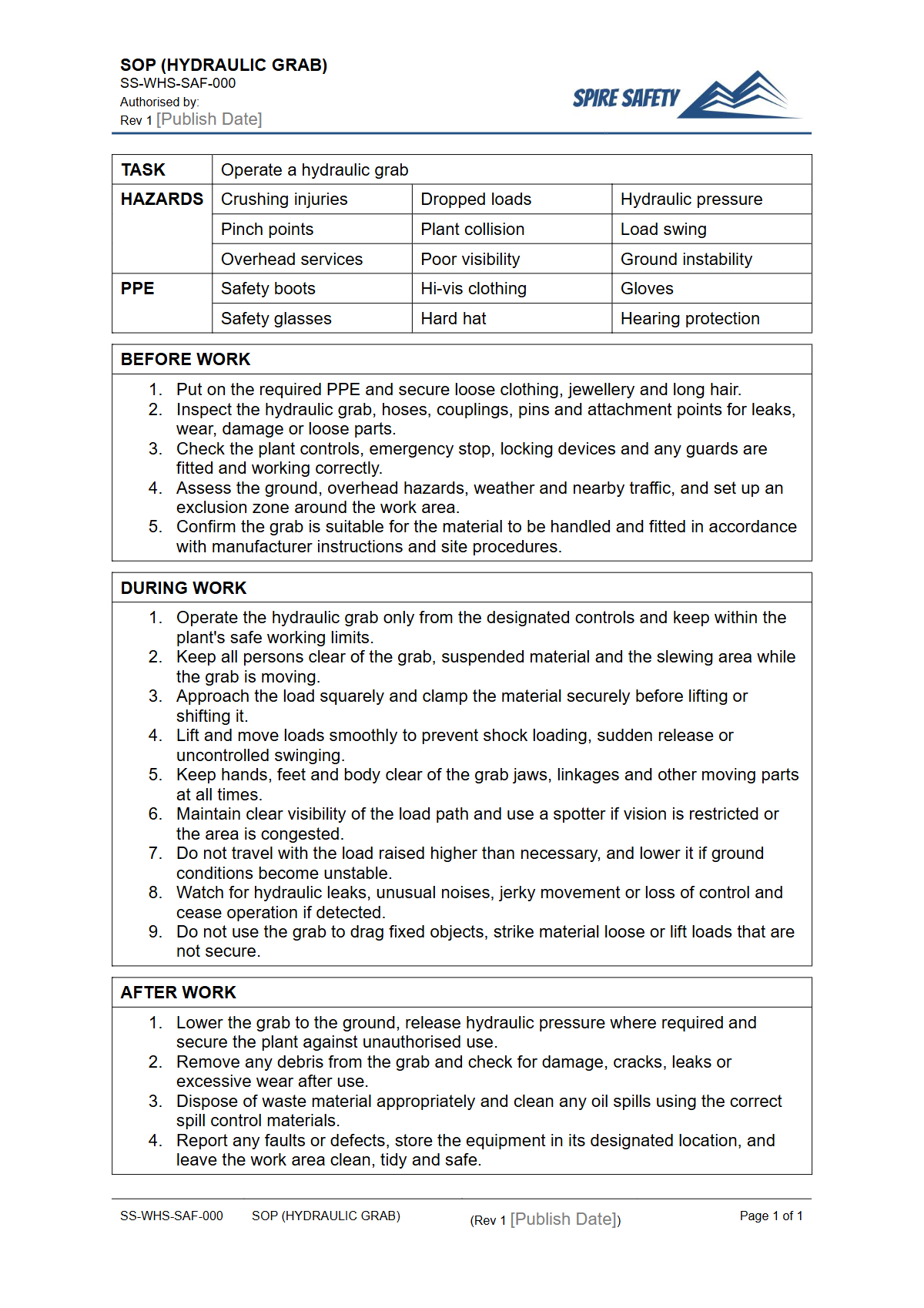
Purpose of the Free Safe Operating Procedure (Hydraulic Grab) Template
A hydraulic grab, often attached to an excavator or other mobile plant, introduces specific risks that must be managed to ensure worker safety. This Free Safe Operating Procedure (Hydraulic Grab) Template provides a structured framework for documenting the required steps to operate this equipment safely.
A Safe Operating Procedure (SOP) is a fundamental administrative control that outlines a step-by-step process, identifies potential hazards, and specifies the control measures needed to eliminate or minimise risks. Using a clear SOP helps an organisation meet its duty of care, standardises training, and reduces the likelihood of incidents related to dropped loads, hydraulic failure, or uncontrolled movement.
Implementing robust procedures is a core component of any effective safety framework. These documented systems are not just for high-risk equipment; they are essential for standardising tasks across your operations, including those detailed in resources like our FREE Hydraulic Press SOP. A well-drafted SOP forms a critical part of your overall safety system, providing clear instructions that workers can follow.
Video walkthrough
How to Use the Free Safe Operating Procedure (Hydraulic Grab) Template
This downloadable document is a starting point designed to be adapted to your unique operational context. Generic procedures are insufficient for managing site-specific risks.
To use this template effectively, you must conduct a thorough risk assessment for your particular hydraulic grab, carrier machine (e.g., excavator), common tasks, and work environment. This process ensures the final SOP is a practical and relevant tool for your workers.
It is crucial to understand that this template is a starting point. We have provided a comprehensive framework, but you must customise every section to reflect your specific equipment, site conditions, tasks, and control measures.
Consultation with operators, maintenance personnel, and supervisors is mandatory during this process. Integrating customised SOPs into your broader WHS management systems ensures a consistent and systematic approach to safety across the entire organisation.
Key Sections to Customise
Pay close attention to the following sections, filling them with detail specific to your workplace:
- Required Personal Protective Equipment (PPE): List all mandatory PPE, such as high-visibility clothing, steel-capped boots, hard hats, safety glasses, and gloves suitable for handling hydraulic components.
- Pre-Operational Checks: Detail the visual and functional checks required before each use. This must include inspecting hydraulic hoses for leaks or damage, checking the security of the attachment locking mechanism (e.g., quick hitch), and verifying control functions.
- Step-by-Step Operating Sequence: Document the safe process for attaching, operating, and detaching the grab. Cover key actions like lifting, sorting, stockpiling, and loading materials. Crucially, define procedures for establishing and maintaining exclusion zones to protect pedestrians and other workers from moving plant and potential dropped loads. This level of detail is also vital when creating documents like an SOP for a trencher or other specialised attachments.
- Emergency Procedures: Outline the immediate actions to be taken in an emergency, including hydraulic system failure, fire, or medical incident. Include details on emergency stops and equipment isolation (lockout/tagout).
- Maintenance and Cleaning: Specify requirements for scheduled maintenance, cleaning, and the associated safety precautions, such as de-pressurising the hydraulic system before work begins.
When to Use a Hydraulic Grab Safe Operating Procedure
A Safe Operating Procedure for a hydraulic grab should be used consistently as a primary reference document. Its primary application is during worker training, ensuring all operators receive the same baseline instructions on safe operation.
It should also be readily available at the work site for operators to reference before starting a task. Furthermore, the SOP serves as a benchmark for supervisors conducting workplace inspections and competency assessments.
Regular reviews of site practices against the documented SOP can be integrated into your WHS compliance auditing program to verify that safe work methods are being followed correctly and consistently.
Who Should Use This Safe Operating Procedure
This SOP is intended for several key roles within a business (PCBU). Operators are the primary users and must be trained on its contents to understand the approved, safe method for performing their work.
Supervisors and Managers must use the SOP to induct new workers, deliver training, and monitor compliance on site. Health and Safety Representatives (HSRs) and safety committee members should be involved in the development and review of the SOP through consultation.
This collaborative approach ensures the procedure is practical, understood, and accepted by the people who perform the work. When managing a fleet of varied machinery, it's beneficial to maintain a suite of similar documents, such as our free Telehandler SOP template, to ensure consistency in your safety documentation.
By thoroughly customising and implementing this SOP, you create a safer work environment and a valuable tool for training and operational consistency. For more templates and safety guides, explore our complete free WHS resources library.
Common mistakes
Common mistakes to avoid
- Using a generic SOP without customising it for the specific grab model and host machine.
- Failing to establish, signpost, and enforce clear exclusion zones around the operating area.
- Inadequate pre-start checks, especially neglecting to inspect hydraulic hoses and connectors for wear or leaks.
- Using the grab for tasks it wasn't designed for, such as prying, demolition, or lifting beyond its rated capacity.
Legal references
Legal considerations
The following legal requirements may be relevant to this type of work.
- Work Health and Safety Act (Harmonised) — Provides the primary duties for protecting workers and other people from work health and safety risks.
- Work Health and Safety Regulations (Harmonised) — Sets out requirements supporting the management of workplace hazards and risks.
The following codes may be relevant to this type of work.
- Managing WHS Risks Code of Practice — Provides practical guidance on identifying hazards, assessing risks and applying effective controls.
- Work Health and Safety Consultation, Cooperation and Coordination Code of Practice — Provides practical guidance on consulting workers and coordinating with other duty holders.
- Managing the Work Environment and Facilities Code of Practice — Provides practical guidance on safe work environments, workplace facilities and related controls.
Did you know
Hydraulic Injection Injury
A pinhole leak in a high-pressure hydraulic hose can eject fluid at a velocity high enough to penetrate skin and cause a severe injection injury. This is a medical emergency that can lead to tissue damage and amputation if not treated immediately.
Attachment Compatibility
Not every grab is suitable for every excavator. The weight of the attachment, its hydraulic flow requirements, and its lifting capacity must be compatible with the specifications of the host machine to ensure stability and prevent damage or failure.
FAQ
Frequently asked questions
01What is a hydraulic grab used for?
02Is a Safe Operating Procedure a legal requirement for hydraulic grabs?
03How often should a hydraulic grab SOP be reviewed?
04Can this template be used for other hydraulic attachments?
Share this resource
Free Safe Operating Procedure (Hydraulic Grab) Template
Browse Categories
How To Use It
- 1Download and open in Word or PDF.
- 2Replace the placeholders with your business details.
- 3Get it reviewed by a WHS specialist before rollout.
Need it customised?
Our WHS consultants can adapt this template to your site, run a gap analysis, or audit what you already have in place.
Book a Free Consultation WHS consulting servicesor call 1300 156 382
Related templates
- Free Safe Operating Procedure (Hydraulic Hose Testing) Template
- Free Safe Operating Procedure (Hydraulic Isolation) Template
- Free Safe Operating Procedure (Hydraulic Jack) Template
- Free Safe Operating Procedure (Hydraulic Lift Table) Template
- Free Safe Operating Procedure (Hydraulic Nut Splitter) Template
- Free Safe Operating Procedure (Hydraulic Power Pack) Template