
Free Safe Operating Procedure (Hydraulic Breaker) Template
Outline safe work methods for operating a hydraulic breaker with our structured template. Download your free Safe Operating Procedure to get started.
Free Safe Operating Procedure (Hydraulic Breaker) Template
DOCX • 126 KB + PDF
Updated Oct 2026
No signup required
Purpose of the Free Safe Operating Procedure (Hydraulic Breaker) Template
A hydraulic breaker, often attached to an excavator or other heavy machinery, is a powerful tool used for demolition, construction, and quarrying. Its operation introduces significant workplace hazards, including high-pressure hydraulic fluid, flying debris, extreme noise, and intense vibration.
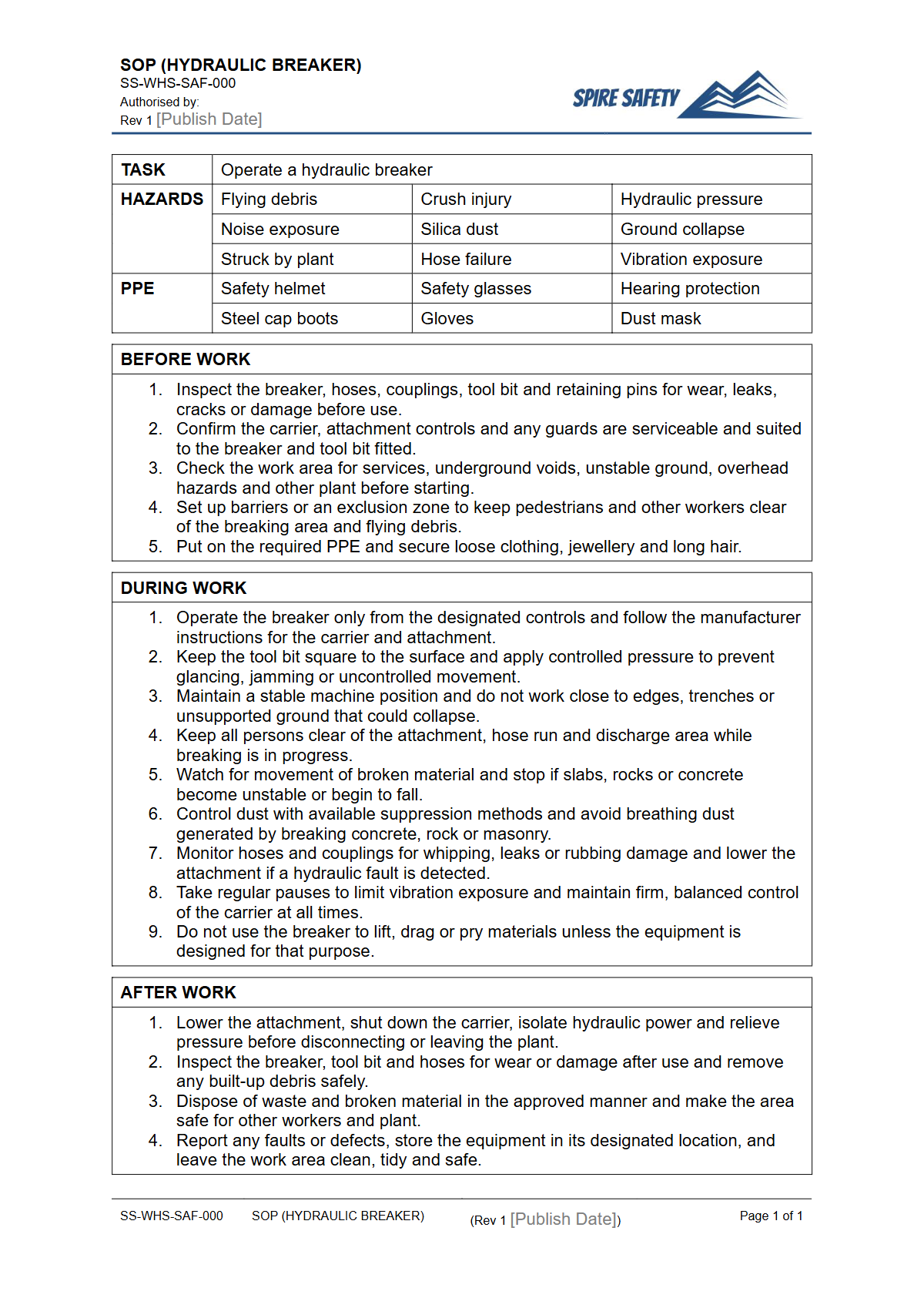
This Free Safe Operating Procedure (Hydraulic Breaker) Template provides a structured framework for documenting the required steps to operate this equipment safely. A well-developed SOP is a critical component of any organisation's safety protocols, helping to minimise risks and guide worker behaviour. By defining clear instructions for pre-start checks, operation, and shutdown, this template helps you establish a consistent and safe system of work, which is a cornerstone of effective WHS management systems.
Video walkthrough
How to use the Free Safe Operating Procedure (Hydraulic Breaker) Template
This Safe Operating Procedure is available for download as a DOCX file for easy editing and a PDF for simple distribution. It is designed as a foundational document, pre-filled with common sections relevant to hydraulic breaker operations.
It is not a complete, ready-to-use document. You must adapt it to your specific context.
It's crucial to remember that this document is a template, not a finished product. We have provided a structured starting point, but you must customise it to reflect your specific equipment (make and model of both the breaker and the carrier machine), site conditions, and organisational procedures.
When customising, involve operators and supervisors to ensure the final SOP is practical and reflects how the work is actually performed. For related demolition or excavation tasks, you might also find value in our free Trencher SOP.
When to use it
A Hydraulic Breaker SOP should be developed and implemented before any worker is permitted to operate the equipment. It is a proactive control measure that forms part of the planning and risk management process.
The SOP should be used as a primary reference document during worker training, competency assessments, and site inductions. It also serves as a benchmark for supervisors conducting safety observations and for auditors reviewing operational compliance.
Regularly reviewing the SOP—at least annually, or after an incident or change in equipment—ensures it remains a relevant and effective tool for managing site safety.
Who should use it
This SOP is intended for a range of personnel within a business:
- Plant Operators: To understand and follow the approved, safe steps for operating the hydraulic breaker.
- Supervisors and Site Managers: To train workers, enforce safe work practices, and conduct safety observations against a documented standard.
- WHS/HSE Managers: To develop and integrate the procedure into the broader safety management system and use it as evidence of risk control.
- Training Coordinators: To use as a core document for developing training programs and assessing operator competency.
Each person has a responsibility to not only use the SOP but also to contribute to its improvement. This collaborative approach helps build a stronger safety culture.
Procedures like this are often reviewed during WHS compliance auditing to verify that documented processes are being followed in practice.
Key Information Covered in the Template
Our template provides a comprehensive starting point, with dedicated sections for critical safety information. Key areas you will need to customise include:
- Personal Protective Equipment (PPE): Specifies mandatory PPE such as hard hats, safety glasses or face shields, steel-capped boots, hearing protection (earmuffs or plugs), and anti-vibration gloves.
- Pre-Operational Checks: A checklist to verify the condition of the hydraulic hoses, fittings, connectors, tool bit, and retaining pins before starting work. This is a critical step in preventing catastrophic failures.
- Step-by-Step Operating Guide: Covers the entire sequence of operation, from starting the carrier machine and positioning the breaker to applying correct pressure and shutting down the system safely. This section should detail how to avoid blank firing, which can damage the equipment. A similar level of detail can be found in our Grader SOP for earthmoving tasks.
- Emergency Procedures: Outlines immediate actions to take in case of hydraulic fluid leaks, equipment malfunction, or personal injury.
- Housekeeping and Maintenance: Includes instructions for cleaning the equipment after use and outlines basic maintenance requirements and reporting procedures for faults.
Ensuring you have robust procedures for all high-risk plant is essential. For instance, moving or positioning equipment on site might require a separate Telehandler SOP template. You can explore our entire free WHS resources library for more templates.
Common mistakes
Common mistakes to avoid
- Failing to conduct pre-start checks on hydraulic hoses and fittings, leading to high-pressure fluid leaks.
- Using the incorrect tool bit (e.g., a blunt or chisel point) for the material being broken.
- Neglecting to establish and enforce a clear exclusion zone for personnel around the work area.
- Operating the breaker for extended periods without breaks, increasing the risk of Hand-Arm Vibration Syndrome (HAVS).
Legal references
Legal considerations
The following legal requirements may be relevant to this type of work.
- Work Health and Safety Act (Harmonised) — Provides the primary duties for protecting workers and other people from work health and safety risks.
- Work Health and Safety Regulations (Harmonised) — Sets out requirements supporting the management of workplace hazards and risks.
The following codes may be relevant to this type of work.
- Managing WHS Risks Code of Practice — Provides practical guidance on identifying hazards, assessing risks and applying effective controls.
- Work Health and Safety Consultation, Cooperation and Coordination Code of Practice — Provides practical guidance on consulting workers and coordinating with other duty holders.
- Managing the Work Environment and Facilities Code of Practice — Provides practical guidance on safe work environments, workplace facilities and related controls.
Did you know
Hand-Arm Vibration Syndrome (HAVS)
Prolonged exposure to vibration from tools like hydraulic breakers can lead to Hand-Arm Vibration Syndrome (HAVS), a painful and disabling condition affecting blood vessels, nerves, and joints.
Noise Levels
A hydraulic breaker can operate at over 120 decibels (dB), well above the Australian workplace exposure standard of 85 dB. This makes high-grade hearing protection non-negotiable for operators and nearby workers.
FAQ
Frequently asked questions
01What are the main hazards of using a hydraulic breaker?
02How often should a Hydraulic Breaker SOP be reviewed?
03Is an SOP the same as a risk assessment?
04Does this template cover all types of hydraulic breakers?
Share this resource
Free Safe Operating Procedure (Hydraulic Breaker) Template
Browse Categories
How To Use It
- 1Download and open in Word or PDF.
- 2Replace the placeholders with your business details.
- 3Get it reviewed by a WHS specialist before rollout.
Need it customised?
Our WHS consultants can adapt this template to your site, run a gap analysis, or audit what you already have in place.
Book a Free Consultation WHS consulting servicesor call 1300 156 382
Related templates
- Free Safe Operating Procedure (Hydraulic Crimper) Template
- Free Safe Operating Procedure (Hydraulic Grab) Template
- Free Safe Operating Procedure (Hydraulic Hose Testing) Template
- Free Safe Operating Procedure (Hydraulic Isolation) Template
- Free Safe Operating Procedure (Hydraulic Jack) Template
- Free Safe Operating Procedure (Hydraulic Lift Table) Template