
Free Safe Operating Procedure (HVAC Vent Cleaning) Template
Manage HVAC cleaning risks with our structured Safe Operating Procedure. Download this free, customisable template to formalise your safety processes.
Free Safe Operating Procedure (HVAC Vent Cleaning) Template
DOCX • 126 KB + PDF
Updated Oct 2026
No signup required
Purpose of the Free Safe Operating Procedure (HVAC Vent Cleaning) Template
Effectively managing workplace health and safety during maintenance tasks is critical. This Free Safe Operating Procedure (HVAC Vent cleaning) Template provides a structured starting point for businesses to formalise their processes for cleaning heating, ventilation, and air conditioning systems.
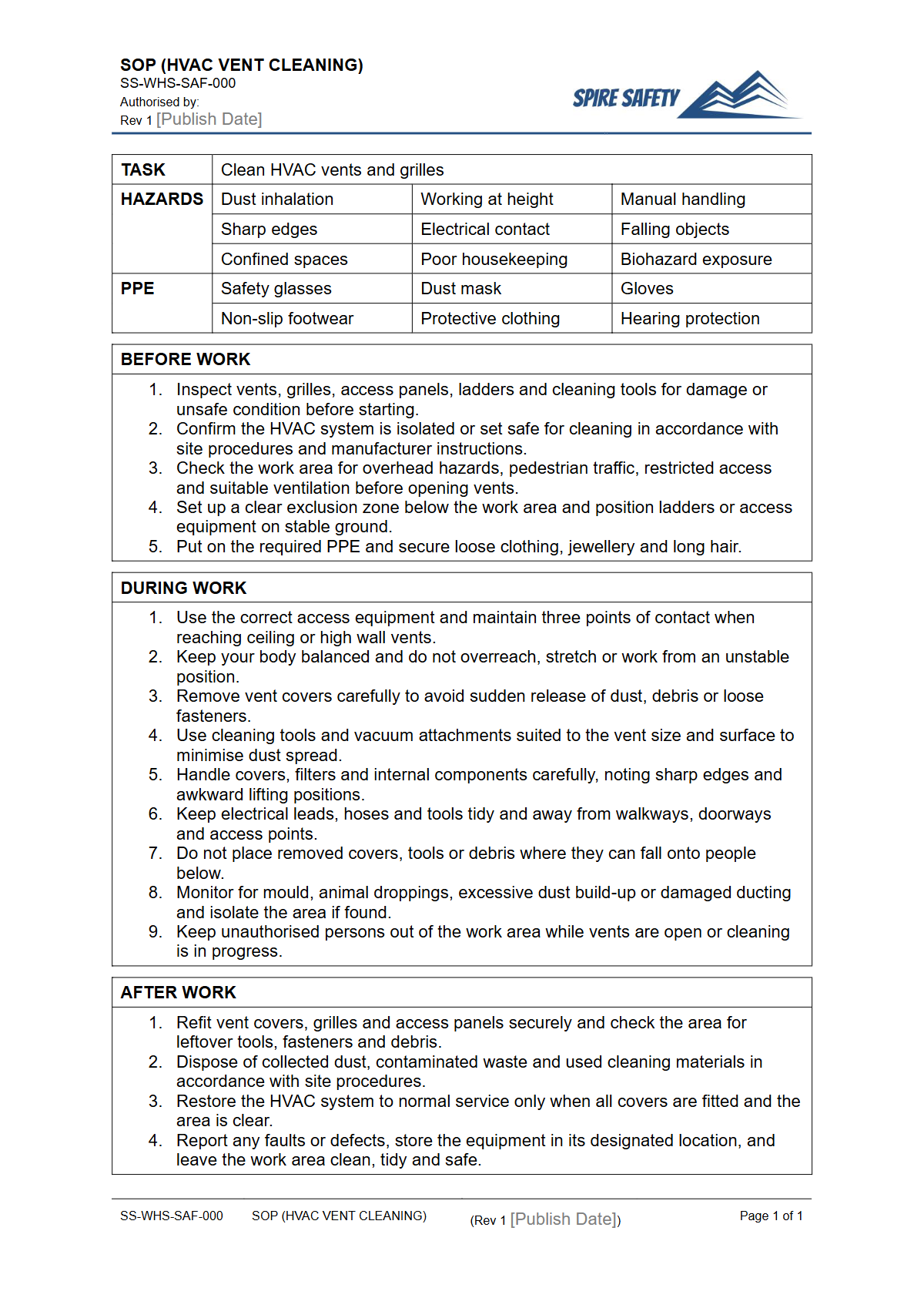
Using this SOP helps to identify hazards, assess risks, and implement control measures to ensure workers can perform their duties safely. It guides users through the necessary steps for pre-operational checks, the cleaning process itself, and post-operational clean-up, creating a clear and repeatable safety framework.
A documented Safe Operating Procedure (SOP) is a key component of a robust safety management system. It serves as a training tool for new employees and a reference for experienced technicians, promoting consistent and safe work practices.
This template is designed to be adapted to specific site conditions and equipment, helping your organisation meet its WHS obligations by systematically addressing risks such as hazardous dust exposure, electrical hazards, working at heights, and manual handling. Proper procedures also help maintain better indoor air quality, which benefits all building occupants.
Video walkthrough
How to use the Free Safe Operating Procedure (HVAC Vent Cleaning) Template
This template is provided in both DOCX and PDF formats for your convenience. The DOCX file is fully editable, allowing you to tailor the content to the unique requirements of your workplace, the specific HVAC systems you service, and the equipment your team uses.
To use it effectively, download the document and work through each section with key stakeholders, including technicians who perform the work and their supervisors.
It is essential to customise this document. A generic procedure is not sufficient for compliance or safety.
We have included placeholder text and prompts to guide you, but you must replace these with specific details relevant to your operations. This includes listing the exact personal protective equipment (PPE) required, detailing your emergency procedures, and specifying the tools and cleaning agents used.
This process ensures the final SOP is a practical and useful tool that accurately reflects your work methods. For tasks involving specific machinery, you may need additional documentation, such as a procedure for the safe operation of an air compressor.
The Safe Operating Procedure document includes sections for:
- Defining the scope of work and required PPE.
- Detailing potential hazards and risk control measures.
- Listing step-by-step instructions for pre-operational checks, task execution, and shutdown.
- Recording training and competency requirements for operators.
- Outlining emergency response procedures.
When to use it
This Safe Operating Procedure should be used whenever maintenance or cleaning work is performed on HVAC ductwork and vents. It is particularly important for scheduled preventative maintenance, deep cleaning projects, and responding to indoor air quality complaints.
It should be reviewed and referenced before the start of any HVAC cleaning job to ensure all team members are aware of the required safety protocols. Furthermore, the SOP should be a central part of toolbox talks and pre-start meetings related to HVAC maintenance tasks. Developing these procedures is an integral part of building comprehensive WHS management systems.
Who should use it
This template is intended for use by Persons Conducting a Business or Undertaking (PCBUs), such as facilities management companies, HVAC service contractors, and building owners. Health and safety managers, supervisors, and team leaders will find it useful for drafting and implementing safety procedures.
Technicians and maintenance workers who perform the cleaning tasks are the end-users of the finalised SOP and should be actively involved in its development and review. This ensures the procedures are practical and reflect the realities of the job.
In some cases, accessing external vents or ductwork may require specialised equipment; if so, a separate SOP covering the safe use of a telehandler may also be necessary.
The process of creating and implementing SOPs helps demonstrate due diligence in managing workplace risks. Organisations that formalise their procedures are better equipped to protect their workers and maintain a safe working environment. The effectiveness of these procedures should be verified through regular WHS compliance auditing.
In some refurbishment or access scenarios, minor structural modifications may be needed to reach concealed ductwork. Any cutting or alteration must be governed by its own strict procedure, such as an SOP for the safe use of a circular saw, to control the associated risks.
For more templates and safety documents, browse our complete free WHS resources library, which covers a wide range of tasks and equipment.
Common mistakes
Common mistakes to avoid
- Failing to electrically isolate the HVAC unit before starting work, creating a risk of electric shock or unexpected start-up.
- Neglecting to wear appropriate PPE, especially respiratory protection (P2/N95 masks) for dust and mould.
- Using incompatible or overly harsh cleaning chemicals that can damage ductwork or leave harmful residues.
- Inadequate containment measures, allowing dust and debris to contaminate surrounding occupied spaces.
Legal references
Legal considerations
The following legal requirements may be relevant to this type of work.
- Work Health and Safety Act (Harmonised) — Provides the primary duties for protecting workers and other people from work health and safety risks.
- Work Health and Safety Regulations (Harmonised) — Sets out requirements supporting the management of workplace hazards and risks.
The following codes may be relevant to this type of work.
- Managing WHS Risks Code of Practice — Provides practical guidance on identifying hazards, assessing risks and applying effective controls.
- Work Health and Safety Consultation, Cooperation and Coordination Code of Practice — Provides practical guidance on consulting workers and coordinating with other duty holders.
- Managing the Work Environment and Facilities Code of Practice — Provides practical guidance on safe work environments, workplace facilities and related controls.
Did you know
Indoor Air Quality
The CSIRO estimates that poor indoor air quality costs Australia more than $12 billion per year in lost productivity and illness. Regular HVAC cleaning is a key strategy for maintaining healthy indoor air.
Fire Risk
Accumulated dust and lint in HVAC ductwork can become a significant fire hazard. When ignited by a spark from the system's motor or an external source, it can cause fire to spread rapidly throughout a building.
FAQ
Frequently asked questions
01What hazards are involved in HVAC vent cleaning?
02Is a Safe Operating Procedure legally required for HVAC cleaning in Australia?
03How often should an HVAC cleaning SOP be reviewed?
04Can this template be used for residential HVAC cleaning?
Share this resource
Free Safe Operating Procedure (HVAC Vent Cleaning) Template
Browse Categories
How To Use It
- 1Download and open in Word or PDF.
- 2Replace the placeholders with your business details.
- 3Get it reviewed by a WHS specialist before rollout.
Need it customised?
Our WHS consultants can adapt this template to your site, run a gap analysis, or audit what you already have in place.
Book a Free Consultation WHS consulting servicesor call 1300 156 382
Related templates
- Free Safe Operating Procedure (Hydrant Testing) Template
- Free Safe Operating Procedure (Hydration Station Setup) Template
- Free Safe Operating Procedure (Hydraulic Breaker) Template
- Free Safe Operating Procedure (Hydraulic Crimper) Template
- Free Safe Operating Procedure (Hydraulic Grab) Template
- Free Safe Operating Procedure (Hydraulic Hose Testing) Template