
Free Safe Operating Procedure (HVAC Intake Cleaning) Template
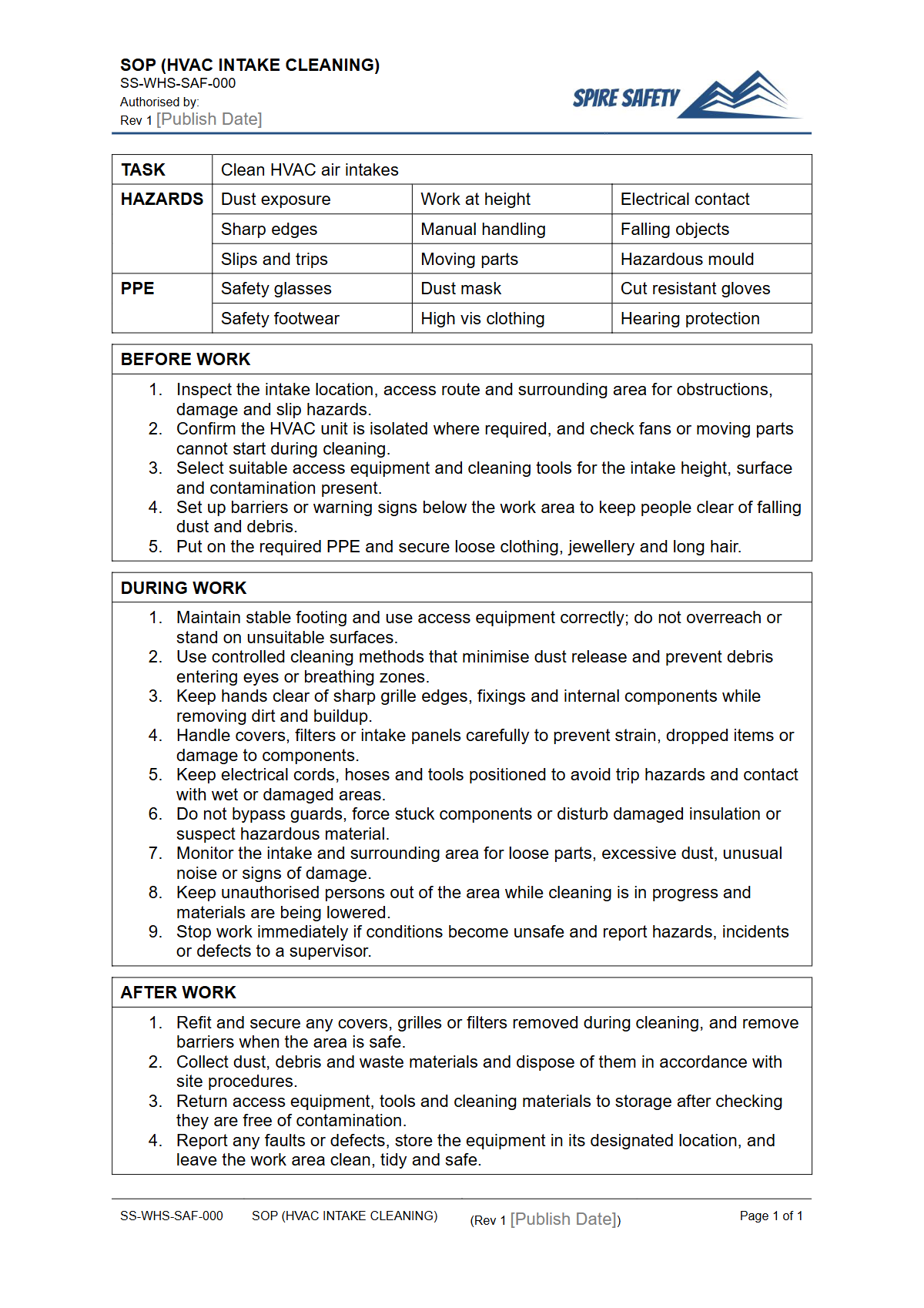
Download our free Safe Operating Procedure for HVAC intake cleaning to manage risks and standardise your maintenance tasks. Get your customisable template now.
Free Safe Operating Procedure (HVAC Intake Cleaning) Template
DOCX • 126 KB + PDF
Updated Oct 2026
No signup required
Purpose of the Free Safe Operating Procedure (HVAC Intake Cleaning) Template
Maintaining a building's heating, ventilation, and air conditioning (HVAC) system is crucial for air quality and operational efficiency. This free Safe Operating Procedure (HVAC Intake Cleaning) template provides a structured framework for outlining the step-by-step process to safely clean and maintain these critical components.
An SOP standardises your approach, ensuring that every technician or maintenance worker follows a consistent, safe, and effective method. It serves as a vital tool for risk management, helping to control hazards such as electrical shock, chemical exposure, hazardous dust, and musculoskeletal injuries from manual tasks.
By documenting the required steps, safety controls, personal protective equipment (PPE), and emergency procedures, this Safe Operating Procedure (SOP) helps you meet your WHS obligations to provide a safe system of work. It forms a core part of broader WHS management systems, demonstrating a proactive approach to workplace safety and operational integrity.
Using a standardised procedure reduces the likelihood of incidents, protects workers, and ensures the HVAC system functions as intended.
Video walkthrough
How to use the Free Safe Operating Procedure (HVAC Intake Cleaning) Template
This resource is available for download as a DOCX file for easy editing, or as a PDF for quick reference. To implement it effectively, you must adapt the content to your specific operational context.
The procedure should be reviewed and customised by a competent person familiar with your site’s unique HVAC equipment, layout, and the cleaning agents used. Generic procedures are a starting point, not a final solution.
Follow these steps to get started:
- Download the DOCX template.
- Fill in the site-specific details, including equipment models, locations, and responsible personnel.
- Review the listed hazards and control measures, adding or removing items to reflect your work environment. For example, a rooftop intake has different access risks than one at ground level.
- Specify the exact PPE required for the task, such as P2-rated respiratory masks, chemical-resistant gloves, and safety glasses.
- Detail your organisation's specific lockout-tagout (LOTO) procedure for isolating energy sources.
- Once complete, arrange for a final review and sign-off by a manager or safety officer. You may consider engaging a third party for WHS compliance auditing to verify your customised procedures align with legislative requirements.
Important: This is a template only. We have included prompts and example text, but you must customise this document to reflect the specific equipment, chemicals, environment, and processes used in your workplace to ensure it is effective.
When to use this Safe Operating Procedure
An SOP for HVAC intake cleaning should be used consistently as a primary reference document for the task. It is not a document to be filed away and forgotten.
It should be readily accessible to all relevant workers and integrated into your daily operations. Key times to use the SOP include:
- Before every cleaning task: Workers should review the SOP as a pre-start checklist to refresh their memory on hazards and controls.
- Training and induction: Use the SOP as a foundational training document for new employees or workers newly assigned to maintenance duties.
- Annual reviews: Procedures should be reviewed at least annually to ensure they remain current and effective.
- After an incident or near-miss: If an incident occurs during cleaning, the SOP must be reviewed and updated to prevent recurrence.
- When changes occur: If new equipment is installed, different cleaning chemicals are introduced, or the work environment changes, the SOP must be revised accordingly. For complex systems, seeking external advice from a WHS consulting firm can help ensure all risks are addressed.
Who should use it
This Safe Operating Procedure is intended for use by anyone involved in the lifecycle of HVAC maintenance. This includes:
- HVAC Technicians and Maintenance Staff: The primary users who will follow the procedure to perform the cleaning task safely.
- Facilities Managers and Supervisors: Responsible for implementing the SOP, providing training, and ensuring compliance.
- WHS/HSE Officers: Use the SOP for risk assessments, incident investigations, and safety audits.
- Persons Conducting a Business or Undertaking (PCBUs): Business owners and directors use the existence and proper implementation of such SOPs to demonstrate they are meeting their primary duty of care under WHS law.
Many plant rooms contain other equipment that also requires documented safety procedures. For example, if your system relies on compressed air for cleaning, you should also have a Free Air Compressor SOP (Safe Operating Procedure) Template in place. Standardising procedures across all equipment helps build a consistent safety culture. You can browse our complete free WHS resources library to find templates for other common workplace tasks and equipment.
Common mistakes
Common mistakes to avoid
- Forgetting to isolate energy sources (lockout/tagout) before starting work.
- Using incorrect or incompatible cleaning chemicals, leading to equipment damage or hazardous fumes.
- Failing to use appropriate Personal Protective Equipment (PPE) for dust and chemical exposure.
- Not customising the generic procedure to the specific site conditions and equipment.
Legal references
Legal considerations
The following legal requirements may be relevant to this type of work.
- Work Health and Safety Act (Harmonised) — Provides the primary duties for protecting workers and other people from work health and safety risks.
- Work Health and Safety Regulations (Harmonised) — Sets out requirements supporting the management of workplace hazards and risks.
The following codes may be relevant to this type of work.
- Managing WHS Risks Code of Practice — Provides practical guidance on identifying hazards, assessing risks and applying effective controls.
- Work Health and Safety Consultation, Cooperation and Coordination Code of Practice — Provides practical guidance on consulting workers and coordinating with other duty holders.
- Managing the Work Environment and Facilities Code of Practice — Provides practical guidance on safe work environments, workplace facilities and related controls.
Did you know
Indoor Air Quality
Poorly maintained HVAC systems are a primary contributor to 'Sick Building Syndrome', a condition where building occupants experience acute health effects directly linked to time spent in a building.
Energy Efficiency
Regularly cleaning HVAC intakes, coils, and filters can improve a system's energy efficiency by up to 15%, leading to significant reductions in operational costs and environmental impact.
FAQ
Frequently asked questions
01What hazards are involved in cleaning HVAC intakes?
02Is a Safe Operating Procedure a legal requirement in Australia?
03How often should an SOP for HVAC intake cleaning be reviewed?
04Can I use this template for both internal and external HVAC intakes?
Share this resource
Free Safe Operating Procedure (HVAC Intake Cleaning) Template
Browse Categories
How To Use It
- 1Download and open in Word or PDF.
- 2Replace the placeholders with your business details.
- 3Get it reviewed by a WHS specialist before rollout.
Need it customised?
Our WHS consultants can adapt this template to your site, run a gap analysis, or audit what you already have in place.
Book a Free Consultation WHS consulting servicesor call 1300 156 382
Related templates
- Free Safe Operating Procedure (HVAC Return Cleaning) Template
- Free Safe Operating Procedure (HVAC Vent Cleaning) Template
- Free Safe Operating Procedure (Hydrant Testing) Template
- Free Safe Operating Procedure (Hydration Station Setup) Template
- Free Safe Operating Procedure (Hydraulic Breaker) Template
- Free Safe Operating Procedure (Hydraulic Crimper) Template