
Free Safe Operating Procedure (HVAC Filter Change) Template
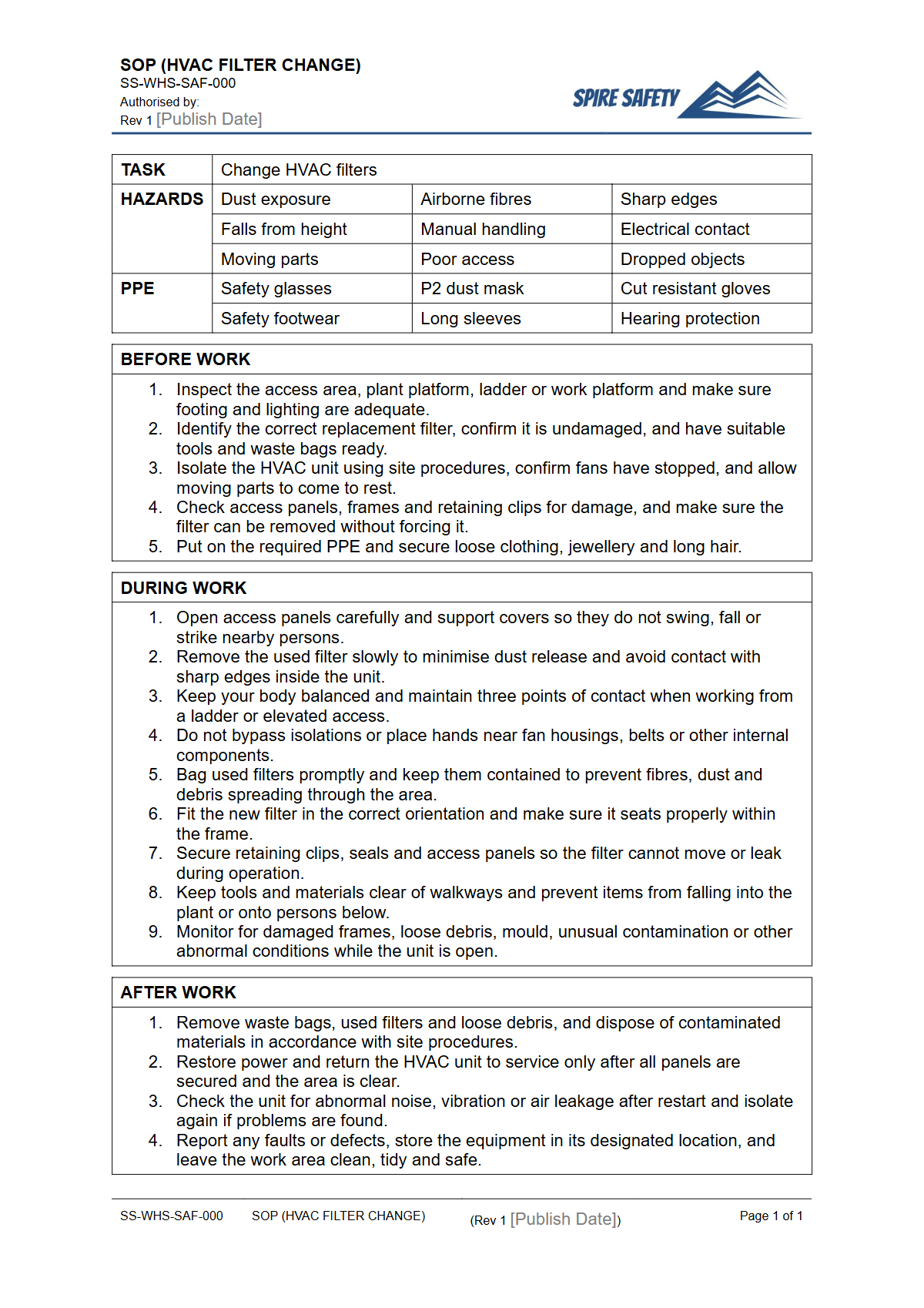
Download our free Safe Operating Procedure (HVAC Filter Change) template to standardise your maintenance tasks. Get your customisable DOCX and PDF now.
Free Safe Operating Procedure (HVAC Filter Change) Template
DOCX • 126 KB + PDF
Updated Oct 2026
No signup required
Purpose of the Free Safe Operating Procedure (HVAC Filter Change) Template
The primary purpose of the Free Safe Operating Procedure (HVAC Filter Change) Template is to help your organisation establish and formalise a safe system of work for this common maintenance task. An effective SOP clearly outlines the required steps, identifies potential hazards like electrical energy, hazardous manual tasks, and exposure to airborne contaminants, and specifies the control measures needed to mitigate those risks. Integrating this procedure into your safety framework helps demonstrate due-diligence and is a fundamental component of comprehensive WHS management systems.
By standardising the process, you reduce the likelihood of errors and ensure that safety controls, such as correct electrical isolation and the use of personal protective equipment (PPE), are consistently applied. This structured approach is applicable to various types of workplace equipment, as seen in our Free Air Compressor SOP, and is crucial for managing risks effectively.
This document serves as a vital training and reference tool for all personnel involved in building maintenance.
Video walkthrough
How to use the Free Safe Operating Procedure (HVAC Filter Change) Template
This downloadable document is a starting point, not a finished product. To use the Free Safe Operating Procedure (HVAC Filter Change) Template effectively, you must customise it to reflect the specific equipment, environment, and processes at your worksite.
We strongly recommend you download the DOCX version and consult directly with your HVAC technicians and maintenance staff to ensure the procedure is practical and accurate. This involves conducting a site-specific risk assessment for the task, detailing the exact make and model of the HVAC units, and outlining the precise lockout-tagout procedure.
Once customised in consultation with your team, the SOP should be formally approved by a manager or supervisor before being implemented. Regular reviews are also essential to maintain its relevance, a process often checked during formal WHS compliance audits. This ensures the procedure remains current with any changes in equipment, personnel, or environmental conditions.
When to use it
This Safe Operating Procedure should be used every time an HVAC filter change is scheduled. It is particularly important for inducting and training new employees or contractors who may be unfamiliar with your specific systems.
The SOP also serves as a critical reference document during routine task observations and safety reviews. It provides a consistent benchmark for safe behaviour, much like a Safe Operating Procedure for a deep fryer does in a commercial kitchen environment.
If an incident or near miss occurs during a filter change, the SOP should be reviewed immediately as part of the investigation process to identify any procedural gaps. It should also be updated whenever there is a change in the equipment, the task itself, or the control measures identified.
Who should use it
This template is designed for use by anyone responsible for overseeing, managing, or performing maintenance tasks on HVAC systems. This includes Facilities Managers, Maintenance Supervisors, WHS Advisors, and the HVAC Technicians or general maintenance workers who physically perform the filter change.
Involving the workers who do the job in the customisation process is crucial for creating a document that is both safe and practical.
Using standardised documents like this SOP, or a Conveyer System SOP for other plant, ensures consistency across all operational tasks. For a wider selection of procedural documents and other valuable tools, you can explore our complete free WHS resources library.
Common mistakes
Common mistakes to avoid
- Forgetting to electrically isolate and lock-out the HVAC unit before starting work.
- Using the incorrect filter size or type, leading to poor performance and contaminant bypass.
- Failing to wear appropriate PPE, such as gloves and a P2 respirator, to protect against dust and biological hazards.
- Neglecting to clean the filter housing and surrounding area, allowing dust to re-enter the system.
Legal references
Legal considerations
The following legal requirements may be relevant to this type of work.
- Work Health and Safety Act (Harmonised) — Provides the primary duties for protecting workers and other people from work health and safety risks.
- Work Health and Safety Regulations (Harmonised) — Sets out requirements supporting the management of workplace hazards and risks.
The following codes may be relevant to this type of work.
- Managing WHS Risks Code of Practice — Provides practical guidance on identifying hazards, assessing risks and applying effective controls.
- Work Health and Safety Consultation, Cooperation and Coordination Code of Practice — Provides practical guidance on consulting workers and coordinating with other duty holders.
- Managing the Work Environment and Facilities Code of Practice — Provides practical guidance on safe work environments, workplace facilities and related controls.
Did you know
Indoor Air Quality
Poor indoor air quality, often linked to dirty HVAC filters, can contribute to 'Sick Building Syndrome', a condition that may cause headaches, fatigue, and respiratory issues for a building's occupants.
Energy Efficiency
A clogged HVAC filter can increase a system's energy consumption by up to 15% as the fan motor has to work significantly harder to draw air through the obstructed media.
FAQ
Frequently asked questions
01What hazards are involved in changing an HVAC filter?
02Is an SOP legally required for changing HVAC filters in Australia?
03How often should an HVAC filter change SOP be reviewed?
04Can this template be used for all types of HVAC systems?
Share this resource
Free Safe Operating Procedure (HVAC Filter Change) Template
Browse Categories
How To Use It
- 1Download and open in Word or PDF.
- 2Replace the placeholders with your business details.
- 3Get it reviewed by a WHS specialist before rollout.
Need it customised?
Our WHS consultants can adapt this template to your site, run a gap analysis, or audit what you already have in place.
Book a Free Consultation WHS consulting servicesor call 1300 156 382
Related templates
- Free Safe Operating Procedure (HVAC Grille Cleaning) Template
- Free Safe Operating Procedure (HVAC Intake Cleaning) Template
- Free Safe Operating Procedure (HVAC Return Cleaning) Template
- Free Safe Operating Procedure (HVAC Vent Cleaning) Template
- Free Safe Operating Procedure (Hydrant Testing) Template
- Free Safe Operating Procedure (Hydration Station Setup) Template