
Free Safe Operating Procedure (Hub Bearing Change) Template
Our free Safe Operating Procedure for a hub bearing change helps formalise your workshop safety processes.
Free Safe Operating Procedure (Hub Bearing Change) Template
DOCX • 126 KB + PDF
Updated Oct 2026
No signup required
Purpose of the Free Safe Operating Procedure (Hub Bearing Change) Template
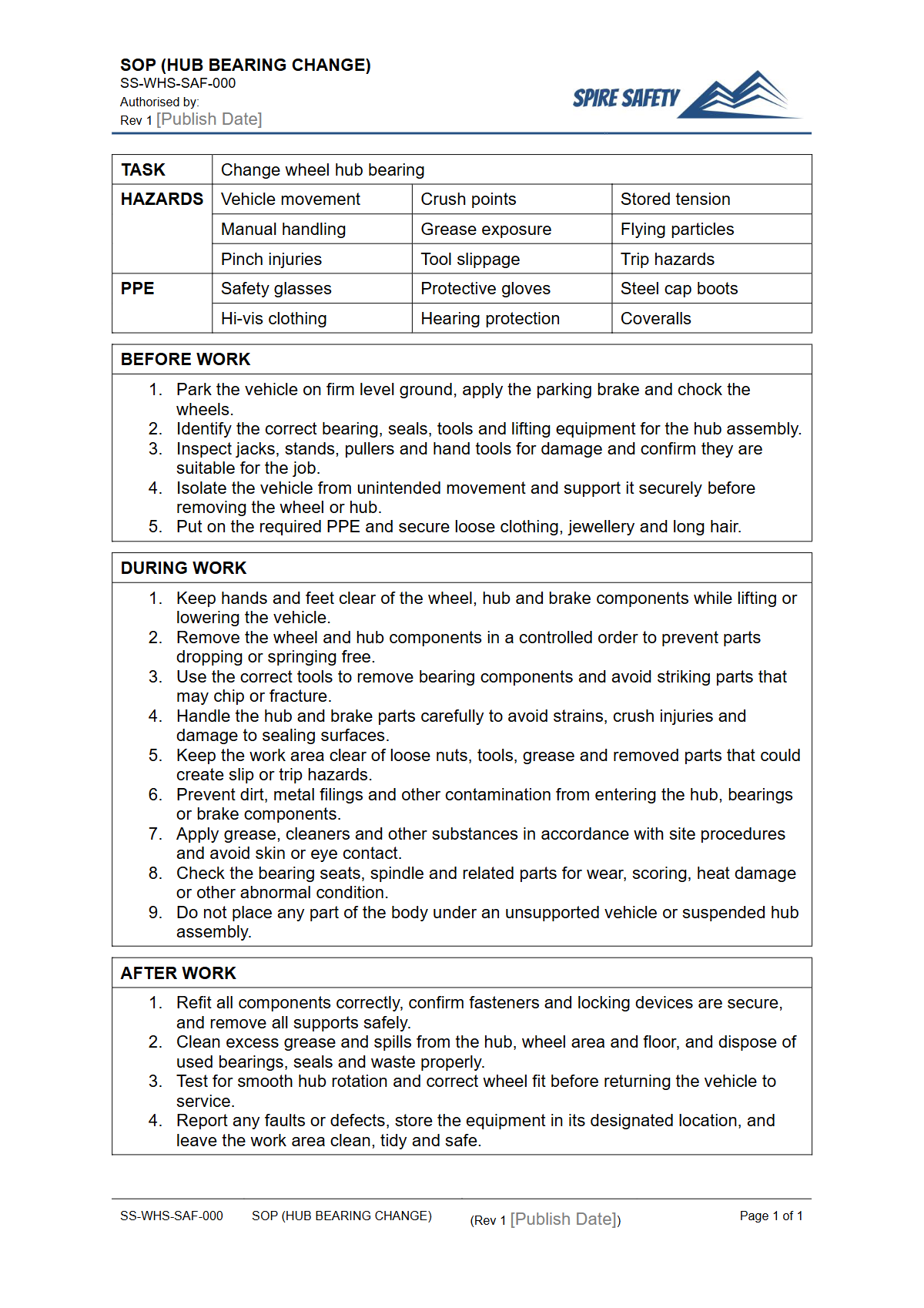
Changing a wheel hub bearing is a common but high-risk maintenance task. This free Safe Operating Procedure (Hub Bearing Change) template provides a structured framework for documenting a safe system of work to manage the associated hazards.
Formalising the process helps ensure every step is performed consistently and safely, reducing the risk of personal injury or equipment damage. Key hazards include crushing from unsecured vehicles, stored energy in suspension components, exposure to chemicals like grease and cleaning solvents, and musculoskeletal injuries from manual tasks.
Implementing clear SOPs is a critical part of a robust WHS management system, demonstrating a commitment to proactive risk management in the workshop.
Video walkthrough
How to use the Free Safe Operating Procedure (Hub Bearing Change) Template
This resource is available for download as a DOCX file for easy editing, or as a PDF for quick reference. It is designed as a comprehensive starting point, not a finished document.
You must adapt it to the specific context of your workplace. Add details about the particular vehicles or machinery you service, list the exact tools and equipment required (including presses and pullers), specify the Personal Protective Equipment (PPE) to be worn, and include your site-specific emergency procedures.
Similar to our free Air Compressor SOP, this document must be customised to be effective. We have written this template to be aligned with Australian WHS principles, but to achieve compliance, you must ensure it reflects the unique risks and control measures of your own operations.
What is included in the template?
The template is organised into logical sections to guide the user through the task safely:
- A section for listing required PPE and necessary tools.
- Pre-operational safety checks (e.g., vehicle securing, isolation).
- A step-by-step procedure for removing the wheel, brake components, hub, and bearing.
- A parallel step-by-step procedure for installation and reassembly.
- Post-operational checks and clean-up procedures.
- A space for noting emergency shutdown and response actions.
When to use this Safe Operating Procedure
A Safe Operating Procedure for a hub bearing change should be used consistently for every job, regardless of the mechanic's experience level. It serves as an essential training tool for apprentices and new employees, ensuring they learn the correct, safe method from the outset.
For experienced technicians, it acts as a checklist to prevent complacency and ensure no critical safety steps are missed. The document is also invaluable during incident investigations, helping to determine if procedural deviations contributed to the event.
Regular reviews of SOPs are a key part of any WHS compliance auditing program, verifying that documented procedures are still relevant and being followed correctly.
Who should use it
This template is intended for use by persons conducting a business or undertaking (PCBUs), workshop managers, supervisors, and WHS professionals responsible for developing and implementing safe work systems. The final, customised SOP should be used by competent personnel, such as qualified mechanics and trained apprentices under supervision, who are tasked with performing hub bearing changes.
It helps supervisors confirm that tasks are being completed according to the established safe standard, particularly when dealing with complex equipment like that covered in our free Grader SOP template. The SOP provides a clear benchmark for performance, training, and safety expectations for everyone involved in vehicle and machinery maintenance. For more templates and safety documents, browse our complete free WHS resources library.
Common mistakes
Common mistakes to avoid
- Using incorrect tools, such as the wrong type of puller or press, leading to component damage or injury.
- Failing to properly clean and inspect the steering knuckle or housing before installing the new bearing.
- Incorrectly setting the bearing preload (on tapered bearings) or applying the wrong torque to the axle nut.
- Neglecting to use the manufacturer-specified type and amount of grease or lubricant.
Legal references
Legal considerations
The following legal requirements may be relevant to this type of work.
- Work Health and Safety Act (Harmonised) — Provides the primary duties for protecting workers and other people from work health and safety risks.
- Work Health and Safety Regulations (Harmonised) — Sets out requirements supporting the management of workplace hazards and risks.
The following codes may be relevant to this type of work.
- Managing WHS Risks Code of Practice — Provides practical guidance on identifying hazards, assessing risks and applying effective controls.
- Work Health and Safety Consultation, Cooperation and Coordination Code of Practice — Provides practical guidance on consulting workers and coordinating with other duty holders.
- Managing the Work Environment and Facilities Code of Practice — Provides practical guidance on safe work environments, workplace facilities and related controls.
Did you know
Bearing Failure
Incorrect fitting and improper lubrication are two of the leading causes of premature wheel bearing failure, which can potentially lead to wheel detachment and a serious vehicle incident.
Manual Tasks Risk
Manual tasks are the leading cause of workplace injuries in Australia. Lifting and moving heavy or awkward items like wheel hub assemblies contributes significantly to these statistics, highlighting the need for correct technique and mechanical aids.
FAQ
Frequently asked questions
01What are the main hazards when changing a hub bearing?
02Is a Safe Operating Procedure a legal requirement in Australia?
03How detailed should a hub bearing change SOP be?
04Can this SOP template be used for any vehicle?
Share this resource
Free Safe Operating Procedure (Hub Bearing Change) Template
Browse Categories
How To Use It
- 1Download and open in Word or PDF.
- 2Replace the placeholders with your business details.
- 3Get it reviewed by a WHS specialist before rollout.
Need it customised?
Our WHS consultants can adapt this template to your site, run a gap analysis, or audit what you already have in place.
Book a Free Consultation WHS consulting servicesor call 1300 156 382
Related templates
- Free Safe Operating Procedure (Hull Cleaning) Template
- Free Safe Operating Procedure (HVAC Coil Cleaning) Template
- Free Safe Operating Procedure (HVAC Filter Change) Template
- Free Safe Operating Procedure (HVAC Grille Cleaning) Template
- Free Safe Operating Procedure (HVAC Intake Cleaning) Template
- Free Safe Operating Procedure (HVAC Return Cleaning) Template