
Free Safe Operating Procedure (Hull Cleaning) Template
Download our free Safe Operating Procedure (Hull Cleaning) template to manage risks associated with marine maintenance.
Free Safe Operating Procedure (Hull Cleaning) Template
DOCX • 126 KB + PDF
Updated Oct 2026
No signup required
Purpose of the Free Safe Operating Procedure (Hull Cleaning) Template
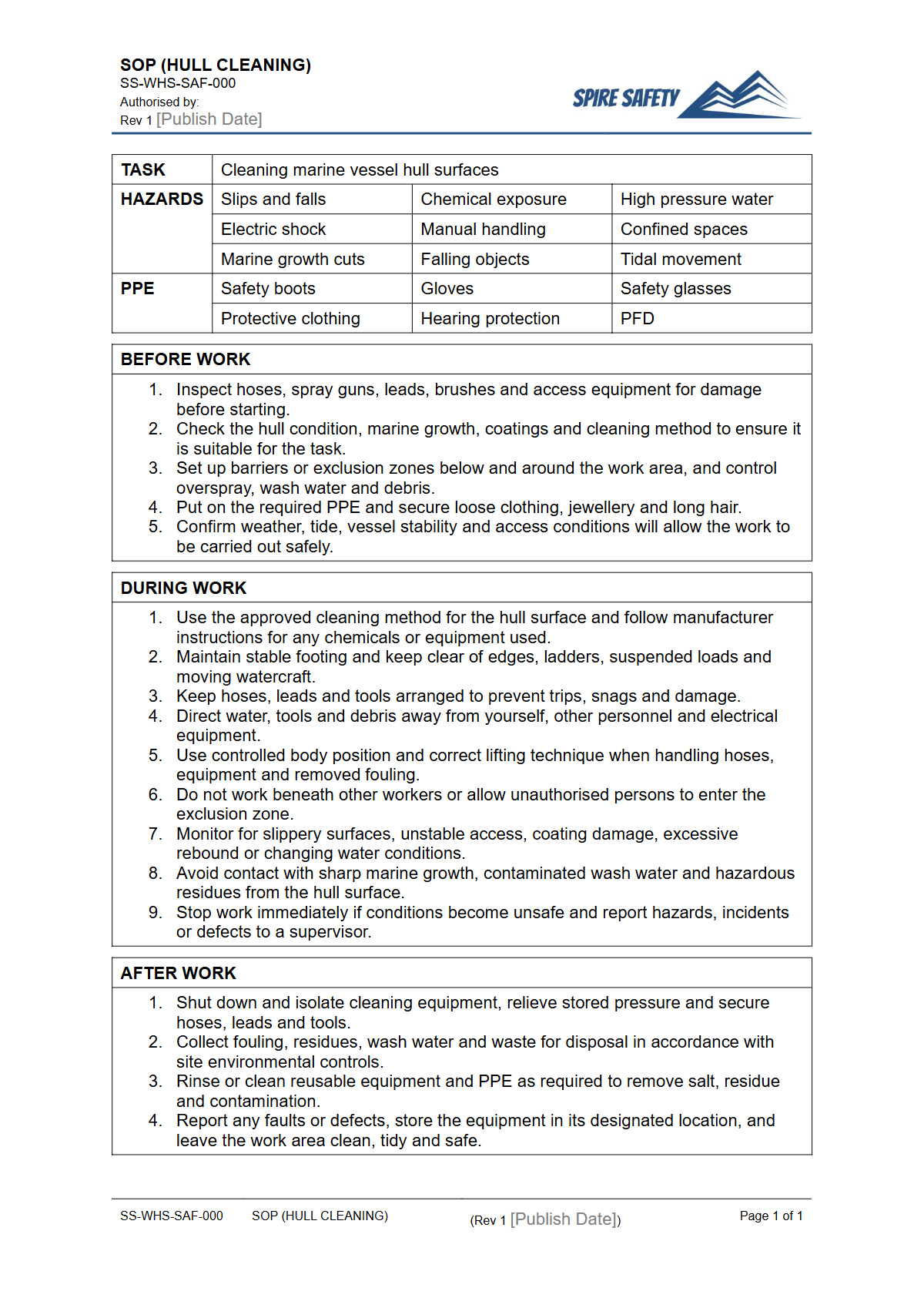
Hull cleaning is a specialised task fraught with significant workplace health and safety risks. This free Safe Operating Procedure (Hull Cleaning) Template provides a structured starting point for documenting a safe system of work for this activity.
It prompts you to consider hazards inherent in the process, including drowning, musculoskeletal injuries from awkward postures, exposure to hazardous substances from anti-fouling paints, and dangerous marine life. A well-developed SOP is a critical component of your overall safety framework, helping your organisation meet its duty of care obligations.
Formalising these procedures is a key step in developing robust WHS management systems that protect your workers and your business.
Video walkthrough
How to use the Free Safe Operating Procedure (Hull Cleaning) Template
This document is a template, not a finished product. To make it effective, you must customise it for the specific context of your workplace.
Your customisation should detail the exact vessel type, the cleaning method being used (e.g., diver-operated, remotely operated vehicle (ROV), or in-water cleaning systems), the specific equipment involved, and the environmental conditions. Include details on pre-operational checks, emergency procedures, and communication protocols between divers and surface support. For related workshop activities, you may also need procedures like our FREE Circular Saw SOP (Safe Operating Procedure) Template.
Important: This is a template that we expect you to change. You must consult with your workers and adapt this Safe Operating Procedure to reflect the unique hazards, risks, and control measures specific to your equipment and worksite.
This customisation is essential for ensuring the procedure is relevant and effective.
The Safe Operating Procedure is structured to cover:
- Hazard Identification: Prompts to identify risks such as drowning, entanglement, contaminated water, and equipment malfunction.
- Risk Control Measures: Outlines common controls including the use of personal protective equipment (PPE), dive supervision, lockout-tagout procedures for vessel propulsion, and environmental containment.
- Step-by-Step Instructions: A logical sequence for pre-operational checks, conducting the cleaning task, and post-operational procedures.
- Training and Competency Requirements: A section to specify the necessary qualifications and experience for operators, particularly for diving operations.
- Emergency Response: Sections to detail emergency contacts and procedures for scenarios like diver emergencies or equipment failure.
When to use a Safe Operating Procedure for Hull Cleaning
A Safe Operating Procedure for hull cleaning should be used consistently before any such task is undertaken. It serves as a critical planning tool for supervisors and a final checklist for the work crew during pre-start meetings or toolbox talks.
It should also be a core document for training new team members and for conducting periodic competency assessments. Regular reviews of the SOP are also crucial, especially after an incident, a near miss, or when new equipment or cleaning agents are introduced.
Integrating this procedure into your routine can be verified through a systematic WHS compliance auditing process to ensure it is being followed correctly.
Who should use this template
This template is designed for any person conducting a business or undertaking (PCBU) involved in the maritime industry where hull cleaning is performed. This includes marina operators, commercial diving contractors, vessel maintenance yards, fleet managers, and skippers of commercial vessels.
WHS managers, supervisors, and safety officers will find it a valuable tool for formalising safety protocols and demonstrating due diligence. For workplaces that involve heavy lifting of equipment in a shipyard setting, it's also worth considering procedures like our FREE Telehandler SOP (Safe Operating Procedure) Template to cover associated risks.
By customising and implementing this SOP, you can create a safer, more organised, and more professional approach to a high-risk task.
Common mistakes
Common mistakes to avoid
- Failing to adequately assess and control environmental risks, such as the release of anti-fouling paint particles into the water.
- Using a generic SOP without customising it for the specific vessel, location, and equipment.
- Inadequate dive safety planning, including a lack of a designated standby diver and emergency procedures.
- Neglecting to check and comply with the specific regulations of the local port, harbour, or marine authority.
Legal references
Legal considerations
The following legal requirements may be relevant to this type of work.
- Work Health and Safety Act (Harmonised) — Provides the primary duties for protecting workers and other people from work health and safety risks.
- Work Health and Safety Regulations (Harmonised) — Sets out requirements supporting the management of workplace hazards and risks.
The following codes may be relevant to this type of work.
- Managing WHS Risks Code of Practice — Provides practical guidance on identifying hazards, assessing risks and applying effective controls.
- Work Health and Safety Consultation, Cooperation and Coordination Code of Practice — Provides practical guidance on consulting workers and coordinating with other duty holders.
- Managing the Work Environment and Facilities Code of Practice — Provides practical guidance on safe work environments, workplace facilities and related controls.
Did you know
Biofouling's Fuel Penalty
Even a thin layer of slime (biofouling) on a ship's hull can increase its fuel consumption by up to 15%. Heavy fouling can increase it by over 40%, making regular, safe cleaning an economic and environmental necessity.
Diving Regulations
In Australia, any diving performed as part of a job, including hull cleaning, is considered occupational diving. This work is strictly regulated under WHS laws and requires adherence to Australian Standard AS/NZS 2299.1.
FAQ
Frequently asked questions
01What key hazards should a Safe Operating Procedure for hull cleaning cover?
02Are specific qualifications required to perform hull cleaning in Australia?
03How often should our hull cleaning SOP be reviewed?
04Can this template be used for both commercial and recreational vessels?
Share this resource
Free Safe Operating Procedure (Hull Cleaning) Template
Browse Categories
How To Use It
- 1Download and open in Word or PDF.
- 2Replace the placeholders with your business details.
- 3Get it reviewed by a WHS specialist before rollout.
Need it customised?
Our WHS consultants can adapt this template to your site, run a gap analysis, or audit what you already have in place.
Book a Free Consultation WHS consulting servicesor call 1300 156 382
Related templates
- Free Safe Operating Procedure (HVAC Coil Cleaning) Template
- Free Safe Operating Procedure (HVAC Filter Change) Template
- Free Safe Operating Procedure (HVAC Grille Cleaning) Template
- Free Safe Operating Procedure (HVAC Intake Cleaning) Template
- Free Safe Operating Procedure (HVAC Return Cleaning) Template
- Free Safe Operating Procedure (HVAC Vent Cleaning) Template