
Free Safe Operating Procedure (Housekeeping Cart Use) Template
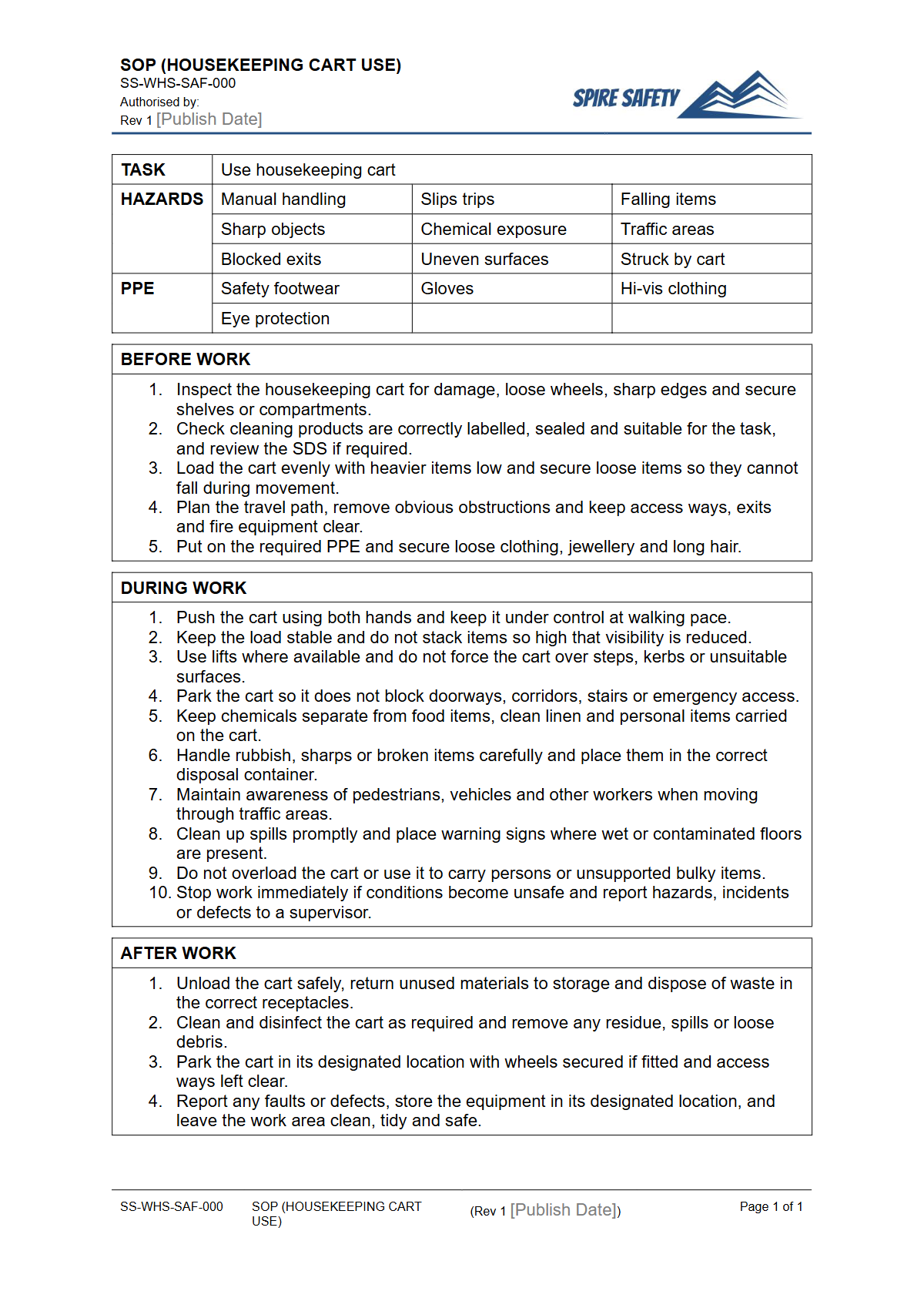
Streamline your cleaning operations with our Free Safe Operating Procedure (Housekeeping Cart Use) Template. Download the DOCX and PDF today to get started.
Free Safe Operating Procedure (Housekeeping Cart Use) Template
DOCX • 126 KB + PDF
Updated Oct 2026
No signup required
Purpose of the Free Safe Operating Procedure (Housekeeping Cart Use) Template
A housekeeping or cleaning cart, while seemingly simple, presents several workplace hazards if not managed correctly. These include manual handling injuries from pushing heavy or poorly balanced loads, slips and trips from unattended carts, and exposure to hazardous chemicals.
This Free Safe Operating Procedure (Housekeeping Cart Use) Template provides a structured framework for documenting the safe and correct methods for preparing, using, and storing these essential pieces of equipment. Implementing a formal SOP helps standardise work practices, ensuring every worker follows the safest procedure, every time.
It serves as a critical tool for hazard identification and risk control.
Using a documented procedure is a fundamental part of a systematic approach to workplace safety. It demonstrates a commitment to managing risks and provides a clear, actionable guide for workers.
This SOP is a key document within broader WHS management systems, helping your organisation fulfil its duty of care by providing safe systems of work. It establishes clear expectations for worker behaviour, from pre-operational checks to waste disposal, minimising the chance of incidents and injuries in sectors like hospitality, healthcare, and commercial cleaning.
Video walkthrough
How to use the Free Safe Operating Procedure (Housekeeping Cart Use) Template
This Safe Operating Procedure template is provided as a downloadable DOCX file, allowing for complete customisation, as well as a ready-to-print PDF. To use it effectively, download the document and methodically work through each section, replacing the placeholder text with information specific to your workplace and the particular models of housekeeping carts in use.
This includes detailing the exact cleaning chemicals used, required Personal Protective Equipment (PPE), and site-specific rules for navigating corridors and interacting with the public.
Please note: We have developed this template as a guide. To ensure it is effective for your specific needs, you must customise it to reflect the actual equipment, chemicals, tasks, and control measures in your workplace.
A generic procedure is not sufficient; it must be a living document that accurately reflects your operational reality. For more examples, explore our extensive free WHS resources library.
Your customisation should also include details on emergency procedures, such as what to do in case of a chemical spill. For businesses in the accommodation or food service industry, you may need multiple SOPs for different equipment.
For example, kitchen staff may require a Free Safe Operating Procedure (Deep Fryer) template in addition to procedures for cleaning tasks.
When to use it
A Safe Operating Procedure for housekeeping cart use should be integrated into several key stages of your safety management process. It is an essential training document for new employees during their induction, providing them with a clear, step-by-step guide before they begin work.
It should also be used for regular refresher training to reinforce safe habits and introduce any changes to procedures or equipment. The SOP is a valuable reference tool that workers can consult at any time to confirm the correct process.
The document should also be reviewed and updated following any incident or near-miss involving a housekeeping cart. It serves as a benchmark for investigating what went wrong and identifying areas for improvement in the procedure itself.
Furthermore, it's a key piece of evidence during safety reviews and WHS compliance auditing, demonstrating that formal processes are in place to manage identified risks.
Beyond scheduled training, the SOP is a practical tool for supervisors conducting on-the-job observations and competency assessments. It provides an objective standard against which to measure worker performance and ensure procedures are being followed correctly.
For facility maintenance teams who may support cleaning operations, other procedures like our Free Air Compressor SOP (Safe Operating Procedure) Template can help standardise tasks across different departments.
Who should use it
This Safe Operating Procedure is intended for a range of personnel within an organisation. The primary users are the workers who operate the housekeeping carts daily, including cleaners, porters, and room attendants in hotels, hospitals, and commercial buildings.
They rely on the SOP for clear instructions on how to perform their tasks safely. Supervisors and team leaders should also use the document to train their staff, monitor compliance, and enforce safe work practices.
WHS managers and safety officers will use the template as part of the risk assessment process and to build a comprehensive library of safe work procedures for the organisation. It helps them ensure that controls for hazards like manual tasks and chemical handling are properly documented and communicated.
Even maintenance personnel who service the carts can refer to sections on pre-start checks to understand the equipment's safety features. In a large facility, their safety documentation might also include a FREE Circular Saw SOP (Safe Operating Procedure) Template for various repair and maintenance jobs.
Common mistakes
Common mistakes to avoid
- Overloading the cart, making it heavy and difficult to control.
- Leaving the cart unattended in the middle of a corridor or doorway, creating a trip hazard.
- Using a damaged cart with wobbly wheels or a broken frame.
- Storing cleaning chemicals improperly, such as in unlabelled containers or next to incompatible substances.
Legal references
Legal considerations
The following legal requirements may be relevant to this type of work.
- Work Health and Safety Act (Harmonised) — Provides the primary duties for protecting workers and other people from work health and safety risks.
- Work Health and Safety Regulations (Harmonised) — Sets out requirements supporting the management of workplace hazards and risks.
The following codes may be relevant to this type of work.
- Managing WHS Risks Code of Practice — Provides practical guidance on identifying hazards, assessing risks and applying effective controls.
- Work Health and Safety Consultation, Cooperation and Coordination Code of Practice — Provides practical guidance on consulting workers and coordinating with other duty holders.
- Managing the Work Environment and Facilities Code of Practice — Provides practical guidance on safe work environments, workplace facilities and related controls.
Did you know
Manual Handling Injuries
In Australia, injuries resulting from hazardous manual tasks are a leading cause of serious workers' compensation claims. Properly loading and manoeuvring a housekeeping cart is a key control for preventing these types of injuries in the cleaning and hospitality industries.
FAQ
Frequently asked questions
01What are the key hazards associated with using a housekeeping cart?
02How often should a Safe Operating Procedure for a housekeeping cart be reviewed?
03Is specific training required to use a housekeeping cart safely?
04What should be included in a pre-operational check for a housekeeping cart?
Share this resource
Free Safe Operating Procedure (Housekeeping Cart Use) Template
Browse Categories
How To Use It
- 1Download and open in Word or PDF.
- 2Replace the placeholders with your business details.
- 3Get it reviewed by a WHS specialist before rollout.
Need it customised?
Our WHS consultants can adapt this template to your site, run a gap analysis, or audit what you already have in place.
Book a Free Consultation WHS consulting servicesor call 1300 156 382
Related templates
- Free Safe Operating Procedure (Hub Bearing Change) Template
- Free Safe Operating Procedure (Hull Cleaning) Template
- Free Safe Operating Procedure (HVAC Coil Cleaning) Template
- Free Safe Operating Procedure (HVAC Filter Change) Template
- Free Safe Operating Procedure (HVAC Grille Cleaning) Template
- Free Safe Operating Procedure (HVAC Intake Cleaning) Template