
Free Safe Operating Procedure (Hotel Room Minibar) Template
Standardise the safe restocking and maintenance of hotel room minibars with our structured Safe Operating Procedure. Download your free template today.
Free Safe Operating Procedure (Hotel Room Minibar) Template
DOCX • 126 KB + PDF
Updated Oct 2026
No signup required
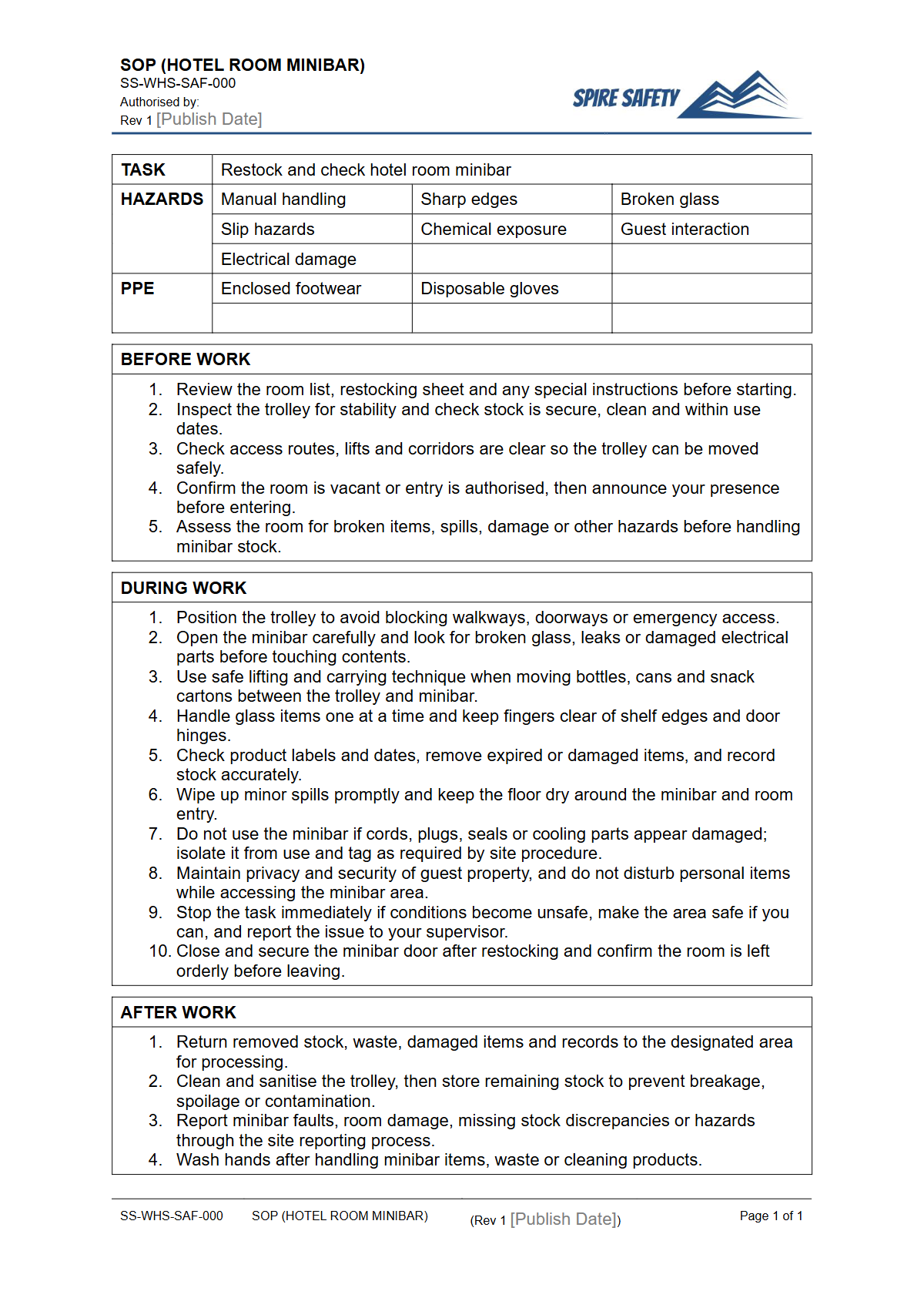
Purpose of the Free Safe Operating Procedure (Hotel Room Minibar) Template
Managing hotel room minibars involves more than just restocking drinks and snacks; it presents several workplace health and safety risks that must be controlled. This Free Safe Operating Procedure (Hotel Room Minibar) Template provides a structured foundation for documenting the safe methods required to service these units.
It helps accommodation providers formalise procedures to manage risks including manual handling injuries from lifting heavy stock, electrical hazards from faulty appliances, exposure to cleaning chemicals, and slips, trips, and falls in guest rooms.
By implementing a clear Safe Operating Procedure (SOP), your organisation can ensure all team members follow a consistent, safe process for every minibar service. This not only protects workers but also helps maintain high standards of hygiene and guest safety.
The template is designed to be adapted to your specific workplace, equipment, and the products you use, forming a key part of your overall safety management system.
Video walkthrough
How to use the Free Safe Operating Procedure (Hotel Room Minibar) Template
This downloadable resource is provided in both DOCX and PDF formats for your convenience. The DOCX file is fully editable, allowing you to customise the content to precisely match your hotel's operational requirements, cleaning products, and staff responsibilities.
A well-developed SOP is an essential component of a comprehensive WHS management system, providing clear, actionable instructions for your employees.
To effectively use this template:
- Download: Choose the DOCX version for editing.
- Consult: Involve workers who perform the task, such as housekeeping and maintenance staff, in the customisation process. Their direct experience is invaluable for identifying all relevant hazards and control measures.
- Customise: Add specific details about your hotel, including the types of minibars used, the exact cleaning chemicals (and references to their Safety Data Sheets), and procedures for reporting faults or issues.
- Train: Once finalised, use the SOP as a training tool for all relevant employees to ensure they understand and follow the documented procedures.
- Review: Schedule regular reviews of the SOP to ensure it remains current and effective.
Note: This document is a template only. It must be customised to suit the specific circumstances of your workplace.
We make no guarantee that this document is compliant for your workplace as it is your responsibility to ensure you have met your work health and safety obligations.
When to use a Safe Operating Procedure for a Hotel Room Minibar
A minibar SOP should be used by employees every time they are required to interact with, restock, clean, or inspect a minibar unit. It formalises the steps for routine tasks, ensuring safety and consistency.
This is particularly important for high-turnover roles where new staff need clear guidance from day one. The procedure covers pre-work checks, the physical act of restocking, cleaning protocols, and post-task checks.
Using a documented procedure helps manage a range of operational factors, from ensuring correct stock rotation and hygiene to verifying electrical safety. The structured approach is similar to processes required for other hospitality tasks, such as those detailed in our Free Safe Operating Procedure for Deep Fryers, where consistency is key to managing risk.
Who should use this Safe Operating Procedure
This SOP is primarily intended for hotel housekeeping staff, porters, or dedicated minibar attendants responsible for the daily servicing and restocking of in-room minibars. It is also relevant for maintenance staff who may be called to inspect or repair faulty units, as it outlines basic safety checks before they begin their work.
Supervisors and managers in housekeeping and hotel operations should use the SOP to train staff, set performance expectations, and conduct workplace inspections. For businesses looking to build robust safety frameworks beyond individual procedures, engaging expert support through WHS consulting can help ensure effective implementation and a strong safety culture across the entire organisation.
Key Elements of a Hotel Room Minibar SOP
A robust minibar SOP should contain several key sections to guide the worker through the task safely.
- Personal Protective Equipment (PPE): Specifies any required PPE, such as gloves for handling cleaning chemicals or closed-toe shoes to protect from falling items.
- Pre-Operational Checks: Includes visual inspection of the minibar for damage, checking that the power cord is in good condition, and ensuring the unit is operating at a safe temperature.
- Restocking Procedure: Outlines safe manual handling techniques for carrying and lifting stock trays, principles of stock rotation (First-In, First-Out), and checking expiry dates on all products.
- Cleaning and Sanitising: Details the approved food-safe cleaning chemicals, correct dilution ratios, contact times, and the method for cleaning interior and exterior surfaces to prevent cross-contamination.
- Waste Disposal: Describes the correct procedure for disposing of expired stock and packaging materials.
- Fault Reporting: Establishes a clear process for reporting any faults, such as a malfunctioning cooling unit, a damaged seal, or electrical issues, to a supervisor or the maintenance department.
Regular reviews of the procedure, which can form part of a scheduled WHS compliance audit, are crucial to verify that these steps are being followed correctly and that the document remains relevant to current practices.
By systematically addressing these elements, your SOP becomes a powerful tool for risk management. For additional templates and safety documents covering a wide range of industries and tasks, explore our comprehensive free WHS resources library.
Common mistakes
Common mistakes to avoid
- Failing to check the electrical safety (test and tag) status of the minibar unit and power cord.
- Ignoring correct manual handling techniques when lifting and carrying heavy stock trays.
- Using general-purpose or non-food-safe chemicals to clean the interior of the minibar.
- Not having a clear system for stock rotation, leading to expired products being left for guests.
Legal references
Legal considerations
The following legal requirements may be relevant to this type of work.
- Work Health and Safety Act (Harmonised) — Provides the primary duties for protecting workers and other people from work health and safety risks.
- Work Health and Safety Regulations (Harmonised) — Sets out requirements supporting the management of workplace hazards and risks.
The following codes may be relevant to this type of work.
- Managing WHS Risks Code of Practice — Provides practical guidance on identifying hazards, assessing risks and applying effective controls.
- Work Health and Safety Consultation, Cooperation and Coordination Code of Practice — Provides practical guidance on consulting workers and coordinating with other duty holders.
- Managing the Work Environment and Facilities Code of Practice — Provides practical guidance on safe work environments, workplace facilities and related controls.
Did you know
Manual Handling Risk
A fully stocked minibar tray can weigh over 10kg. Repetitive lifting of these trays without correct technique is a significant cause of musculoskeletal injuries for hotel housekeeping staff.
Hidden Electrical Hazard
Minibars are electrical appliances often located near sources of liquid. A damaged cord or faulty internal component can create a serious electrocution or fire risk that may go unnoticed without regular checks.
FAQ
Frequently asked questions
01What hazards are associated with restocking a hotel minibar?
02Does this SOP template cover food safety requirements?
03How often should we review our Minibar Safe Operating Procedure?
04Is training required to follow a Safe Operating Procedure?
Share this resource
Free Safe Operating Procedure (Hotel Room Minibar) Template
Browse Categories
How To Use It
- 1Download and open in Word or PDF.
- 2Replace the placeholders with your business details.
- 3Get it reviewed by a WHS specialist before rollout.
Need it customised?
Our WHS consultants can adapt this template to your site, run a gap analysis, or audit what you already have in place.
Book a Free Consultation WHS consulting servicesor call 1300 156 382
Related templates
- Free Safe Operating Procedure (Household Chemical Drop) Template
- Free Safe Operating Procedure (Housekeeping Cart Clean) Template
- Free Safe Operating Procedure (Housekeeping Cart Use) Template
- Free Safe Operating Procedure (Hub Bearing Change) Template
- Free Safe Operating Procedure (Hull Cleaning) Template
- Free Safe Operating Procedure (HVAC Coil Cleaning) Template