
Free Safe Operating Procedure (Household Chemical Drop) Template
Manage risks at chemical collection points with our comprehensive template. Download your free Safe Operating Procedure for Household Chemical Drops now.
Free Safe Operating Procedure (Household Chemical Drop) Template
DOCX • 126 KB + PDF
Updated Oct 2026
No signup required
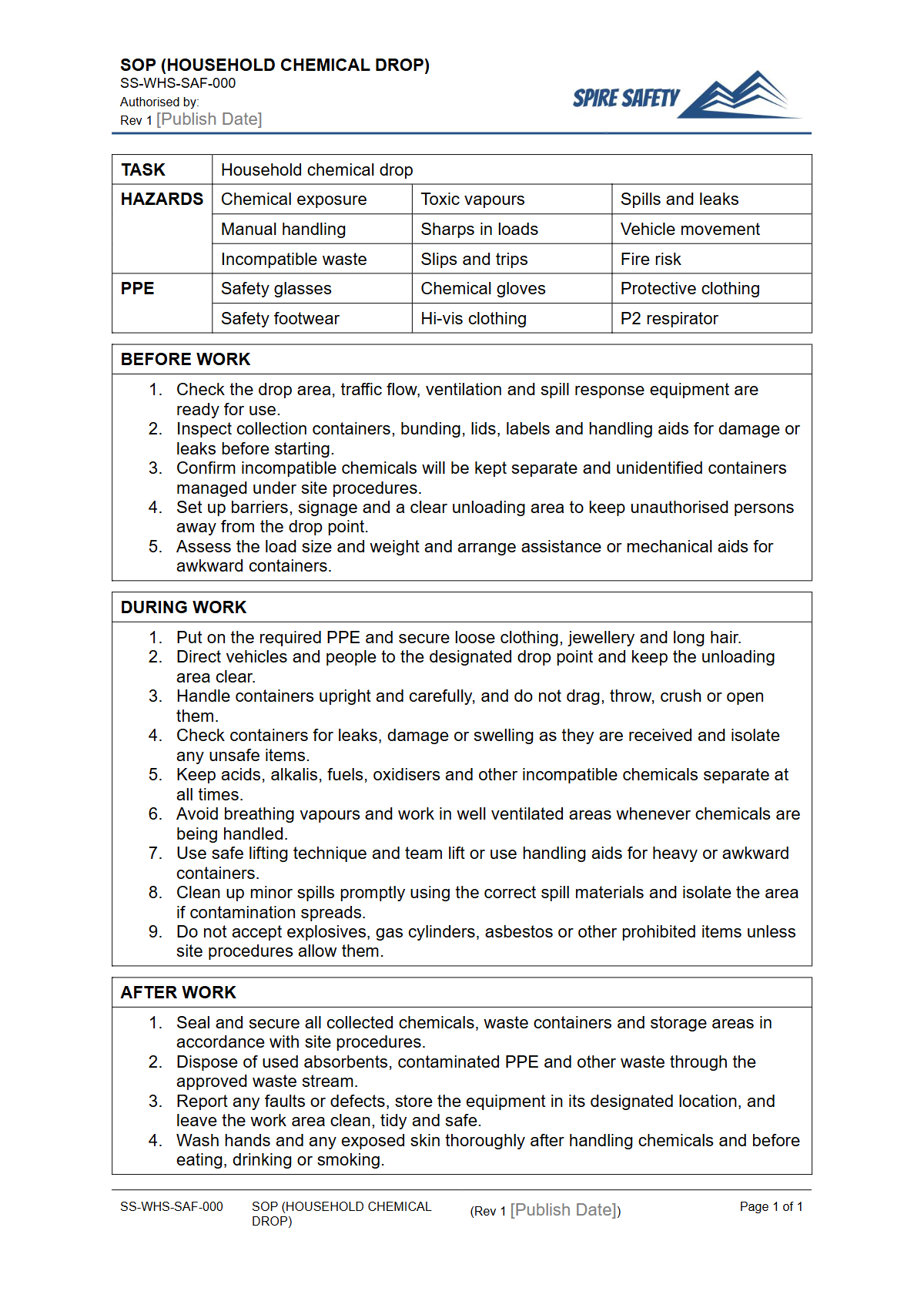
Purpose of the Free Safe Operating Procedure (Household Chemical Drop) Template
Operating a household chemical drop-off point, whether as a one-off event or a permanent facility, involves significant risks. This Safe Operating Procedure (SOP) provides a structured framework to manage the health, safety, and environmental hazards associated with accepting, segregating, and storing domestic chemical waste.
The primary goal is to establish a clear, repeatable process that protects workers, the public, and the environment from chemical exposure, spills, fires, and other related incidents. This document outlines the required personal protective equipment (PPE), emergency responses, and correct handling techniques to ensure tasks are performed safely and consistently.
Video walkthrough
How to use the Free Safe Operating Procedure (Household Chemical Drop) Template
This template is provided as a fully editable DOCX file, with a PDF version also available for easy printing and distribution. It is designed as a comprehensive starting point, pre-filled with common tasks, hazards, and controls relevant to household chemical collection.
To be effective, you must adapt this document to the specific context of your site, equipment, chemicals handled, and personnel. Effective procedures are a key component of broader WHS management systems that drive a positive safety culture.
Important: We have developed this template as a foundational guide. You must consult with your workers and other stakeholders to review, modify, and add site-specific details.
This collaborative process ensures the final SOP is practical, understood by everyone, and accurately reflects the realities of your work environment.
Key Sections for Customisation
- Hazard Identification: Review and update the list of potential hazards to include any unique to your location, such as traffic management, site security, or specific environmental risks.
- Personal Protective Equipment (PPE): Specify the exact type and rating of gloves, eyewear, respiratory protection, and protective clothing required for the chemicals you accept.
- Chemical Segregation Chart: Adapt the segregation guide to align with the categories of waste you collect, ensuring incompatible substances are stored safely apart.
- Emergency Procedures: Detail your site-specific contacts, muster points, spill kit locations, and first aid facilities. Ensure procedures for fire, major spills, and medical emergencies are clear and actionable.
When to use it
This SOP should be implemented and readily accessible wherever household chemicals are collected from the public. This includes council-run chemical clean-up days, permanent drop-off zones at waste transfer stations or recycling centres, and special community collection events.
It should be used as the primary reference for training new staff and for conducting refresher training for existing workers. The SOP also serves as a critical document during safety audits and procedural reviews. Verifying that the documented procedures are followed in practice is a vital step, often achieved through regular WHS compliance auditing.
Who should use it
This document is intended for use by Persons Conducting a Business or Undertaking (PCBUs) who manage chemical collection services. Key personnel responsible for implementing, monitoring, and using this SOP include: Site Supervisors, Waste Management Officers, Environmental Health Officers, and WHS Advisors.
Critically, the workers who directly perform the tasks of receiving, identifying, and handling the chemicals must be thoroughly trained on its contents and follow the specified procedures every time. For facilities using machinery to move bulk containers like intermediate bulk containers (IBCs) or drums, consider integrating procedures from our FREE Telehandler SOP Template.
Integrating with Other Processes
For larger, permanent facilities, the chemical drop-off process may be just one part of a larger waste stream. Where chemicals are sorted and moved through a facility, the principles in this SOP should be integrated with other operational procedures.
For example, if a sorting line is used, a separate procedure like our FREE Conveyer System SOP would be necessary to manage mechanical hazards. Similarly, processes for decontamination and cleaning of equipment must also be documented.
Procedures for using equipment during cleanup, such as those outlined in our Free Air Compressor SOP, help ensure safety is maintained throughout the entire operational lifecycle. For more templates and checklists, you can browse our free WHS resources library.
Common mistakes
Common mistakes to avoid
- Accepting non-compliant, unlabelled, or commercial quantities of chemicals without a proper procedure.
- Storing incompatible chemicals together (e.g., flammable liquids next to oxidisers), creating a risk of fire or dangerous reactions.
- Using inadequate or incorrect PPE for the specific chemicals being handled.
- Failing to have a clear, well-stocked spill kit and an emergency plan that all workers understand.
Legal references
Legal considerations
The following legal requirements may be relevant to this type of work.
- Work Health and Safety Act (Harmonised) — Provides the primary duties for protecting workers and other people from work health and safety risks.
- Work Health and Safety Regulations (Harmonised) — Sets out requirements supporting the management of workplace hazards and risks.
The following codes may be relevant to this type of work.
- Managing WHS Risks Code of Practice — Provides practical guidance on identifying hazards, assessing risks and applying effective controls.
- Work Health and Safety Consultation, Cooperation and Coordination Code of Practice — Provides practical guidance on consulting workers and coordinating with other duty holders.
- Managing the Work Environment and Facilities Code of Practice — Provides practical guidance on safe work environments, workplace facilities and related controls.
Did you know
Household Hazard
According to Planet Ark, Australian households are responsible for thousands of tonnes of hazardous waste each year. Safe collection programs are essential to prevent these chemicals from ending up in landfill, where they can contaminate soil and water.
FAQ
Frequently asked questions
01What kind of chemicals are typically accepted at household chemical drop-offs?
02Is an SOP legally required for managing chemical waste in Australia?
03How should you handle an unknown chemical dropped off by a member of the public?
04What is the most important PPE for handling household chemicals?
Share this resource
Free Safe Operating Procedure (Household Chemical Drop) Template
Browse Categories
How To Use It
- 1Download and open in Word or PDF.
- 2Replace the placeholders with your business details.
- 3Get it reviewed by a WHS specialist before rollout.
Need it customised?
Our WHS consultants can adapt this template to your site, run a gap analysis, or audit what you already have in place.
Book a Free Consultation WHS consulting servicesor call 1300 156 382
Related templates
- Free Safe Operating Procedure (Housekeeping Cart Clean) Template
- Free Safe Operating Procedure (Housekeeping Cart Use) Template
- Free Safe Operating Procedure (Hub Bearing Change) Template
- Free Safe Operating Procedure (Hull Cleaning) Template
- Free Safe Operating Procedure (HVAC Coil Cleaning) Template
- Free Safe Operating Procedure (HVAC Filter Change) Template