
Free Safe Operating Procedure (Hotel Linen Cart) Template
Streamline your hotel's safety protocols with our free Safe Operating Procedure for hotel linen carts. Download your customisable template today.
Free Safe Operating Procedure (Hotel Linen Cart) Template
DOCX • 126 KB + PDF
Updated Oct 2026
No signup required
Purpose of the Free Safe Operating Procedure (Hotel Linen Cart) Template
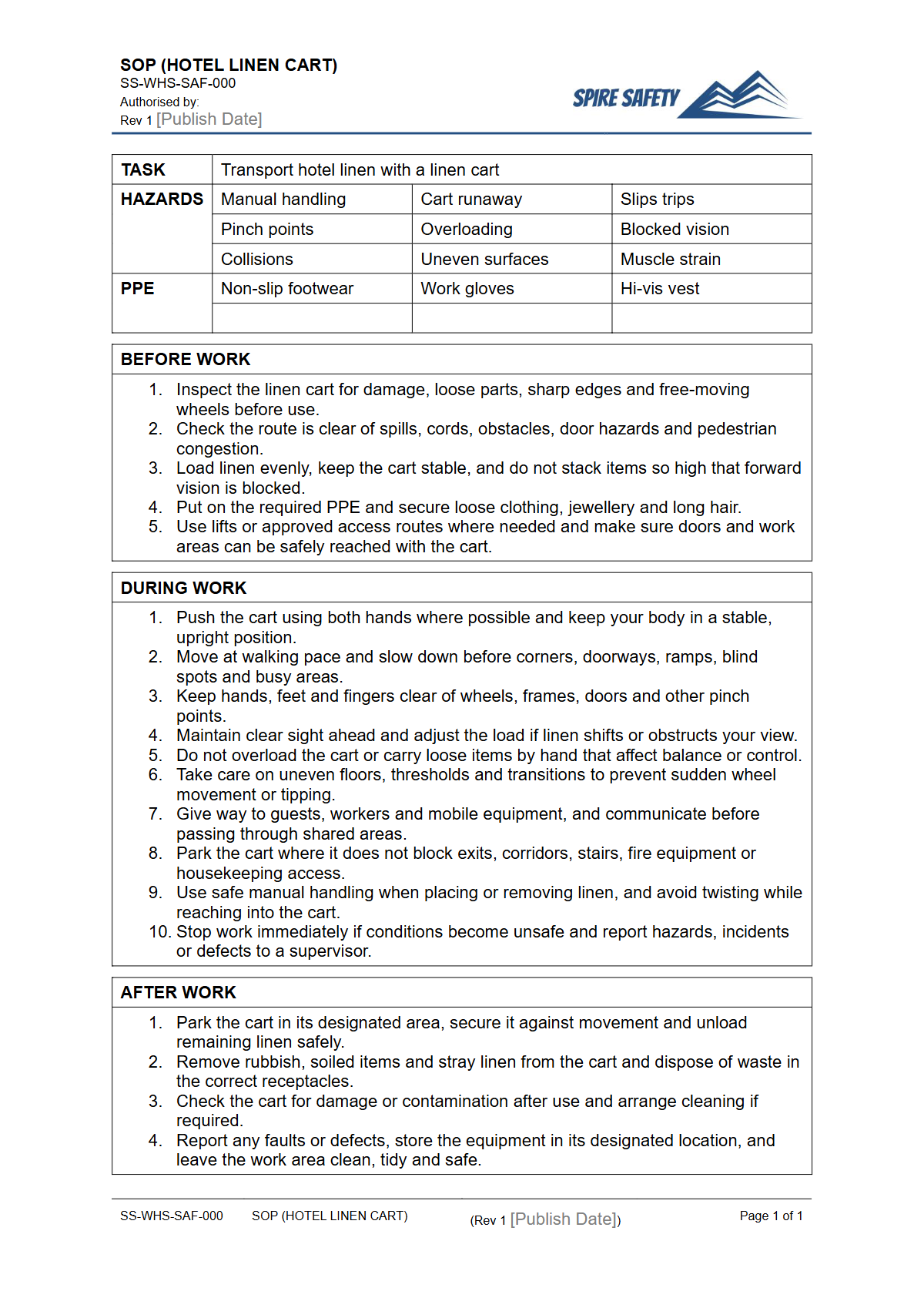
This Free Safe Operating Procedure (Hotel Linen Cart) Template provides a structured framework for documenting the safe use of linen carts and trolleys in a hotel or accommodation setting. Its primary purpose is to control risks associated with manual tasks, specifically pushing, pulling, and maneuvering heavily loaded carts.
By establishing a clear, step-by-step process, this SOP helps prevent common injuries such as sprains, strains, and other musculoskeletal disorders (MSDs) among housekeeping and porterage staff. It serves as a critical training tool for new employees and a benchmark for ongoing performance and safety observations.
Implementing a formal Safe Operating Procedure for this task demonstrates a commitment to proactive risk management. It standardises safe work practices across all shifts and teams, ensuring consistency in how tasks are performed.
This document forms an essential part of comprehensive WHS management systems, providing auditable evidence that hazards have been identified and control measures have been implemented and communicated to workers.
Video walkthrough
How to use the Free Safe Operating Procedure (Hotel Linen Cart) Template
Our Free Safe Operating Procedure (Hotel Linen Cart) Template is provided in both DOCX and PDF formats for your convenience. The DOCX file is fully editable, allowing you to adapt it to the unique requirements of your workplace.
To effectively implement this SOP, you should begin by downloading the template and reviewing it with key stakeholders, including housekeeping supervisors and experienced staff members who use the carts daily. Their input is invaluable for identifying site-specific hazards and practical control measures.
Note: This document is a template and must be customised to your specific workplace. We are not familiar with your site's unique conditions, the specific models of equipment you use, your workers' training, or the full scope of your operations. It is your responsibility to add site-specific details, such as designated cart routes, weight limits for your specific trolleys, procedures for navigating ramps or lifts, and emergency contacts.
Once customised, the SOP should be formally approved, and all relevant personnel must be trained on its contents. If you require assistance with this process, our general WHS consulting services can provide expert guidance.
When to use this Safe Operating Procedure
A Safe Operating Procedure for hotel linen carts should be a living document, integrated into the daily rhythm of operations. It is used as the primary reference for the correct and safe method of collecting, transporting, and distributing linen.
This SOP should be a central part of new employee inductions, ensuring every team member understands the expected safety standards from their first day. It is also a vital tool for conducting refresher training, particularly for long-term staff, to prevent complacency and reinforce safe work habits.
The SOP must be reviewed and potentially updated following any incident or near-miss involving a linen cart. It should also be revisited whenever there is a change in the work environment, such as the introduction of new or different types of carts, alterations to the hotel layout, or changes in workflow.
Regular reviews, often as part of routine WHS compliance auditing, ensure the procedure remains relevant and effective at managing risk.
Who should use this Safe Operating Procedure
This Safe Operating Procedure is intended for all personnel involved in the handling and movement of hotel linen carts. The primary users are housekeeping and room attendants who use the carts to service guest rooms.
It is also relevant for porters, laundry staff, and maintenance workers who may be required to move carts around the facility. Supervisors and managers in these departments have a critical role in ensuring the SOP is implemented correctly, providing training, and monitoring compliance.
WHS managers and coordinators will also use this document as part of the broader risk management framework. They can use it to verify that control measures for hazardous manual tasks are in place and to guide safety conversations and toolbox talks.
As a foundational document, it can be adapted for similar tasks within the hospitality environment, much like our Safe Operating Procedure for a deep fryer can be adapted for other kitchen equipment.
Furthering Your Safety System
An SOP is a foundational element, but a truly safe workplace is built on a culture of continuous improvement. Regularly review your procedures, consult with your team, and ensure your documentation reflects your actual practices.
To explore more tools and templates for building out your safety framework, browse our complete free WHS resources library for checklists, policies, and other useful documents.
Common mistakes
Common mistakes to avoid
- Failing to adjust the template for specific hotel layouts, such as ramps, lifts, and narrow corridors.
- Overloading carts beyond their safe weight limit or stacking linen so high it obstructs the user's view.
- Neglecting to inspect cart wheels, brakes, and frames for damage before each use.
- Treating the SOP as a one-time document instead of a live tool for ongoing training and review.
Legal references
Legal considerations
The following legal requirements may be relevant to this type of work.
- Work Health and Safety Act (Harmonised) — Provides the primary duties for protecting workers and other people from work health and safety risks.
- Work Health and Safety Regulations (Harmonised) — Sets out requirements supporting the management of workplace hazards and risks.
The following codes may be relevant to this type of work.
- Managing WHS Risks Code of Practice — Provides practical guidance on identifying hazards, assessing risks and applying effective controls.
- Work Health and Safety Consultation, Cooperation and Coordination Code of Practice — Provides practical guidance on consulting workers and coordinating with other duty holders.
- Managing the Work Environment and Facilities Code of Practice — Provides practical guidance on safe work environments, workplace facilities and related controls.
Did you know
The Weight of a Cart
A fully loaded hotel linen cart can weigh over 100kg. This makes correct pushing technique and load management essential to prevent serious musculoskeletal injuries.
Hospitality Industry Risks
Work-related musculoskeletal disorders are a leading cause of serious injury claims in the Australian accommodation industry, with body stressing from manual tasks being a primary contributor.
FAQ
Frequently asked questions
01What hazards are associated with using a hotel linen cart?
02How often should we review our Hotel Linen Cart SOP?
03Is this template suitable for all types of linen trolleys?
04Who is responsible for training staff on this Safe Operating Procedure?
Share this resource
Free Safe Operating Procedure (Hotel Linen Cart) Template
Browse Categories
How To Use It
- 1Download and open in Word or PDF.
- 2Replace the placeholders with your business details.
- 3Get it reviewed by a WHS specialist before rollout.
Need it customised?
Our WHS consultants can adapt this template to your site, run a gap analysis, or audit what you already have in place.
Book a Free Consultation WHS consulting servicesor call 1300 156 382
Related templates
- Free Safe Operating Procedure (Hotel Luggage Handling) Template
- Free Safe Operating Procedure (Hotel Minibar Restock) Template
- Free Safe Operating Procedure (Hotel Room Minibar) Template
- Free Safe Operating Procedure (Household Chemical Drop) Template
- Free Safe Operating Procedure (Housekeeping Cart Clean) Template
- Free Safe Operating Procedure (Housekeeping Cart Use) Template