
Free Safe Operating Procedure (Hotel Luggage Handling) Template
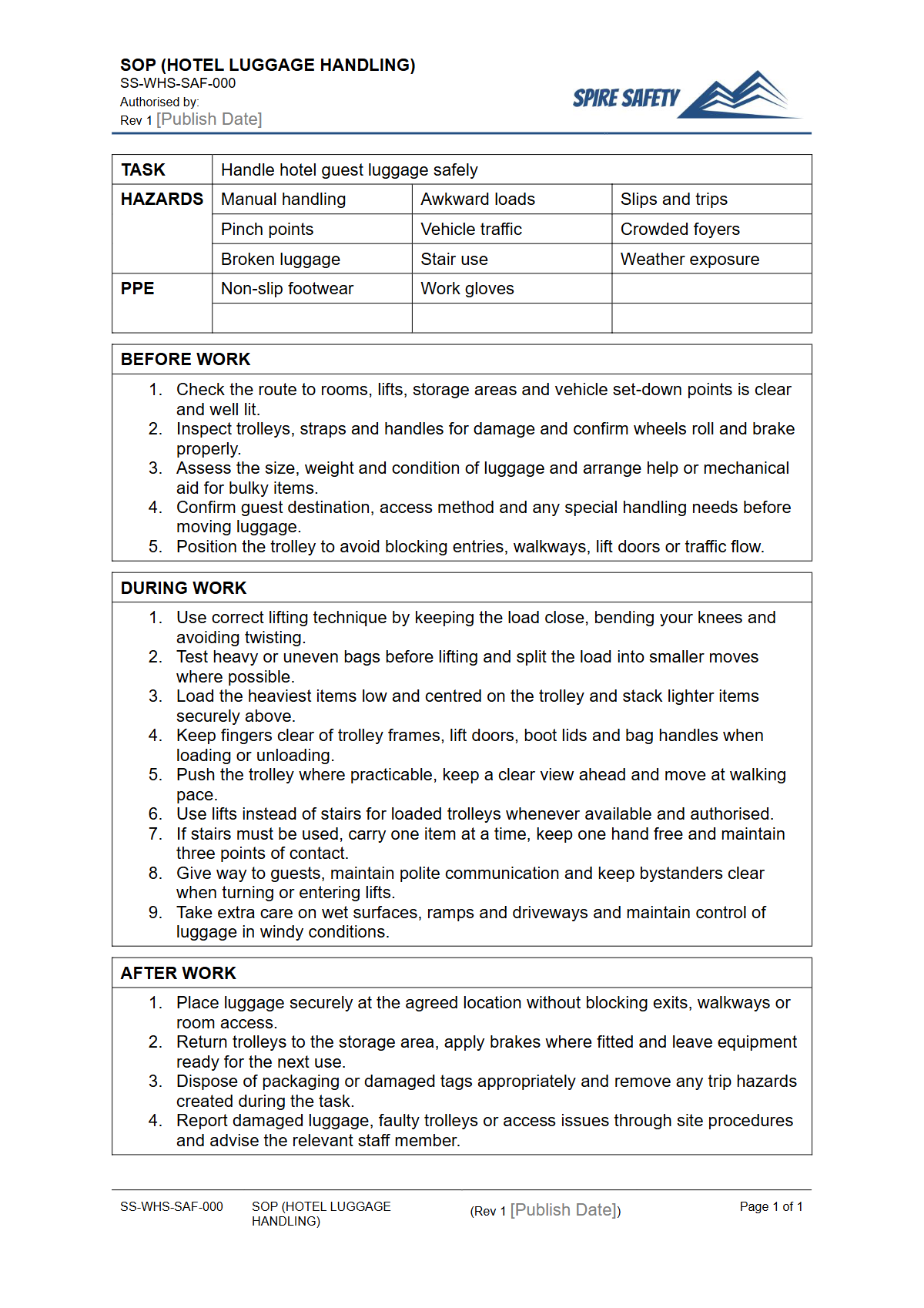
Effectively manage manual handling risks in your hotel with our free Safe Operating Procedure for luggage handling. Download the customisable template now.
Free Safe Operating Procedure (Hotel Luggage Handling) Template
DOCX • 126 KB + PDF
Updated Oct 2026
No signup required
Purpose of the Free Safe Operating Procedure (Hotel Luggage Handling) Template
This Free Safe Operating Procedure (Hotel Luggage Handling) Template provides a structured framework for documenting the safest way to perform manual handling tasks involving guest luggage. Its primary purpose is to minimise the risk of musculoskeletal disorders (MSDs), which are a significant hazard for porters, bellhops, and concierge staff.
By outlining a clear, step-by-step process, this SOP helps standardise safe work practices across your team, ensuring every worker understands the expected methods for lifting, carrying, and transporting baggage. It serves as a critical training tool for new employee inductions and refresher courses, reinforcing your organisation's commitment to worker health and safety.
A well-implemented SOP helps a Person Conducting a Business or Undertaking (PCBU) meet their primary duty of care under Australian WHS legislation. It acts as a formal record of the risk controls implemented for hazardous manual tasks.
This document is not just about compliance; it's about creating a safer, more efficient work environment. By reducing injuries, you can improve staff morale, lower workers' compensation claims, and ensure consistent, high-quality guest service.
Integrating this procedure is a key part of developing robust WHS management systems within the hospitality sector.
Video walkthrough
How to use the Free Safe Operating Procedure (Hotel Luggage Handling) Template
Our Free Safe Operating Procedure (Hotel Luggage Handling) Template is available in both DOCX and PDF formats for your convenience. The DOCX file is fully editable, allowing you to adapt the content to the unique circumstances of your hotel.
To use it effectively, download the template and methodically work through each section, adding specific details relevant to your workplace. This includes information on the types of luggage trolleys used, specific routes through the hotel (noting ramps, stairs, or tight corners), weight limits, and procedures for team lifts or handling oversized items.
IMPORTANT: This document is a template and must be customised to suit the specific equipment, layout, and operational context of your workplace. We recommend that a person with appropriate knowledge of your hotel's operations, in consultation with the workers who perform the task, reviews and approves the final document before implementation.
A generic procedure is not sufficient to control risks effectively.
When to use this Safe Operating Procedure
A Safe Operating Procedure for hotel luggage handling should be a core part of your daily operations. Its application is crucial in several scenarios:
- Pre-Task Reference: Workers should be familiar with the SOP before they begin any luggage handling tasks.
- Induction and Training: It is an essential document for training new porters, bellhops, and concierge staff, ensuring they learn the safe method from day one.
- Refresher Training: Use the SOP as the basis for periodic refresher training to prevent complacency and reinforce safe behaviours.
- Post-Incident Review: Following a manual handling incident or near miss, the SOP should be reviewed and updated to prevent recurrence. If your processes require a formal check, consider engaging in WHS compliance auditing to identify any gaps.
- Procedural Changes: If the hotel introduces new equipment (like different luggage carts) or changes guest flow and lobby layouts, the SOP must be reviewed and amended.
Who should use this Safe Operating Procedure
This SOP is designed for use by a range of personnel within a hotel or accommodation setting:
- Hotel Management and Supervisors: To ensure they are providing a safe system of work and to use as a benchmark for monitoring performance and compliance.
- WHS/HSE Officers: To integrate into the broader safety management system and use as a tool for risk assessments and training needs analysis.
- Porters, Bellhops, and Concierge Staff: As a direct guide for performing their duties safely and consistently. These workers are the primary end-users. Their consultation during the drafting process is vital to ensure the procedure is practical and effective. If you need assistance facilitating this consultation, our WHS consulting expertise can guide you through the process.
While this SOP is specific to luggage handling, many hospitality venues require procedures for other tasks. For kitchen operations, you might find our deep fryer SOP a useful starting point.
Some larger establishments may even need a conveyor system SOP for baggage handling systems in loading docks or storage areas. You can explore our complete free WHS resources library for more templates relevant to your business.
Common mistakes
Common mistakes to avoid
- Using a generic template without customising it for specific hotel layouts and equipment.
- Failing to provide practical, hands-on training that reinforces the documented procedure.
- Not reviewing and updating the SOP after an incident, near miss, or change in operations.
- Forgetting to include procedures for non-standard situations like damaged, oversized, or unusually heavy luggage.
Legal references
Legal considerations
The following legal requirements may be relevant to this type of work.
- Work Health and Safety Act (Harmonised) — Provides the primary duties for protecting workers and other people from work health and safety risks.
- Work Health and Safety Regulations (Harmonised) — Sets out requirements supporting the management of workplace hazards and risks.
The following codes may be relevant to this type of work.
- Managing WHS Risks Code of Practice — Provides practical guidance on identifying hazards, assessing risks and applying effective controls.
- Work Health and Safety Consultation, Cooperation and Coordination Code of Practice — Provides practical guidance on consulting workers and coordinating with other duty holders.
- Managing the Work Environment and Facilities Code of Practice — Provides practical guidance on safe work environments, workplace facilities and related controls.
Did you know
MSDs in Hospitality
Musculoskeletal disorders from hazardous manual tasks are a leading cause of serious workers' compensation claims in the accommodation and food services industry in Australia.
The Power of Consultation
Consulting with your porters and concierge staff when developing an SOP is not only a legal requirement under WHS law but also leads to more practical, effective, and readily adopted procedures.
FAQ
Frequently asked questions
01What is a Safe Operating Procedure for hotel luggage handling?
02Why are manual handling procedures so important in the hotel industry?
03Who is responsible for creating a luggage handling SOP?
04How often should a Safe Operating Procedure for luggage handling be reviewed?
Share this resource
Free Safe Operating Procedure (Hotel Luggage Handling) Template
Browse Categories
How To Use It
- 1Download and open in Word or PDF.
- 2Replace the placeholders with your business details.
- 3Get it reviewed by a WHS specialist before rollout.
Need it customised?
Our WHS consultants can adapt this template to your site, run a gap analysis, or audit what you already have in place.
Book a Free Consultation WHS consulting servicesor call 1300 156 382
Related templates
- Free Safe Operating Procedure (Hotel Minibar Restock) Template
- Free Safe Operating Procedure (Hotel Room Minibar) Template
- Free Safe Operating Procedure (Household Chemical Drop) Template
- Free Safe Operating Procedure (Housekeeping Cart Clean) Template
- Free Safe Operating Procedure (Housekeeping Cart Use) Template
- Free Safe Operating Procedure (Hub Bearing Change) Template