
Free Safe Operating Procedure (Hot Plate) Template
Clearly outline the steps for safely using hot plates in your workplace with our structured template. Download your free DOCX to get started today.
Free Safe Operating Procedure (Hot Plate) Template
DOCX • 126 KB + PDF
Updated Oct 2026
No signup required
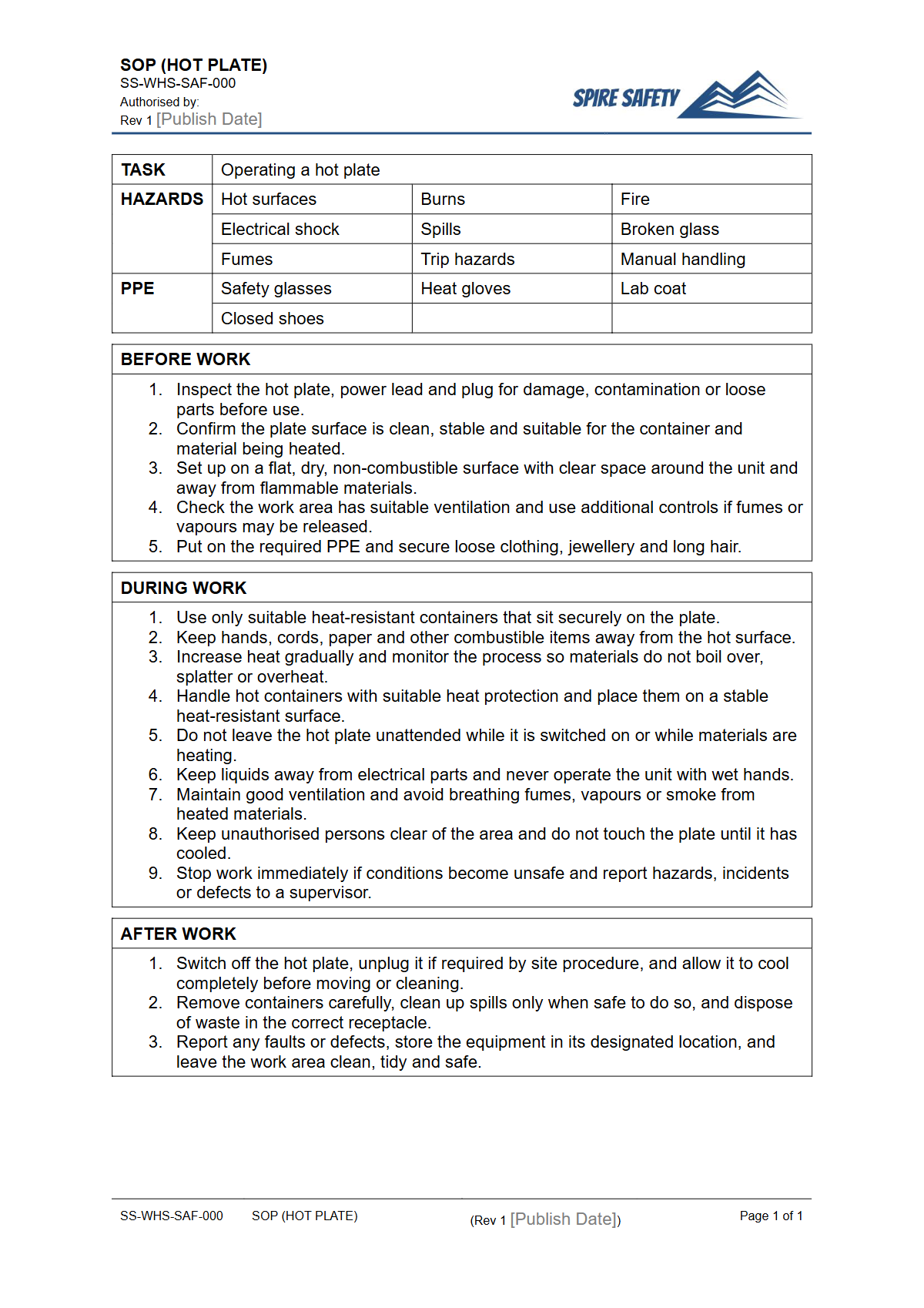
Purpose of the Free Safe Operating Procedure (Hot Plate) Template
The primary purpose of this Safe Operating Procedure is to eliminate or minimise the risks associated with using electric hot plates. It provides a step-by-step guide covering pre-operational checks, safe operation, and post-operational procedures.
This includes instructions for inspecting the equipment, selecting appropriate cookware or glassware, managing temperature settings, and shutting down the device safely. Documenting these steps helps standardise safe work practices, reducing the likelihood of incidents. Similar principles of managing heat and equipment apply to other appliances, as detailed in our Safe Operating Procedure for a deep fryer.
Video walkthrough
How to use the Free Safe Operating Procedure (Hot Plate) Template
This template is provided in both DOCX and PDF formats. The DOCX file is fully editable, allowing you to tailor it to the specific models of hot plates used at your site and your unique operational environment.
You must add site-specific details, including emergency procedures, contact persons, and any specific personal protective equipment (PPE) required. A well-developed SOP forms a key part of your safety documentation.
Important: This is a template only. We have created it as a starting point, but it is your responsibility to ensure it is customised to reflect the actual hazards and control measures in your workplace.
An SOP is most effective when it is integrated into your broader WHS management systems and supported by practical training and supervision.
When to use a Safe Operating Procedure
A Safe Operating Procedure for a hot plate should be used as a primary reference tool in several situations. It is essential for inducting new employees or contractors who will be required to operate the equipment.
It should also be used as a basis for regular refresher training to reinforce safe behaviours. The SOP serves as a valuable pre-start reference and can be discussed during toolbox talks or safety meetings.
Furthermore, in the event of an incident or near miss, the SOP is a key document for investigation and review. Its existence and proper use are often checked as part of a WHS compliance audit.
Who should use this SOP
This SOP is intended for several key roles within an organisation:
- Workers and Operators: To understand and follow the approved safe method for using the hot plate every time.
- Supervisors and Team Leaders: To train workers, enforce safe procedures, and monitor compliance. They are responsible for ensuring the SOP is understood and followed.
- WHS Managers and Personnel: To develop, review, and update the procedure as part of the overall safety management system. They also use it to assist in risk assessments and incident investigations.
Ultimately, anyone involved in the lifecycle of the task—from operation to supervision and safety oversight—should be familiar with the contents of this document. The principles of creating task-specific instructions are universal, whether for a hot plate or a different piece of equipment detailed in our FREE Circular Saw SOP Template.
By customising and implementing this hot plate SOP, you take a proactive step towards fulfilling your duty of care and fostering a stronger safety culture. Consistent application of documented procedures is fundamental to workplace health and safety.
You can explore our free WHS resources library for more templates to support your safety systems.
Common mistakes
Common mistakes to avoid
- Leaving a hot plate unattended, especially when heating flammable liquids or operating near combustible materials.
- Using glassware that is not rated for thermal shock (e.g., standard soda-lime glass instead of borosilicate), leading to shattering.
- Failing to inspect the power cord and plug for damage before each use, creating an electrical hazard.
- Placing the hot plate on an unstable or cluttered surface, increasing the risk of it being knocked over.
Legal references
Legal considerations
The following legal requirements may be relevant to this type of work.
- Work Health and Safety Act (Harmonised) — Provides the primary duties for protecting workers and other people from work health and safety risks.
- Work Health and Safety Regulations (Harmonised) — Sets out requirements supporting the management of workplace hazards and risks.
The following codes may be relevant to this type of work.
- Managing WHS Risks Code of Practice — Provides practical guidance on identifying hazards, assessing risks and applying effective controls.
- Work Health and Safety Consultation, Cooperation and Coordination Code of Practice — Provides practical guidance on consulting workers and coordinating with other duty holders.
- Managing the Work Environment and Facilities Code of Practice — Provides practical guidance on safe work environments, workplace facilities and related controls.
Did you know
Burn Severity
Contact with a surface at just 70°C for one second can cause a full-thickness third-degree burn. Many laboratory and workshop hot plates can reach temperatures exceeding 300°C.
Electrical Testing
In Australia, portable electrical appliances used in a work environment, like hot plates, must be regularly inspected and tested for electrical safety in accordance with standard AS/NZS 3760.
FAQ
Frequently asked questions
01What should be included in a hot plate Safe Operating Procedure?
02How often should a Safe Operating Procedure for a hot plate be reviewed?
03Are SOPs a legal requirement in Australia?
04Can this template be used for laboratory hot plates?
Share this resource
Free Safe Operating Procedure (Hot Plate) Template
Browse Categories
How To Use It
- 1Download and open in Word or PDF.
- 2Replace the placeholders with your business details.
- 3Get it reviewed by a WHS specialist before rollout.
Need it customised?
Our WHS consultants can adapt this template to your site, run a gap analysis, or audit what you already have in place.
Book a Free Consultation WHS consulting servicesor call 1300 156 382
Related templates
- Free Safe Operating Procedure (Hot Sugar Handling) Template
- Free Safe Operating Procedure (Hot Water Urn) Template
- Free Safe Operating Procedure (Hotel Guest Room Setup) Template
- Free Safe Operating Procedure (Hotel Laundry Collection) Template
- Free Safe Operating Procedure (Hotel Linen Cart) Template
- Free Safe Operating Procedure (Hotel Luggage Handling) Template