
Free Safe Operating Procedure (Hot Display Cabinet) Template
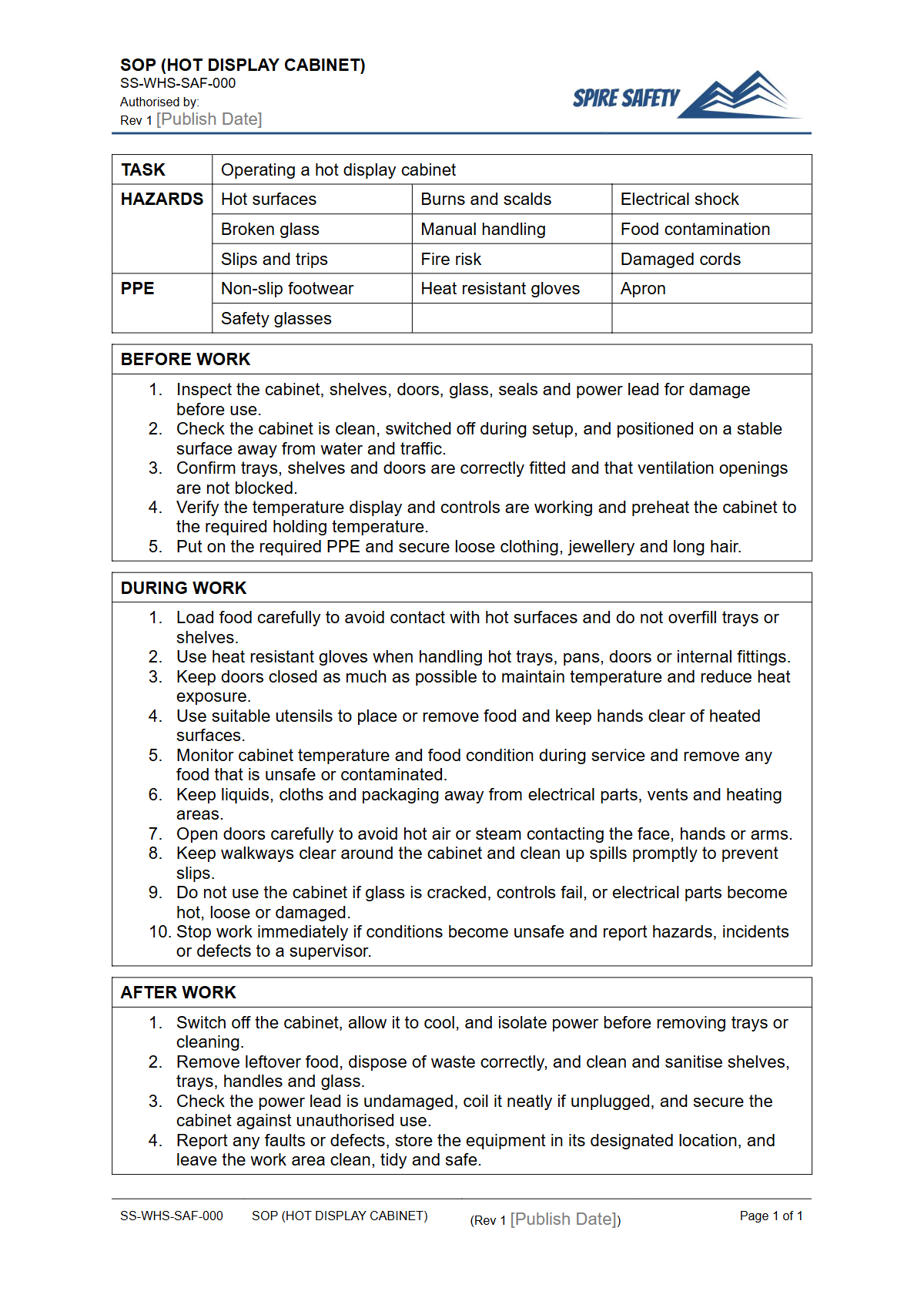
Download our free Safe Operating Procedure (Hot Display Cabinet) Template to define safe work practices for your team. Start standardising your safety today.
Free Safe Operating Procedure (Hot Display Cabinet) Template
DOCX • 126 KB + PDF
Updated Oct 2026
No signup required
Purpose of the Free Safe Operating Procedure (Hot Display Cabinet) Template
Operating commercial kitchen equipment like a hot display cabinet presents several risks, including severe burns, electrical hazards, and food safety breaches. This Free Safe Operating Procedure (Hot Display Cabinet) Template provides a structured starting point for your business to formally document the step-by-step processes required to use this equipment safely.
A well-drafted SOP is a critical tool for training staff, reducing the risk of injury, and demonstrating that your organisation is committed to providing a safe system of work.
By clearly defining pre-operational checks, safe operating steps, cleaning procedures, and emergency responses, you create a consistent standard for all workers. This helps minimise operational errors and ensures key safety and food handling requirements are met every time.
Integrating specific SOPs into broader WHS management systems establishes a proactive approach to workplace health and safety.
Video walkthrough
How to use the Free Safe Operating Procedure (Hot Display Cabinet) Template
This template is provided in both DOCX and PDF formats for your convenience. The DOCX version is fully editable, allowing you to tailor it to the unique circumstances of your workplace.
It is crucial to adapt the document to reflect the specific make and model of your hot display cabinet, your site layout, and any unique environmental factors.
Important: We have provided a comprehensive framework, but to be effective, you must customise this template. Review every section and add, remove, or modify steps to match your actual operational processes and risk controls.
Consult the manufacturer's instructions, conduct a site-specific risk assessment, and involve your workers in the customisation process to ensure the final SOP is practical and relevant. This process is similar to creating a Safe Operating Procedure for a deep fryer, where equipment-specific details are vital.
When to Use This Safe Operating Procedure
An SOP for a hot display cabinet should be a living document used consistently throughout your daily operations. Its primary uses include:
- New Employee Induction and Training: Use the SOP as a core training document to ensure new kitchen staff, servers, or supervisors understand the correct and safe way to operate the equipment from day one.
- Refresher Training: Regularly review the SOP with existing staff to reinforce safe work practices and communicate any procedural updates.
- Daily Operational Reference: Keep the SOP in an accessible location near the equipment so workers can quickly refer to it for pre-start checks, temperature monitoring, or cleaning instructions.
- Incident Investigation: Following a near miss or incident, the SOP serves as a benchmark to assess whether established procedures were followed and to identify areas for improvement.
Regularly reviewing the effectiveness of your SOPs is a key part of safety management. Periodic WHS compliance audits can help identify gaps between your documented procedures and actual work practices.
Who Should Use It
This Safe Operating Procedure is intended for use by a range of personnel within a food service environment, from the front line to management. Key users include:
- Kitchen Staff and Food Handlers: The primary users who are responsible for the day-to-day operation, loading, unloading, and cleaning of the hot display cabinet.
- Supervisors and Managers: Responsible for ensuring staff are trained on the SOP, monitoring its implementation, and initiating reviews or updates when necessary.
- WHS Representatives and Committees: Use the document as part of workplace inspections and risk management activities to verify that controls are in place and effective.
- Maintenance Personnel: Refer to the SOP for lockout/tagout procedures and other safety requirements before commencing maintenance or repair work.
If you need assistance in developing or implementing SOPs as part of a wider safety strategy, seeking expert WHS consulting can provide valuable guidance. You can also explore our extensive free WHS resources library for more templates and guides.
Common mistakes
Common mistakes to avoid
- Using the generic template without customising it for the specific equipment model and workplace.
- Failing to adequately train all relevant staff on the final, approved SOP.
- Neglecting to include specific temperature monitoring requirements and logs for food safety.
- Storing the SOP in an office instead of making it readily accessible to workers near the equipment.
Legal references
Legal considerations
The following legal requirements may be relevant to this type of work.
- Work Health and Safety Act (Harmonised) — Provides the primary duties for protecting workers and other people from work health and safety risks.
- Work Health and Safety Regulations (Harmonised) — Sets out requirements supporting the management of workplace hazards and risks.
The following codes may be relevant to this type of work.
- Managing WHS Risks Code of Practice — Provides practical guidance on identifying hazards, assessing risks and applying effective controls.
- Work Health and Safety Consultation, Cooperation and Coordination Code of Practice — Provides practical guidance on consulting workers and coordinating with other duty holders.
- Managing the Work Environment and Facilities Code of Practice — Provides practical guidance on safe work environments, workplace facilities and related controls.
Did you know
Temperature Danger Zone
The food safety 'danger zone' where bacteria multiply rapidly is between 5°C and 60°C. Australian food safety standards require hot food to be held at 60°C or above to prevent foodborne illness.
Burn Severity
Contact with a surface heated to 70°C can cause a severe third-degree burn in less than a second. Many components of a hot display cabinet, including glass and metal trays, can easily exceed this temperature.
FAQ
Frequently asked questions
01What are the main hazards associated with a hot display cabinet?
02How often should a hot display cabinet SOP be reviewed?
03Is a Safe Operating Procedure a legal requirement in Australia?
04Can I use this template for a cold food display or bain-marie?
Share this resource
Free Safe Operating Procedure (Hot Display Cabinet) Template
Browse Categories
How To Use It
- 1Download and open in Word or PDF.
- 2Replace the placeholders with your business details.
- 3Get it reviewed by a WHS specialist before rollout.
Need it customised?
Our WHS consultants can adapt this template to your site, run a gap analysis, or audit what you already have in place.
Book a Free Consultation WHS consulting servicesor call 1300 156 382
Related templates
- Free Safe Operating Procedure (Hot Melt Applicator) Template
- Free Safe Operating Procedure (Hot Oil Filtering) Template
- Free Safe Operating Procedure (Hot Plate) Template
- Free Safe Operating Procedure (Hot Sugar Handling) Template
- Free Safe Operating Procedure (Hot Water Urn) Template
- Free Safe Operating Procedure (Hotel Guest Room Setup) Template