
Free Safe Operating Procedure (Hot Melt Applicator) Template
Effectively manage thermal burn risks with our free Safe Operating Procedure (Hot Melt Applicator) Template. Download the customisable DOCX to start today.
Free Safe Operating Procedure (Hot Melt Applicator) Template
DOCX • 126 KB + PDF
Updated Oct 2026
No signup required
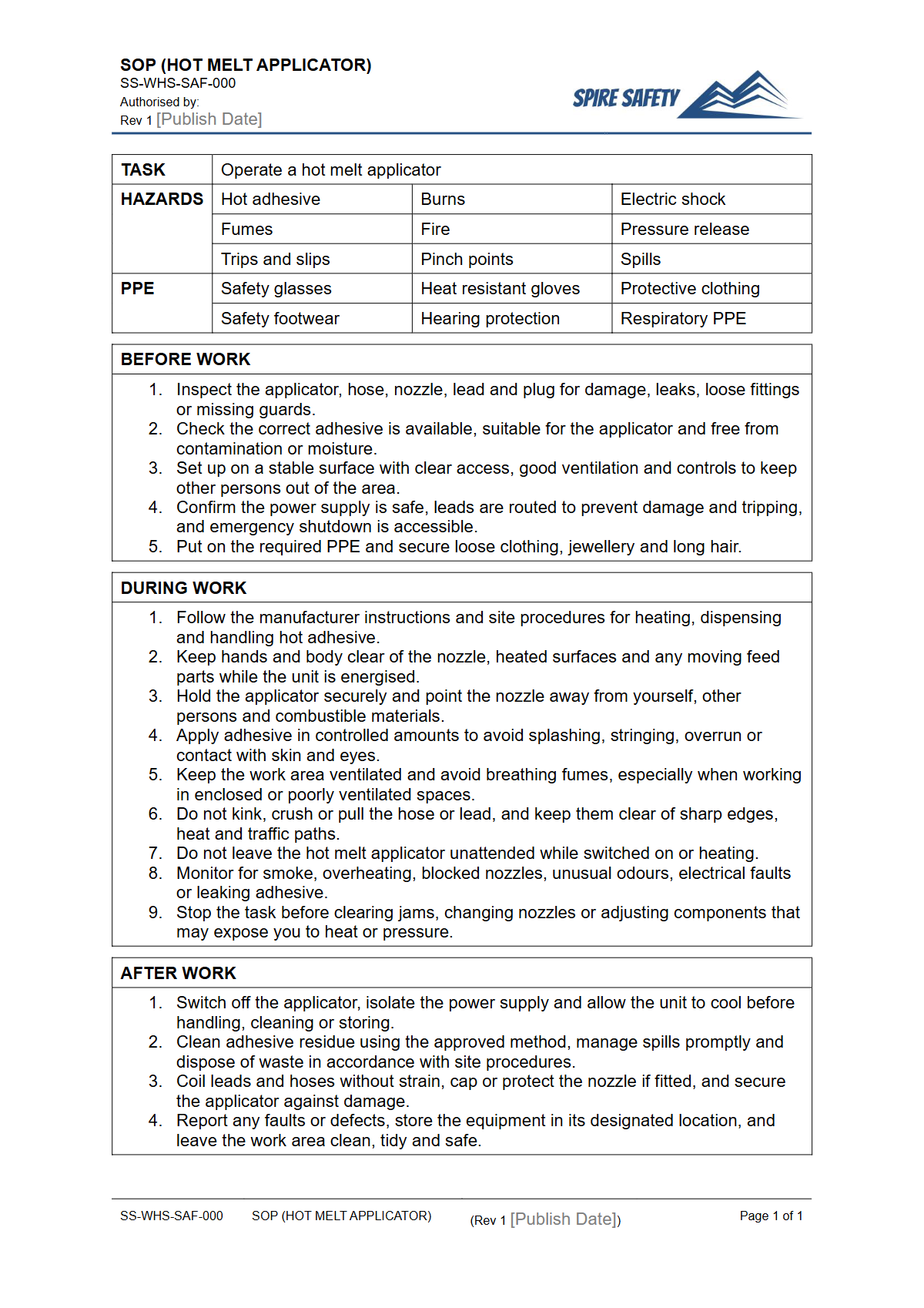
Purpose of the Free Safe Operating Procedure (Hot Melt Applicator) Template
This Free Safe Operating Procedure (Hot Melt Applicator) Template provides a structured starting point for documenting the safe use of hot melt glue guns in your workplace. Hot melt applicators are common in industries from packaging and manufacturing to construction and crafts, but they introduce significant risks, primarily severe thermal burns from molten adhesive and hot equipment surfaces.
Other hazards include electrical shock from faulty equipment, respiratory irritation from fumes, and slips from spilled adhesive. This SOP template helps you systematically identify these hazards, assess the risks, and implement effective control measures.
Using a standardised procedure ensures that all operators understand the required safety precautions, personal protective equipment (PPE), and emergency responses. It forms a key part of your safety management system, promoting consistent and safe work practices.
In many workplaces, hot melt applicators are used on production lines, which often require their own safety documentation like a Conveyer System SOP to manage associated risks.
Video walkthrough
How to use the Free Safe Operating Procedure (Hot Melt Applicator) Template
To effectively implement this Safe Operating Procedure (Hot Melt Applicator) Template, you must adapt it to your specific operational context. A generic document cannot account for the unique variables of your site, equipment, and personnel.
The process of customisation is as important as the final document itself, as it forces a thorough review of your work practices.
Follow these steps to integrate the template:
- Download and Review: Begin by downloading the DOCX version and familiarising yourself with its sections.
- Conduct a Risk Assessment: Evaluate your specific hot melt applicator model, the adhesives used, the work environment (especially ventilation), and the tasks being performed. Identify all potential hazards.
- Customise the Content: Populate the template with site-specific information. Include the make and model of the applicator, specific PPE requirements (e.g., brand/type of heat-resistant gloves), emergency contact details, and detailed, step-by-step instructions for your tasks.
- Train Your Team: Once finalised, use the SOP as a training tool for all new and existing operators. Ensure they understand every step and have an opportunity to ask questions. Document this training.
- Review and Update: The SOP should be a living document. Review it annually, after any incident or near-miss, or whenever a new applicator model, adhesive, or process is introduced.
Properly documented procedures are fundamental to demonstrating safety diligence. They form a critical component of robust WHS management systems, providing clear instructions and evidence of risk management.
Key Sections to Customise
Pay close attention to customising these critical areas of the template:
- Personal Protective Equipment (PPE): Go beyond generic terms. Specify the exact type of thermal-resistant gloves and AS/NZS-compliant safety glasses required.
- Pre-Operational Checks: Detail the daily checks operators must perform, such as inspecting the power cord for damage, ensuring the nozzle is clean and free of blockages, and checking the stand for stability.
- Safe Operation: Write clear, unambiguous steps for loading glue sticks, setting the correct temperature (if adjustable), applying adhesive safely, and preventing contact with the hot nozzle.
- Shutdown and Cleaning: Outline the procedure for powering down, allowing the tool to cool in a safe location away from flammable materials, and any cleaning requirements.
- Emergency Procedures: Clearly state the first aid response for thermal burns and the procedure for reporting an electrical fault or other equipment failure. While the hazard is different, the principles for managing high temperatures are similar to those in our Safe Operating Procedure for a Deep Fryer.
When to use it
A Safe Operating Procedure for a hot melt applicator should be consulted before any task involving the equipment. It is an essential document for worker inductions and task-specific training sessions.
Supervisors should use it as a benchmark for observing work practices and correcting unsafe behaviour. Furthermore, it serves as a valuable pre-start reference for operators to refresh their memory on key safety controls, particularly if they do not use the equipment frequently. In a workshop environment, these applicators are often used alongside other powered tools, each requiring its own procedure, such as our free Circular Saw SOP template.
Who should use it
This SOP is intended for several groups within an organisation. The primary users are the workers and operators who physically handle the hot melt applicator.
They rely on it for clear guidance on performing their job safely. Supervisors and team leaders are also key users, responsible for ensuring the procedures are followed, providing training, and leading incident investigations.
Finally, WHS managers and safety officers use the SOP as part of the broader risk management framework. Properly developed and implemented documented procedures are a key piece of evidence reviewed during a WHS compliance audit, demonstrating that the organisation has a formal process for managing equipment-related risks.
Developing comprehensive safety documentation tailored to your business can be complex. For expert assistance in developing and implementing your safety documents to align with Australian WHS standards, consider our WHS consulting services. You can also explore our complete free WHS resources library for more templates and guides.
Common mistakes
Common mistakes to avoid
- Using the wrong diameter or type of glue stick, which can cause jamming or damage to the applicator.
- Failing to wear appropriate heat-resistant gloves and safety glasses during operation.
- Resting a hot applicator on its side or on a flammable surface instead of using its designated stand.
- Not allowing the applicator to cool down completely in a safe location before storage.
Legal references
Legal considerations
The following legal requirements may be relevant to this type of work.
- Work Health and Safety Act (Harmonised) — Provides the primary duties for protecting workers and other people from work health and safety risks.
- Work Health and Safety Regulations (Harmonised) — Sets out requirements supporting the management of workplace hazards and risks.
The following codes may be relevant to this type of work.
- Managing WHS Risks Code of Practice — Provides practical guidance on identifying hazards, assessing risks and applying effective controls.
- Work Health and Safety Consultation, Cooperation and Coordination Code of Practice — Provides practical guidance on consulting workers and coordinating with other duty holders.
- Managing the Work Environment and Facilities Code of Practice — Provides practical guidance on safe work environments, workplace facilities and related controls.
Did you know
Adhesive Temperatures
Industrial hot melt applicators can heat adhesives to over 200°C. Contact at this temperature can cause immediate and severe third-degree burns.
Fume Hazard
Many common EVA (ethylene-vinyl acetate) hot melt adhesives can release vinyl acetate monomer fumes when heated. In poorly ventilated areas, these fumes can cause respiratory, eye, and skin irritation.
FAQ
Frequently asked questions
01What are the main hazards of using a hot melt applicator?
02What PPE is required for using a hot melt gun?
03How often should a Safe Operating Procedure be reviewed?
04Can this template be used for any brand of hot melt applicator?
Share this resource
Free Safe Operating Procedure (Hot Melt Applicator) Template
Browse Categories
How To Use It
- 1Download and open in Word or PDF.
- 2Replace the placeholders with your business details.
- 3Get it reviewed by a WHS specialist before rollout.
Need it customised?
Our WHS consultants can adapt this template to your site, run a gap analysis, or audit what you already have in place.
Book a Free Consultation WHS consulting servicesor call 1300 156 382
Related templates
- Free Safe Operating Procedure (Hot Oil Filtering) Template
- Free Safe Operating Procedure (Hot Plate) Template
- Free Safe Operating Procedure (Hot Sugar Handling) Template
- Free Safe Operating Procedure (Hot Water Urn) Template
- Free Safe Operating Procedure (Hotel Guest Room Setup) Template
- Free Safe Operating Procedure (Hotel Laundry Collection) Template