
Free Safe Operating Procedure (Hot Oil Filtering) Template
Manage high-risk kitchen tasks with our free Safe Operating Procedure (Hot Oil Filtering) template. Download your customisable DOCX and PDF resource today.
Free Safe Operating Procedure (Hot Oil Filtering) Template
DOCX • 126 KB + PDF
Updated Oct 2026
No signup required
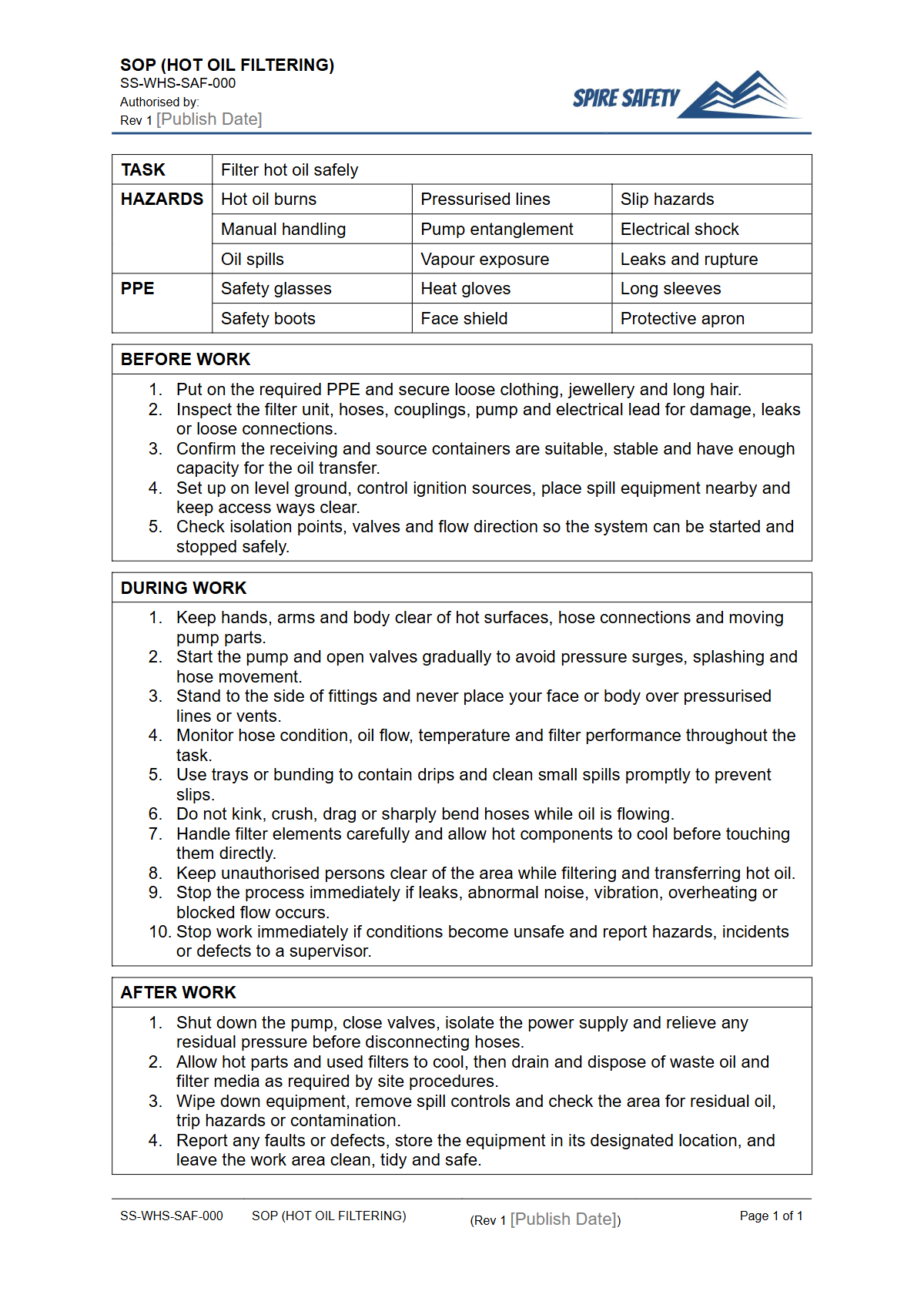
Purpose of the Free Safe Operating Procedure (Hot Oil Filtering) Template
Filtering hot oil is a high-risk activity common in commercial kitchens and food processing facilities. This task presents significant hazards, primarily severe thermal burns from splashes, slips and falls from oil spills, and the potential for fire.
Our Free Safe Operating Procedure (Hot Oil Filtering) Template provides a structured framework for documenting the required safety controls and work steps. Using this SOP helps your organisation formalise the process, ensuring tasks are performed safely and consistently, reducing the risk of injury and meeting your duty of care obligations under Australian WHS laws.
Key Elements of the SOP
This template is designed as a comprehensive starting point. It prompts you to detail specific information relevant to your workplace, including:
- Hazard Identification: Outlining potential risks such as hot surfaces, hot oil splashes, manual handling, and slip hazards.
- Personal Protective Equipment (PPE): Specifying required PPE like heat-resistant gloves, eye protection, face shields, aprons, and non-slip, enclosed footwear.
- Pre-operational Checks: Listing safety checks for the filtering machine, surrounding area, and transfer equipment before work commences.
- Step-by-step Procedure: A detailed, sequential guide for safely draining, filtering, and returning the oil.
- Post-operational Tasks: Instructions for cleaning equipment, managing waste oil, and tidying the work area.
- Emergency Procedures: Clear steps to follow in case of a burn, spill, or fire.
Documenting these steps is a critical part of managing workplace risks. For assistance in developing comprehensive risk assessments and procedures tailored to complex operations, our WHS consulting services can provide expert guidance.
Video walkthrough
How to use the Free Safe Operating Procedure (Hot Oil Filtering) Template
To effectively use this Safe Operating Procedure (Hot Oil Filtering) Template, download the DOCX file and adapt it to your specific operational context. It is crucial to involve workers who perform the task in the review and customisation process to ensure the procedure is practical and reflects the realities of the job.
This collaborative approach improves buy-in and effectiveness.
Important: This is a template, not a finished document. You must customise it to suit the specific make and model of your filtering equipment, the type of oil used, your workplace layout, and your emergency protocols.
We cannot guarantee its suitability for your specific circumstances without customisation. Properly integrated SOPs form a vital part of effective WHS management systems, helping to embed safe work practices into your organisation's culture.
When to use it
This SOP should be the primary reference document used every time hot oil filtering is performed. It serves as a practical tool for ensuring the task is completed according to established safety standards.
Beyond daily use, the SOP is essential for worker training, induction of new staff, and conducting competency assessments. It also provides a clear benchmark for behaviour and process during safety observations or incident investigations.
Furthermore, having documented procedures like this is fundamental during safety inspections. Regular WHS compliance auditing will verify that such procedures are not only in place but are also being actively used and followed by all relevant personnel.
Who should use it
This template is designed for anyone responsible for health and safety in environments where hot oil is handled. This includes Persons Conducting a Business or Undertaking (PCBUs), WHS managers, supervisors, and team leaders in sectors like hospitality, fast food, restaurants, and food manufacturing.
The procedure itself is for direct use by the workers (e.g., kitchen hands, cooks, process workers) who are authorised and trained to perform the task.
Many kitchens that filter hot oil also have deep fryers as the primary appliance. To complement this procedure, you may find our free Safe Operating Procedure for deep fryer operation a valuable addition to your safety documentation.
In larger food production settings, filtered oil might be used in processes involving automated machinery. Ensuring all high-risk equipment has a documented procedure is critical, and our free Conveyer System SOP can help manage risks associated with other common food manufacturing plant.
By implementing clear, specific SOPs for all high-risk tasks, your business demonstrates a proactive commitment to workplace safety. You can find more templates and checklists in our free WHS resources library to support your safety management efforts.
Common mistakes
Common mistakes to avoid
- Attempting to filter oil while it is still too hot, significantly increasing burn and fire risks.
- Using inadequate or damaged PPE, such as standard kitchen gloves instead of rated heat-resistant ones.
- Failing to clean up oil drips and spills immediately, creating dangerous slip hazards for others.
- Transferring hot oil in unsuitable containers that can melt, break, or are difficult to handle securely.
Legal references
Legal considerations
The following legal requirements may be relevant to this type of work.
- Work Health and Safety Act (Harmonised) — Provides the primary duties for protecting workers and other people from work health and safety risks.
- Work Health and Safety Regulations (Harmonised) — Sets out requirements supporting the management of workplace hazards and risks.
The following codes may be relevant to this type of work.
- Managing WHS Risks Code of Practice — Provides practical guidance on identifying hazards, assessing risks and applying effective controls.
- Work Health and Safety Consultation, Cooperation and Coordination Code of Practice — Provides practical guidance on consulting workers and coordinating with other duty holders.
- Managing the Work Environment and Facilities Code of Practice — Provides practical guidance on safe work environments, workplace facilities and related controls.
Did you know
Oil Temperature
The ideal temperature for filtering cooking oil is typically between 150°C and 175°C. Filtering oil that is too cool can be inefficient, while filtering it above this range significantly increases the risk of severe burns and autoignition.
Oil Lifespan
Regular filtering can double the lifespan of cooking oil. This not only represents a significant cost saving but also reduces waste and the manual handling risks associated with frequent oil replacement.
FAQ
Frequently asked questions
01What are the main hazards when filtering hot cooking oil?
02What PPE is required for filtering hot oil?
03How often should commercial cooking oil be filtered?
04Can I use this SOP template for any brand of oil filtering machine?
Share this resource
Free Safe Operating Procedure (Hot Oil Filtering) Template
Browse Categories
How To Use It
- 1Download and open in Word or PDF.
- 2Replace the placeholders with your business details.
- 3Get it reviewed by a WHS specialist before rollout.
Need it customised?
Our WHS consultants can adapt this template to your site, run a gap analysis, or audit what you already have in place.
Book a Free Consultation WHS consulting servicesor call 1300 156 382
Related templates
- Free Safe Operating Procedure (Hot Plate) Template
- Free Safe Operating Procedure (Hot Sugar Handling) Template
- Free Safe Operating Procedure (Hot Water Urn) Template
- Free Safe Operating Procedure (Hotel Guest Room Setup) Template
- Free Safe Operating Procedure (Hotel Laundry Collection) Template
- Free Safe Operating Procedure (Hotel Linen Cart) Template