
Free Safe Operating Procedure (Hose Reel Use) Template
Download our free Safe Operating Procedure for hose reel use to establish clear, safe work instructions. Get your customisable DOCX and PDF template today.
Free Safe Operating Procedure (Hose Reel Use) Template
DOCX • 126 KB + PDF
Updated Oct 2026
No signup required
Purpose of the Free Safe Operating Procedure (Hose Reel Use) Template
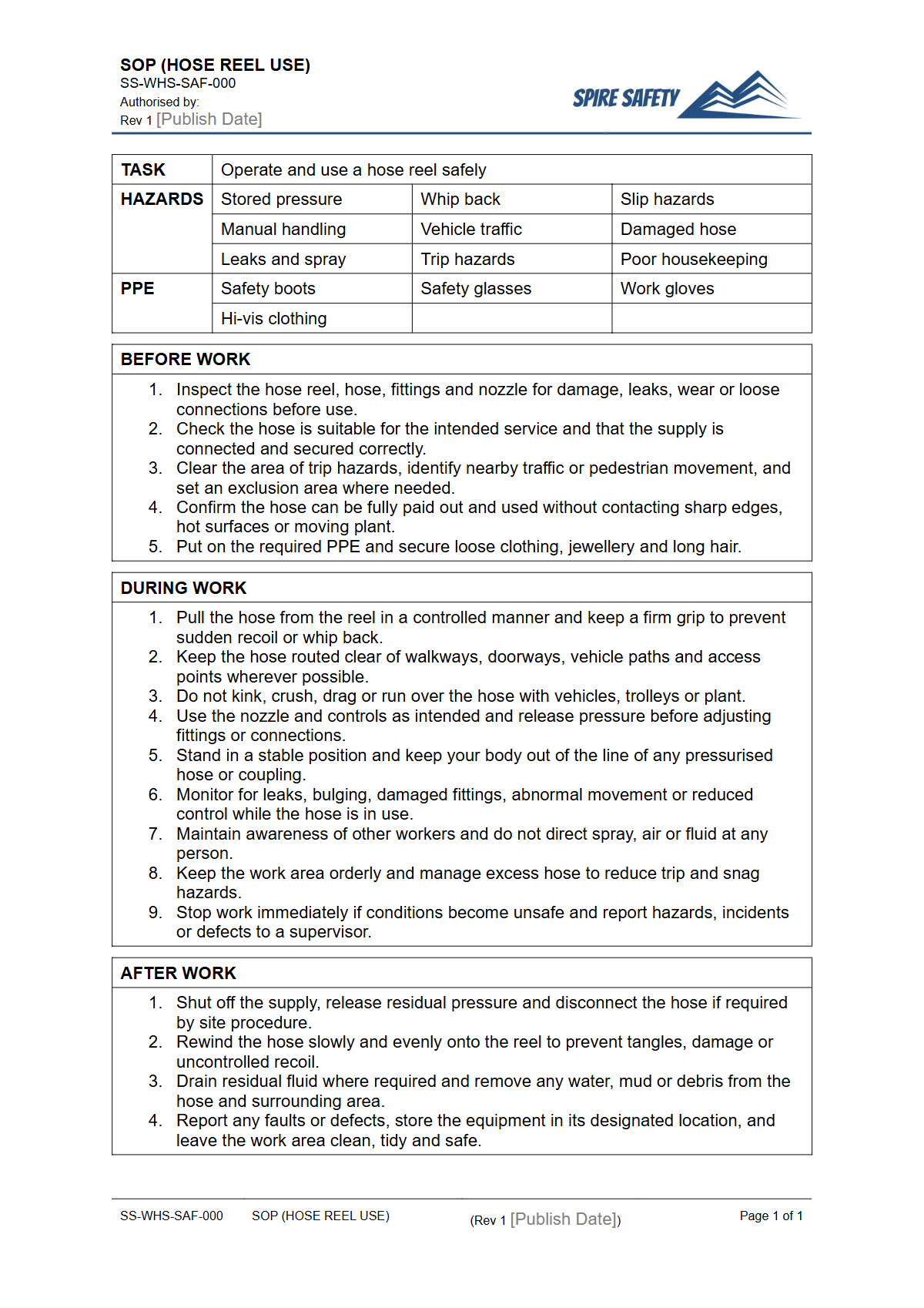
Hose reels are common in workshops, manufacturing sites, and agricultural settings, but they introduce specific workplace hazards if not managed correctly. This Free Safe Operating Procedure (Hose Reel Use) Template provides a structured starting point for organisations to document safe work methods.
It helps control risks such as slips and trips from trailing hoses, musculoskeletal injuries from incorrect pulling techniques, and impact injuries from uncontrolled hose retraction. A documented SOP ensures all workers follow a consistent, safe process, which is a fundamental part of managing workplace health and safety obligations.
Using a formal procedure demonstrates a commitment to proactively identifying and controlling risks. It serves as a key training tool for new employees and a refresher for existing staff, helping to embed a positive safety culture.
Integrating this SOP into your broader WHS management systems creates a more robust framework for operational safety and continuous improvement.
Video walkthrough
How to use the Free Safe Operating Procedure (Hose Reel Use) Template
This template is provided in both DOCX and PDF formats for your convenience. The DOCX file is fully editable, allowing you to tailor the content to the specific hose reels, tasks, and environmental conditions found in your workplace.
A generic template cannot cover all site-specific variables, so customisation is essential for it to be effective.
To use the template, download the file and follow these steps:
- Replace the placeholder text [Your Company Name] with your organisation's details.
- Review each section and add or remove steps to accurately reflect your operational processes.
- Incorporate details specific to your equipment, such as maximum pressure ratings, hose types (e.g., air, water, oil), and unique site hazards.
- Include any specific Personal Protective Equipment (PPE) required for the task.
- Consult with workers and supervisors who use the equipment to ensure the SOP is practical and reflects how the work is actually done.
Important Note: This document is a template only. It is not a substitute for a full risk assessment.
We provide this as a starting point; you must customise it to suit the specific equipment, environment, and tasks at your workplace to ensure it is effective in managing your WHS duties.
Implementing the Safe Operating Procedure
Once customised, the SOP should be formally approved and communicated to all relevant personnel. Make it easily accessible at the point of work, either as a hard copy laminate or digitally.
Ensure all operators receive training on the final procedure and that their understanding is verified. SOPs are critical documents that support other safety processes, such as developing a Free Air Compressor SOP for equipment commonly used with hose reels.
When to use this Safe Operating Procedure
A Safe Operating Procedure for hose reel use is not a document to be filed away and forgotten. It should be an active part of your daily safety management.
It is primarily used to provide clear, step-by-step instructions to workers before they perform a task. It should also be a core reference during worker inductions, task-specific training sessions, and toolbox talks.
Following an incident or near miss involving a hose reel, the SOP should be reviewed as part of the investigation to identify any gaps or areas for improvement. Regular reviews ensure it remains current with any changes in equipment or work practices. Performing routine checks against documented procedures is a key activity during WHS compliance auditing.
Who should use this Safe Operating Procedure
This SOP is intended for several key roles within an organisation. Primarily, it is for the operators—the workers who physically handle and use the hose reels daily.
They must understand and follow the procedure to ensure their own safety and the safety of others around them. Supervisors and team leaders also play a critical role; they must use the SOP to train their teams, monitor compliance, and enforce safe work practices.
Furthermore, WHS managers and safety officers will use this document as part of the overall safety system, for risk assessments, incident investigations, and training program development. Having clear SOPs for all common equipment, such as a FREE Circular Saw SOP Template for workshop tools, builds a comprehensive safety framework.
Ultimately, a well-drafted SOP helps a Person Conducting a Business or Undertaking (PCBU) fulfil their duty of care. For businesses with diverse equipment, maintaining a library of such documents is best practice.
You can find more templates like this one in our free WHS resources library to help build out your safety documentation.
Common mistakes
Common mistakes to avoid
- Failing to rewind the hose after use, creating a significant trip hazard.
- Pulling the hose out at an extreme angle, which strains the reel mechanism and guide arm.
- Not performing a quick visual inspection for cracks, leaks, or damage before pressurising the hose.
- Using a hose and reel assembly for pressures exceeding the manufacturer's specified rating.
Legal references
Legal considerations
The following legal requirements may be relevant to this type of work.
- Work Health and Safety Act (Harmonised) — Provides the primary duties for protecting workers and other people from work health and safety risks.
- Work Health and Safety Regulations (Harmonised) — Sets out requirements supporting the management of workplace hazards and risks.
The following codes may be relevant to this type of work.
- Managing WHS Risks Code of Practice — Provides practical guidance on identifying hazards, assessing risks and applying effective controls.
- Work Health and Safety Consultation, Cooperation and Coordination Code of Practice — Provides practical guidance on consulting workers and coordinating with other duty holders.
- Managing the Work Environment and Facilities Code of Practice — Provides practical guidance on safe work environments, workplace facilities and related controls.
Did you know
Trip Hazard Statistics
Slips, trips, and falls are a leading cause of serious workplace injuries in Australia. Trailing hoses left on walkways are a common and easily preventable contributor to these incidents.
Stored Retraction Energy
Spring-loaded retractable hose reels contain significant stored energy. If the hose is released suddenly or the latching mechanism fails, it can retract violently, causing the hose and its fitting to whip and create a serious impact hazard.
FAQ
Frequently asked questions
01What are the main hazards of using a hose reel?
02Is a Safe Operating Procedure legally required for a hose reel in Australia?
03How often should a hose reel SOP be reviewed?
04Can this template be used for fire hose reels?
Share this resource
Free Safe Operating Procedure (Hose Reel Use) Template
Browse Categories
How To Use It
- 1Download and open in Word or PDF.
- 2Replace the placeholders with your business details.
- 3Get it reviewed by a WHS specialist before rollout.
Need it customised?
Our WHS consultants can adapt this template to your site, run a gap analysis, or audit what you already have in place.
Book a Free Consultation WHS consulting servicesor call 1300 156 382
Related templates
- Free Safe Operating Procedure (Hose Skiving Machine) Template
- Free Safe Operating Procedure (Hospital Bed Movement) Template
- Free Safe Operating Procedure (Hospital Cot Cleaning) Template
- Free Safe Operating Procedure (Hot Air Welder) Template
- Free Safe Operating Procedure (Hot Display Cabinet) Template
- Free Safe Operating Procedure (Hot Melt Applicator) Template