
Free Safe Operating Procedure (Hose Skiving Machine) Template
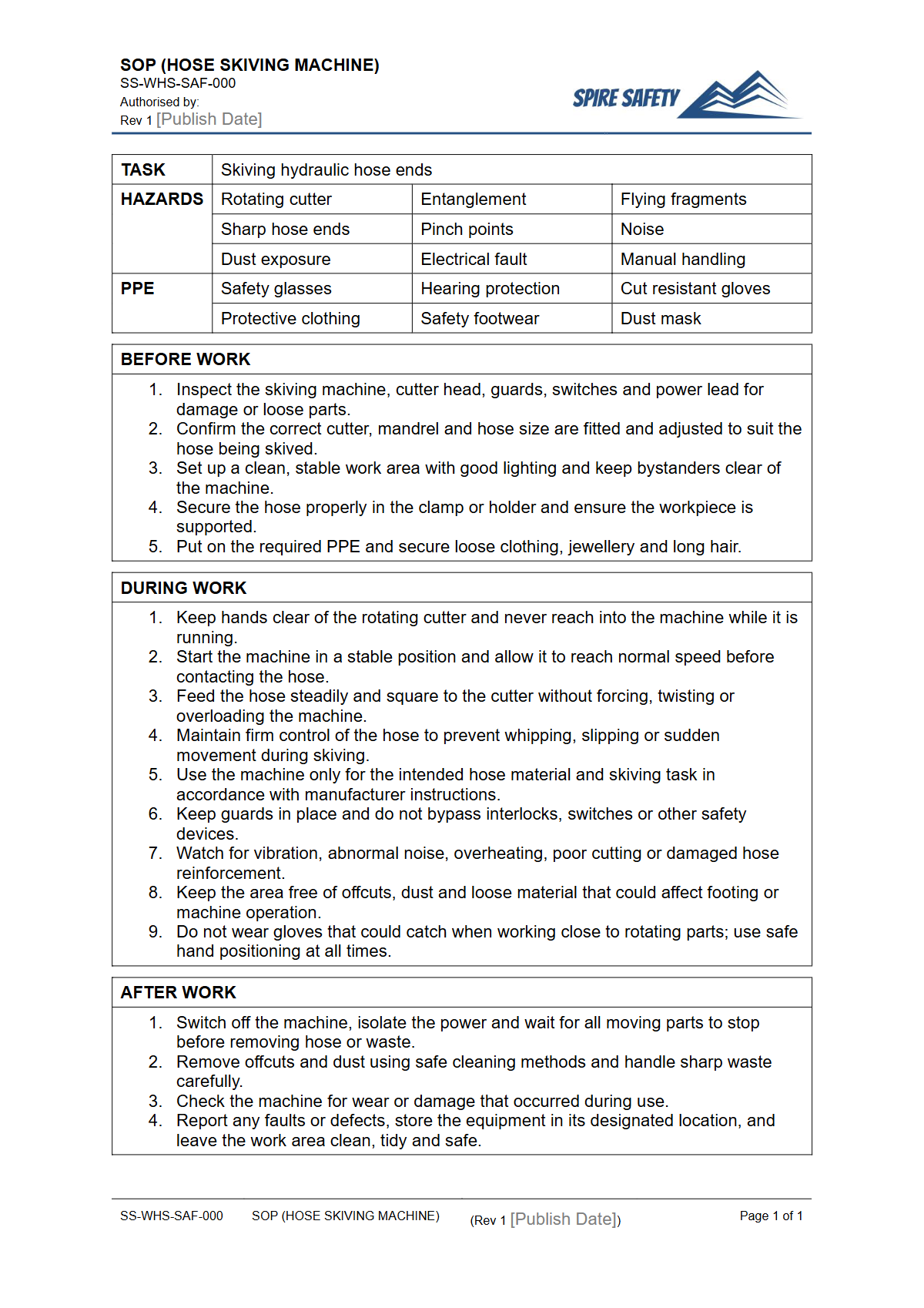
Download our free Safe Operating Procedure (Hose Skiving Machine) template. This customisable document helps you outline safe work practices for your team.
Free Safe Operating Procedure (Hose Skiving Machine) Template
DOCX • 126 KB + PDF
Updated Oct 2026
No signup required
Purpose of the Free Safe Operating Procedure (Hose Skiving Machine) Template
This free Safe Operating Procedure (Hose Skiving Machine) template provides a structured starting point for documenting the safe use of hose skiving equipment in your workplace. A documented SOP is a critical tool for managing risks, ensuring tasks are performed consistently, and meeting your duty of care under Australian WHS laws.
It formalises a safe system of work, helping to prevent serious injuries associated with this type of machinery.
Using a hose skiving machine introduces significant hazards that must be controlled. An effective SOP provides clear, step-by-step instructions that guide operators through pre-operational checks, safe operation, and shutdown procedures. This process helps integrate safety directly into your operational workflow and forms a key part of your overall WHS management systems.
Key Hazards to Address
When customising this template, you must address all foreseeable hazards associated with your specific machine, including:
- Entanglement: Rotating mandrels, spindles, or cutting heads can catch loose clothing, hair, or jewellery.
- Cutting and Laceration: Contact with the sharp cutting blade can cause severe injuries.
- Projectiles: Small pieces of metal wire or rubber can be ejected at high speed during the skiving process, posing a risk to the eyes.
- Hydraulic Fluid Injection: If working with hydraulic hoses, high-pressure fluid injection injuries are a serious risk, requiring immediate medical attention.
- Noise: Prolonged exposure to machine noise can lead to hearing loss if not managed with appropriate controls.
Video walkthrough
How to use the Free Safe Operating Procedure (Hose Skiving Machine) Template
This downloadable document provides a framework aligned with Australian WHS practice. It is not a complete, ready-to-use procedure.
You must adapt it to the specific context of your work environment.
Important: Before implementation, this template must be customised by a competent person. You must consult with your workers to identify all task-specific hazards and document safe control measures.
This includes referencing the manufacturer's operating manual for your particular hose skiving machine model. We are not liable for any incidents arising from the use of this uncustomised document.
Integrating the SOP into Your Safety System
Once customised, the SOP should be used as a primary training document for new and existing workers. Ensure it is readily accessible to operators at or near the machine.
The procedures outlined should be regularly monitored by supervisors and reviewed after any incident or when changes to the equipment or process occur. This systematic approach is also crucial for other common workshop equipment, as shown in our Free Air Compressor SOP (Safe Operating Procedure) Template.
When to use a Safe Operating Procedure
A Safe Operating Procedure for a hose skiving machine should be used consistently for several key activities. Its primary function is to guide the day-to-day, routine operation of the equipment, ensuring every step is performed safely.
It is an essential resource during worker induction and task-specific training, providing a clear benchmark for competency. Furthermore, the SOP serves as a critical reference tool during safety conversations, toolbox talks, and refresher training sessions to reinforce safe work habits.
It also provides a documented procedure that can be referenced during formal WHS compliance auditing to verify that safe systems of work are in place and being followed.
Who should use this SOP
The primary users of this SOP are the machine operators themselves. Having clear, accessible instructions helps them perform their tasks safely and consistently, reducing the risk of error and injury.
Supervisors and managers should also use the SOP to conduct training, verify competency, and monitor that the documented procedures are being followed correctly. Finally, WHS managers and safety personnel will use the customised SOP as a cornerstone of the site's safety documentation, using it for risk assessments and incident investigations. The principles of creating clear, task-specific SOPs apply to a wide range of machinery, including those covered by our FREE Circular Saw SOP (Safe Operating Procedure) Template.
Documenting procedures for all high-risk plant is a fundamental aspect of workplace safety. Just as a hose skiver requires specific instructions, so does other interconnected equipment that might be found in the same production line, such as those detailed in our FREE Conveyer System SOP (Safe Operating Procedure) Template. You can find more templates like this in our complete free WHS resources library to help build out your safety management system.
Common mistakes
Common mistakes to avoid
- Failing to properly customise the template for the specific machine model and workplace hazards.
- Neglecting to include detailed pre-start inspection and shutdown procedures.
- Using incorrect skiving diameter or depth settings for the hose type, leading to faulty connections.
- Providing the SOP without practical, hands-on training and competency verification for operators.
Legal references
Legal considerations
The following legal requirements may be relevant to this type of work.
- Work Health and Safety Act (Harmonised) — Provides the primary duties for protecting workers and other people from work health and safety risks.
- Work Health and Safety Regulations (Harmonised) — Sets out requirements supporting the management of workplace hazards and risks.
The following codes may be relevant to this type of work.
- Managing WHS Risks Code of Practice — Provides practical guidance on identifying hazards, assessing risks and applying effective controls.
- Work Health and Safety Consultation, Cooperation and Coordination Code of Practice — Provides practical guidance on consulting workers and coordinating with other duty holders.
- Managing the Work Environment and Facilities Code of Practice — Provides practical guidance on safe work environments, workplace facilities and related controls.
Did you know
Hydraulic Hose Dangers
A pinhole leak in a hydraulic hose can release fluid at over 600 feet per second. This fluid can penetrate skin and cause severe chemical burns and tissue damage, often requiring surgery.
Machine Guarding
Inadequate machine guarding is consistently one of the most frequently cited safety violations in manufacturing and workshop environments across Australia. A good SOP will include checks to ensure all guards are in place and functional.
FAQ
Frequently asked questions
01What is a Safe Operating Procedure for a hose skiving machine?
02What personal protective equipment (PPE) is typically required for hose skiving?
03Why is training so important for operating this type of machinery?
04How often should a hose skiving machine SOP be reviewed?
Share this resource
Free Safe Operating Procedure (Hose Skiving Machine) Template
Browse Categories
How To Use It
- 1Download and open in Word or PDF.
- 2Replace the placeholders with your business details.
- 3Get it reviewed by a WHS specialist before rollout.
Need it customised?
Our WHS consultants can adapt this template to your site, run a gap analysis, or audit what you already have in place.
Book a Free Consultation WHS consulting servicesor call 1300 156 382
Related templates
- Free Safe Operating Procedure (Hospital Bed Movement) Template
- Free Safe Operating Procedure (Hospital Cot Cleaning) Template
- Free Safe Operating Procedure (Hot Air Welder) Template
- Free Safe Operating Procedure (Hot Display Cabinet) Template
- Free Safe Operating Procedure (Hot Melt Applicator) Template
- Free Safe Operating Procedure (Hot Oil Filtering) Template