
Free Safe Operating Procedure (Horse Feeding) Template
Download our free Safe Operating Procedure (Horse Feeding) Template to manage risks associated with animal handling. Customise this structured DOCX or PDF.
Free Safe Operating Procedure (Horse Feeding) Template
DOCX • 126 KB + PDF
Updated Oct 2026
No signup required
Purpose of the Free Safe Operating Procedure (Horse Feeding) Template
Effectively managing the risks associated with animal handling is a critical part of workplace safety, especially in agricultural and equestrian settings. This free Safe Operating Procedure (Horse Feeding) Template provides a structured starting point for documenting the risks and control measures for this common but potentially hazardous task.
The primary purpose of this document is to help persons conducting a business or undertaking (PCBUs) formally document a safe system of work.
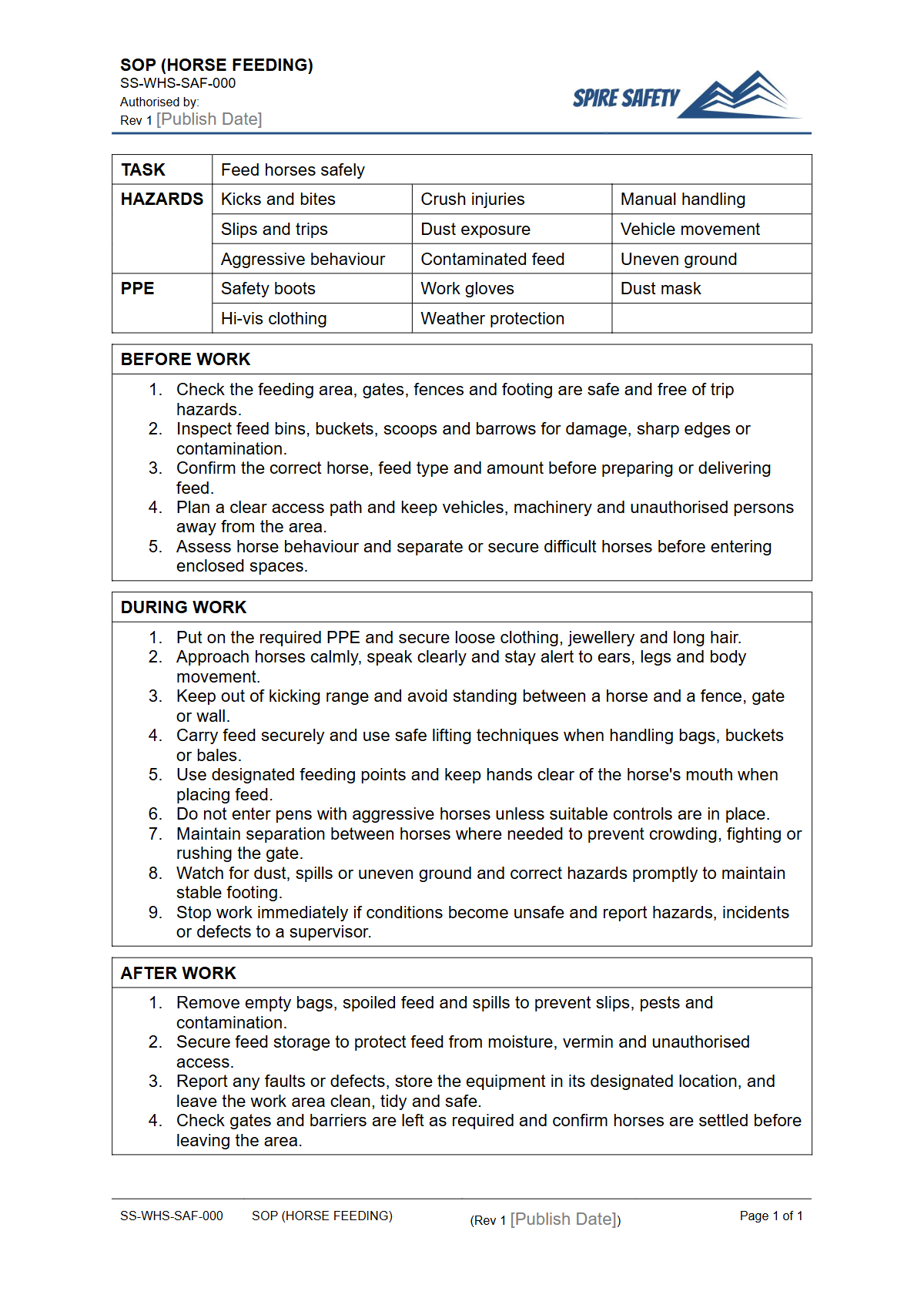
It guides workers through the step-by-step process of feeding horses, highlighting key hazards like bites, kicks, crushing, and musculoskeletal injuries from lifting heavy feed bags. A well-developed Safe Operating Procedure is a fundamental component of robust WHS management systems, demonstrating a commitment to proactive risk management.
Key Elements of the Horse Feeding Safe Operating Procedure
This template is structured to prompt you to consider several critical safety elements, ensuring a comprehensive approach to the task:
- Pre-operational checks: Verifying the work area is clear of hazards, gates are functional, the correct feed is prepared, and the horses' behaviour is assessed before entry.
- Step-by-step procedure: Outlining the safest sequence for approaching the horse(s), distributing feed, and safely exiting the enclosure or paddock.
- Hazard identification: Listing potential risks at each stage, such as unpredictable animal behaviour, crush zones near gates, ergonomic hazards from lifting, and slips or trips.
- Control measures: Specifying actions to eliminate or minimise each identified risk, such as using specific entry/exit points, not feeding large groups in confined spaces, and using mechanical aids for heavy feed.
- Personal Protective Equipment (PPE): Detailing required gear such as steel-capped boots, gloves, and high-visibility clothing where necessary.
Video walkthrough
How to use the Free Safe Operating Procedure (Horse Feeding) Template
To get the most value from this free Safe Operating Procedure (Horse Feeding) Template, you must adapt it to the specific conditions of your workplace. Download the DOCX file and customise it with details about your site, your specific horses, the types of feed used, and the layout of your paddocks or stables.
This is a template, not a finished document. We are not there to observe your operations, so you must ensure the final SOP reflects your actual processes and controls. This includes consulting with your workers who perform the task. If you require assistance in adapting this document or developing more complex safety procedures, our WHS consulting team can provide expert support.
When to use it
A Safe Operating Procedure for horse feeding should be used consistently for every feeding task. It is particularly important when:
- Inducting new staff, volunteers, or contractors.
- Providing refresher training for existing workers.
- Investigating an incident or near-miss related to feeding.
- Reviewing and updating your safety procedures, which should occur regularly or whenever a process, equipment, or location changes.
The principles of documenting procedures for high-risk tasks are consistent across many agricultural activities, similar to the process for developing a Grain Drill SOP.
Who should use it
This template is designed for a broad range of users in rural and equestrian industries, including:
- Farm and Station Owners: To establish and enforce safe work practices for all personnel.
- Stable and Agistment Managers: To ensure consistent safety standards for all staff and clients who handle horses.
- Equestrian Coaches and Trainers: To teach students and staff safe horse handling from the ground up as part of their training.
- WHS Officers and Managers: As a foundation for integrating animal handling into the broader safety system.
Documenting tasks involving animals is just as important as documenting procedures for machinery, such as those covered in our FREE Spreader SOP (Safe Operating Procedure) Template.
Benefits of a Documented Procedure
Implementing a formal SOP for horse feeding offers several key benefits beyond simple compliance. It creates a clear, teachable standard that reduces ambiguity and the likelihood of incidents caused by inconsistent practices or assumptions.
It also serves as a valuable record during safety audits, demonstrating that risks have been identified and managed. A library of well-maintained procedures is a hallmark of a mature safety culture. You can browse more examples in our free WHS resources library.
Common mistakes
Common mistakes to avoid
- Assuming all horses have the same temperament and can be handled identically.
- Failing to properly secure gates and enclosures before, during, and after feeding.
- Not checking feed for mould, contaminants, or foreign objects before giving it to the horses.
- Working alone in isolated areas without a communication or check-in procedure in place.
Legal references
Legal considerations
The following legal requirements may be relevant to this type of work.
- Work Health and Safety Act (Harmonised) — Provides the primary duties for protecting workers and other people from work health and safety risks.
- Work Health and Safety Regulations (Harmonised) — Sets out requirements supporting the management of workplace hazards and risks.
The following codes may be relevant to this type of work.
- Managing WHS Risks Code of Practice — Provides practical guidance on identifying hazards, assessing risks and applying effective controls.
- Work Health and Safety Consultation, Cooperation and Coordination Code of Practice — Provides practical guidance on consulting workers and coordinating with other duty holders.
- Managing the Work Environment and Facilities Code of Practice — Provides practical guidance on safe work environments, workplace facilities and related controls.
Did you know
Horse Vision
Horses have a blind spot directly in front of their face and directly behind their tail. Approaching a horse from these areas can startle it, increasing the risk of a defensive reaction like kicking or bolting.
FAQ
Frequently asked questions
01Why is a Safe Operating Procedure needed for feeding horses?
02What are the main hazards when feeding horses?
03Who is responsible for creating and implementing a horse feeding SOP?
04Can I use this template for feeding other livestock?
Share this resource
Free Safe Operating Procedure (Horse Feeding) Template
Browse Categories
How To Use It
- 1Download and open in Word or PDF.
- 2Replace the placeholders with your business details.
- 3Get it reviewed by a WHS specialist before rollout.
Need it customised?
Our WHS consultants can adapt this template to your site, run a gap analysis, or audit what you already have in place.
Book a Free Consultation WHS consulting servicesor call 1300 156 382
Related templates
- Free Safe Operating Procedure (Horse Stable Cleaning) Template
- Free Safe Operating Procedure (Horticultural Grafting) Template
- Free Safe Operating Procedure (Hose Blowout) Template
- Free Safe Operating Procedure (Hose Crimp Machine) Template
- Free Safe Operating Procedure (Hose Cutoff Saw) Template
- Free Safe Operating Procedure (Hose Flushing) Template