
Free Safe Operating Procedure (Hose Blowout) Template
Effectively manage the risks of high-pressure hose failures with our free Safe Operating Procedure. Download our customisable hose blowout SOP template today.
Free Safe Operating Procedure (Hose Blowout) Template
DOCX • 126 KB + PDF
Updated Oct 2026
No signup required
Purpose of the Free Safe Operating Procedure (Hose Blowout) Template
A sudden hose blowout, whether from a hydraulic, pneumatic, or other pressurised system, poses a severe risk in many industrial and agricultural workplaces. This event can cause catastrophic equipment failure, high-pressure fluid injection injuries, violent hose whiplash, and slip hazards from spilled fluids.
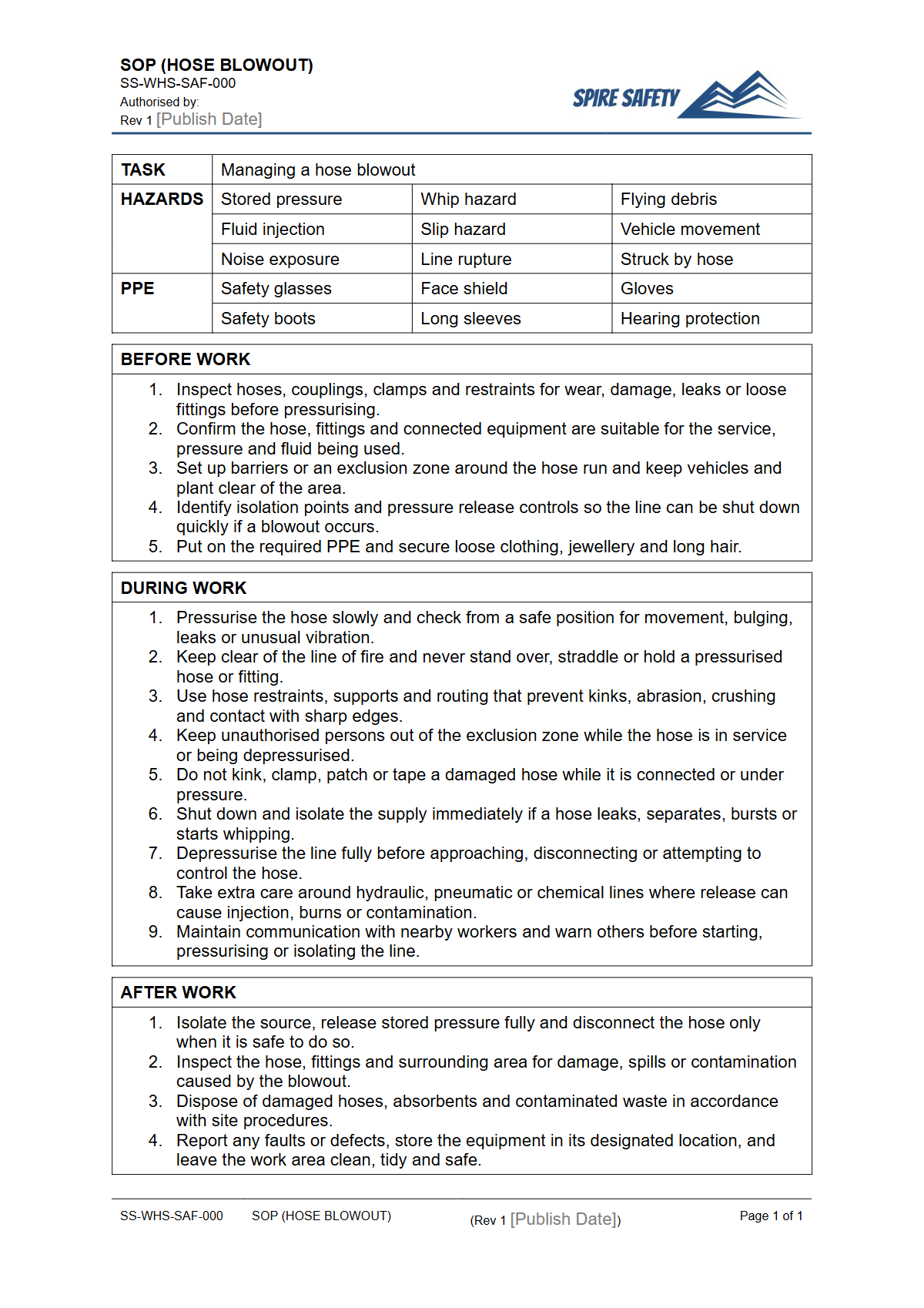
Our Free Safe Operating Procedure (Hose Blowout) Template provides a structured framework for documenting the specific steps required to minimise these risks. It guides your organisation in establishing clear, repeatable instructions for pre-operational checks, safe operation, and emergency response, forming a critical part of your overall safety management system.
Using a documented SOP helps demonstrate compliance with an organisation's duty of care under Australian WHS laws by ensuring tasks involving pressurised systems are performed safely and consistently. This is particularly important for equipment that relies heavily on pressurised air, such as that detailed in our Free Air Compressor SOP template.
Key Elements in the Hose Blowout SOP
This Safe Operating Procedure template is designed to be comprehensive, covering the entire work cycle to ensure all aspects of the task are considered. The downloadable document includes sections for:
- Required Personal Protective Equipment (PPE): Specifies necessary gear like safety glasses, gloves, and protective clothing to guard against fluid spray and other hazards.
- Pre-Operational Checks: Outlines a checklist for inspecting hoses, fittings, couplings, and guards for signs of wear, abrasion, or damage before starting work. This is a crucial step in preventing failures.
- Safe Operating Steps: Details the correct sequence for operating the equipment, including startup, operation, and shutdown procedures that minimise stress on the system.
- Emergency Response: Provides a clear action plan for workers to follow in the event of a hose blowout, covering immediate steps to shut down equipment, isolate energy sources, and provide first aid.
- Post-Incident Procedures: Includes steps for reporting the incident, securing the area, and initiating an investigation to prevent recurrence.
Properly documenting these steps is fundamental to building robust WHS management systems that actively prevent incidents rather than just reacting to them.
Video walkthrough
How to use the Free Safe Operating Procedure (Hose Blowout) Template
This resource is provided as a DOCX file for easy editing and a PDF for straightforward printing and distribution. It is essential to understand that this is a template, not a finished document.
To be effective, you must customise it to your specific workplace.
Important: We have created this template as a starting point. You must consult with your workers and adapt the content to reflect the unique hazards and control measures relevant to your site's specific equipment, hose types, operating pressures, and work environment.
A generic document will not adequately control your specific risks.
For organisations that handle a wide array of heavy machinery, maintaining consistent safety documentation is key. This SOP can be used alongside others, such as a Grader SOP template, to build a cohesive safety library.
When to use it
A Safe Operating Procedure for hose blowouts should be developed and implemented for any task involving pressurised hoses. It serves as a primary reference document for worker training, inductions, and competency assessments.
The SOP should be readily accessible in the work area where the task is performed, not locked away in an office. It is also an invaluable tool during safety meetings, toolbox talks, and incident investigations to reinforce correct procedures and identify areas for improvement.
Regular reviews of your SOPs are a key activity checked during a WHS compliance audit, ensuring your safety documents remain current and effective.
Who should use it
This SOP is intended for several groups within an organisation. Primarily, equipment operators and maintenance personnel who directly interact with pressurised systems must be trained on and follow the procedure.
Supervisors and managers should also use the SOP to oversee work, conduct safety observations, and supports your compliance efforts. Furthermore, WHS professionals and safety committees can use this template as a basis for conducting risk assessments, developing training programs, and standardising safety practices across the business, including for complex machinery like that covered in our FREE Telehandler SOP Template.
If you require assistance in developing site-specific procedures or integrating them into your existing safety framework, our WHS consulting team can provide expert guidance. We encourage you to explore our complete free WHS resources library for more templates and guides to support your safety goals.
Common mistakes
Common mistakes to avoid
- Using a generic SOP without customising it for site-specific equipment and pressures.
- Failing to conduct and document pre-use inspections of hoses and fittings.
- Not training workers in the specific emergency response for a blowout, including shutdown and first aid.
- Storing the SOP in an office instead of making it readily accessible at the point of work.
Legal references
Legal considerations
The following legal requirements may be relevant to this type of work.
- Work Health and Safety Act (Harmonised) — Provides the primary duties for protecting workers and other people from work health and safety risks.
- Work Health and Safety Regulations (Harmonised) — Sets out requirements supporting the management of workplace hazards and risks.
The following codes may be relevant to this type of work.
- Managing WHS Risks Code of Practice — Provides practical guidance on identifying hazards, assessing risks and applying effective controls.
- Work Health and Safety Consultation, Cooperation and Coordination Code of Practice — Provides practical guidance on consulting workers and coordinating with other duty holders.
- Managing the Work Environment and Facilities Code of Practice — Provides practical guidance on safe work environments, workplace facilities and related controls.
Did you know
Injection Injury Risk
A high-pressure fluid stream from a pinhole leak in a hydraulic hose can inject fluid deep into body tissue, even through protective gear. These injuries are a medical emergency and can lead to amputation if not treated immediately.
Hose Whiplash
When a pressurised hose detaches or bursts, the stored energy can cause it to whip around with extreme force, capable of causing severe impact injuries, fractures, or even death to anyone nearby.
FAQ
Frequently asked questions
01What is a hose blowout?
02Why is a Safe Operating Procedure for hose blowouts necessary?
03How often should our hose blowout SOP be reviewed?
04Can I use this template for both hydraulic and pneumatic hoses?
Share this resource
Free Safe Operating Procedure (Hose Blowout) Template
Browse Categories
How To Use It
- 1Download and open in Word or PDF.
- 2Replace the placeholders with your business details.
- 3Get it reviewed by a WHS specialist before rollout.
Need it customised?
Our WHS consultants can adapt this template to your site, run a gap analysis, or audit what you already have in place.
Book a Free Consultation WHS consulting servicesor call 1300 156 382
Related templates
- Free Safe Operating Procedure (Hose Crimp Machine) Template
- Free Safe Operating Procedure (Hose Cutoff Saw) Template
- Free Safe Operating Procedure (Hose Flushing) Template
- Free Safe Operating Procedure (Hose Reel Use) Template
- Free Safe Operating Procedure (Hose Skiving Machine) Template
- Free Safe Operating Procedure (Hospital Bed Movement) Template