
Free Safe Operating Procedure (Horticultural Grafting) Template
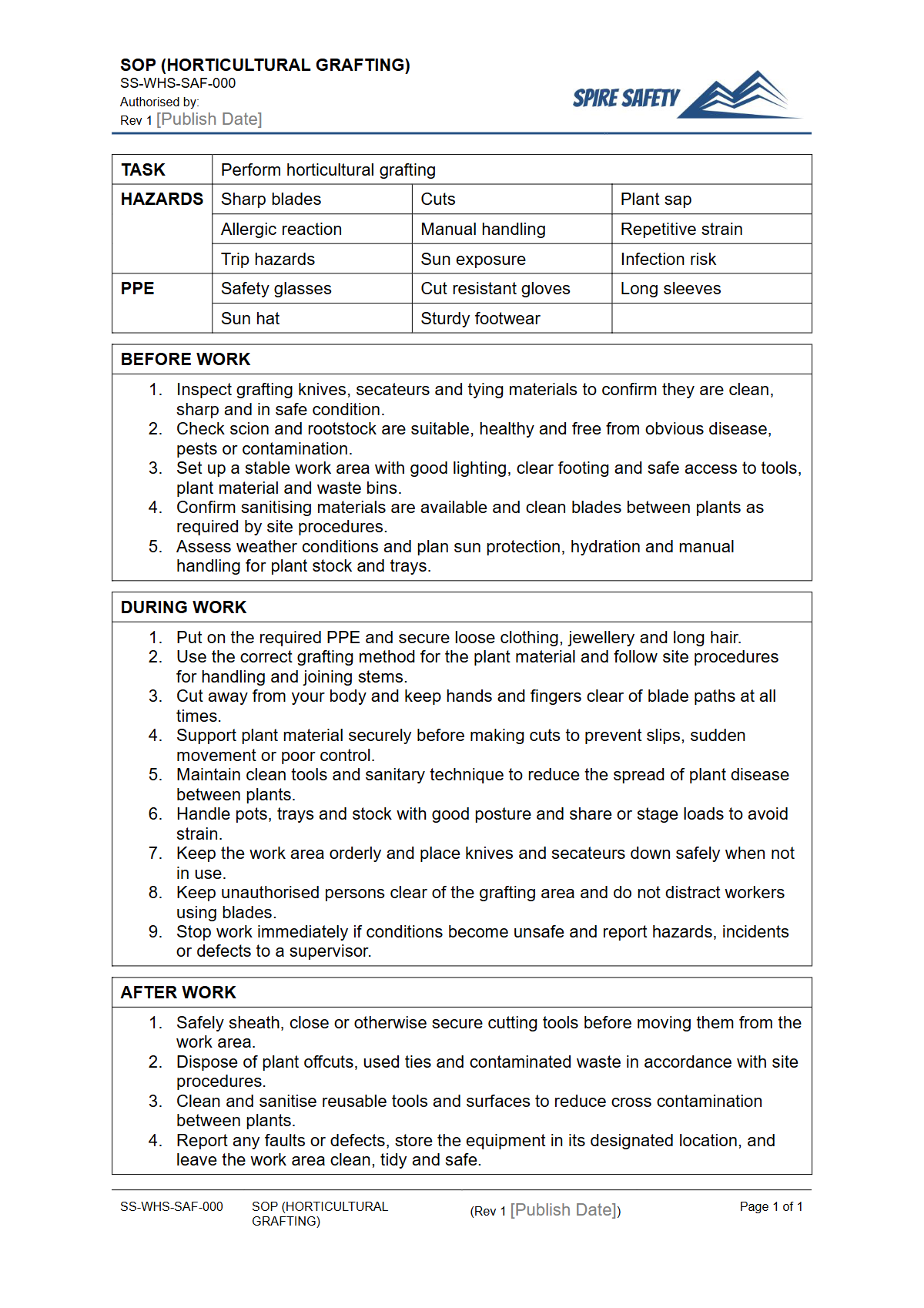
Download our free Safe Operating Procedure for horticultural grafting to standardise your high-risk tasks. This template helps formalise safety controls.
Free Safe Operating Procedure (Horticultural Grafting) Template
DOCX • 126 KB + PDF
Updated Oct 2026
No signup required
Purpose of the Free Safe Operating Procedure (Horticultural Grafting) Template
Horticultural grafting, while a common practice in nurseries, orchards, and agricultural settings, involves significant risks. Workers are exposed to hazards such as severe cuts from sharp knives, repetitive strain injuries, and potential exposure to plant saps or chemicals.
This Free Safe Operating Procedure (Horticultural Grafting) Template provides a structured framework to help businesses identify these risks and implement effective controls. A documented SOP ensures that safety measures are consistently applied, helping your organisation meet its duty of care under Australian WHS laws.
By formalising your grafting process, you create a clear, repeatable system of work that minimises ambiguity and reduces the likelihood of incidents. It serves as a vital training tool for new and existing employees, ensuring everyone understands the established safety protocols.
Integrating this SOP into your operations helps build a stronger safety culture, where managing risks is a shared responsibility. Properly documented procedures are a cornerstone of effective WHS management systems, demonstrating a proactive approach to workplace safety.
Video walkthrough
How to use the Free Safe Operating Procedure (Horticultural Grafting) Template
This template is provided in both DOCX and PDF formats for your convenience. The DOCX version is fully editable, allowing you to tailor the content to the specific circumstances of your workplace.
To use it effectively, download the file and systematically work through each section, replacing the placeholder text with details relevant to your grafting operations.
Consider the exact types of grafting knives and tools used, the specific plant species being worked on, the personal protective equipment (PPE) required, and the unique environmental conditions of your site. Involve workers who perform the task in the customisation process; their direct experience is invaluable for identifying practical risks and effective controls.
Once completed, the SOP should be formally approved, communicated to all relevant personnel, and made easily accessible at the point of work.
IMPORTANT: This is a template only. We have developed it as a structured starting point, but you MUST customise it to reflect the specific tools, equipment, environment, and personnel in your workplace.
Generic procedures are insufficient for managing site-specific risks.
What to Include in Your SOP
A comprehensive SOP for horticultural grafting should cover several key areas to be effective. Ensure your customised document includes:
- Hazard Identification: List all potential hazards, such as cuts, punctures, musculoskeletal strain, chemical exposure, and biological hazards.
- Risk Control Measures: For each hazard, specify the control measures to be implemented. This includes selecting appropriate tools, mandating cut-resistant gloves, ensuring ergonomic workstations, and providing proper ventilation.
- Personal Protective Equipment (PPE): Clearly define the mandatory PPE, such as safety glasses, cut-resistant gloves, and appropriate footwear.
- Pre-Operational Checks: Outline the checks that must be performed before starting work, such as inspecting knives for sharpness and damage, and ensuring the work area is clean and organised.
- Step-by-Step Procedure: Detail the grafting process sequentially, from tool sterilisation and stock preparation to the final binding of the graft. This methodical approach is similar to what is outlined in a FREE Planter SOP (Safe Operating Procedure) Template, ensuring consistency and safety at every stage.
- Emergency Procedures: Include instructions for responding to incidents, such as first aid for cuts, and contact information for first aid officers and emergency services.
When to Use This Safe Operating Procedure
A Safe Operating Procedure for horticultural grafting is not a document to be filed away and forgotten. It should be an active part of your daily operations.
Use it during worker induction and training to establish a baseline of safe behaviour from day one. It should be reviewed with the team before commencing any new or non-routine grafting projects.
Furthermore, the SOP serves as a critical reference tool during safety audits and process reviews. It should be formally reviewed and updated at least annually, or whenever there is a change in equipment, materials, or work practices.
If a near miss or incident occurs, the SOP must be reviewed as part of the investigation to identify any gaps or weaknesses in the procedure. This continuous improvement cycle is vital for maintaining a safe working environment, similar to the protocols required when using heavy equipment detailed in our FREE Grain Drill SOP (Safe Operating Procedure) Template.
Who Should Use It
This SOP template is designed for use by anyone responsible for the safety and management of horticultural operations. This includes:
- Business Owners and Farm Managers: To fulfil their primary duty of care and establish formalised, safe work systems.
- WHS/OHS Managers and Advisors: As a tool to implement risk controls and integrate them into the broader safety management system. If you need expert guidance on this process, our WHS consulting services can provide tailored support.
- Supervisors and Team Leaders: To train, supervise, and monitor workers, ensuring they adhere to the established safe procedures.
- Horticulturists, Nursery Staff, and Orchard Workers: As a clear guide to performing their tasks safely and consistently.
Documenting safety procedures is a fundamental practice across all agricultural tasks. Using specific SOPs for distinct operations, like those covered in a FREE Spreader SOP (Safe Operating Procedure) Template, helps ensure every high-risk activity is managed with appropriate care and diligence.
You can find many more templates like this in our complete free WHS resources library to support your business.
Common mistakes
Common mistakes to avoid
- Using dull or damaged grafting knives, which require more force and can slip easily.
- Failing to wear appropriate personal protective equipment (PPE), particularly cut-resistant gloves and safety eyewear.
- Working with poor posture for extended periods, leading to musculoskeletal strain in the back, neck, and hands.
- Neglecting to properly sterilise tools between plants, which can spread disease and compromise crop health.
Legal references
Legal considerations
The following legal requirements may be relevant to this type of work.
- Work Health and Safety Act (Harmonised) — Provides the primary duties for protecting workers and other people from work health and safety risks.
- Work Health and Safety Regulations (Harmonised) — Sets out requirements supporting the management of workplace hazards and risks.
The following codes may be relevant to this type of work.
- Managing WHS Risks Code of Practice — Provides practical guidance on identifying hazards, assessing risks and applying effective controls.
- Work Health and Safety Consultation, Cooperation and Coordination Code of Practice — Provides practical guidance on consulting workers and coordinating with other duty holders.
- Managing the Work Environment and Facilities Code of Practice — Provides practical guidance on safe work environments, workplace facilities and related controls.
Did you know
An Ancient Practice
Grafting is not a modern invention; it has been practised for thousands of years. There is documented evidence of the technique being used in ancient China and Greece as early as 1560 B.C.
Horticulture Hazards
According to Safe Work Australia, the most common causes of serious injury claims in the agriculture, forestry, and fishing industry are body stressing (ergonomic hazards) and being hit by moving objects, which includes injuries from handheld tools.
FAQ
Frequently asked questions
01What are the main hazards to include in a horticultural grafting SOP?
02Is a Safe Operating Procedure a legal requirement for grafting in Australia?
03How often should our horticultural grafting SOP be reviewed?
04Can this template be used for training new employees?
Share this resource
Free Safe Operating Procedure (Horticultural Grafting) Template
Browse Categories
How To Use It
- 1Download and open in Word or PDF.
- 2Replace the placeholders with your business details.
- 3Get it reviewed by a WHS specialist before rollout.
Need it customised?
Our WHS consultants can adapt this template to your site, run a gap analysis, or audit what you already have in place.
Book a Free Consultation WHS consulting servicesor call 1300 156 382
Related templates
- Free Safe Operating Procedure (Hose Blowout) Template
- Free Safe Operating Procedure (Hose Crimp Machine) Template
- Free Safe Operating Procedure (Hose Cutoff Saw) Template
- Free Safe Operating Procedure (Hose Flushing) Template
- Free Safe Operating Procedure (Hose Reel Use) Template
- Free Safe Operating Procedure (Hose Skiving Machine) Template