
Free Safe Operating Procedure (Horse Stable Cleaning) Template
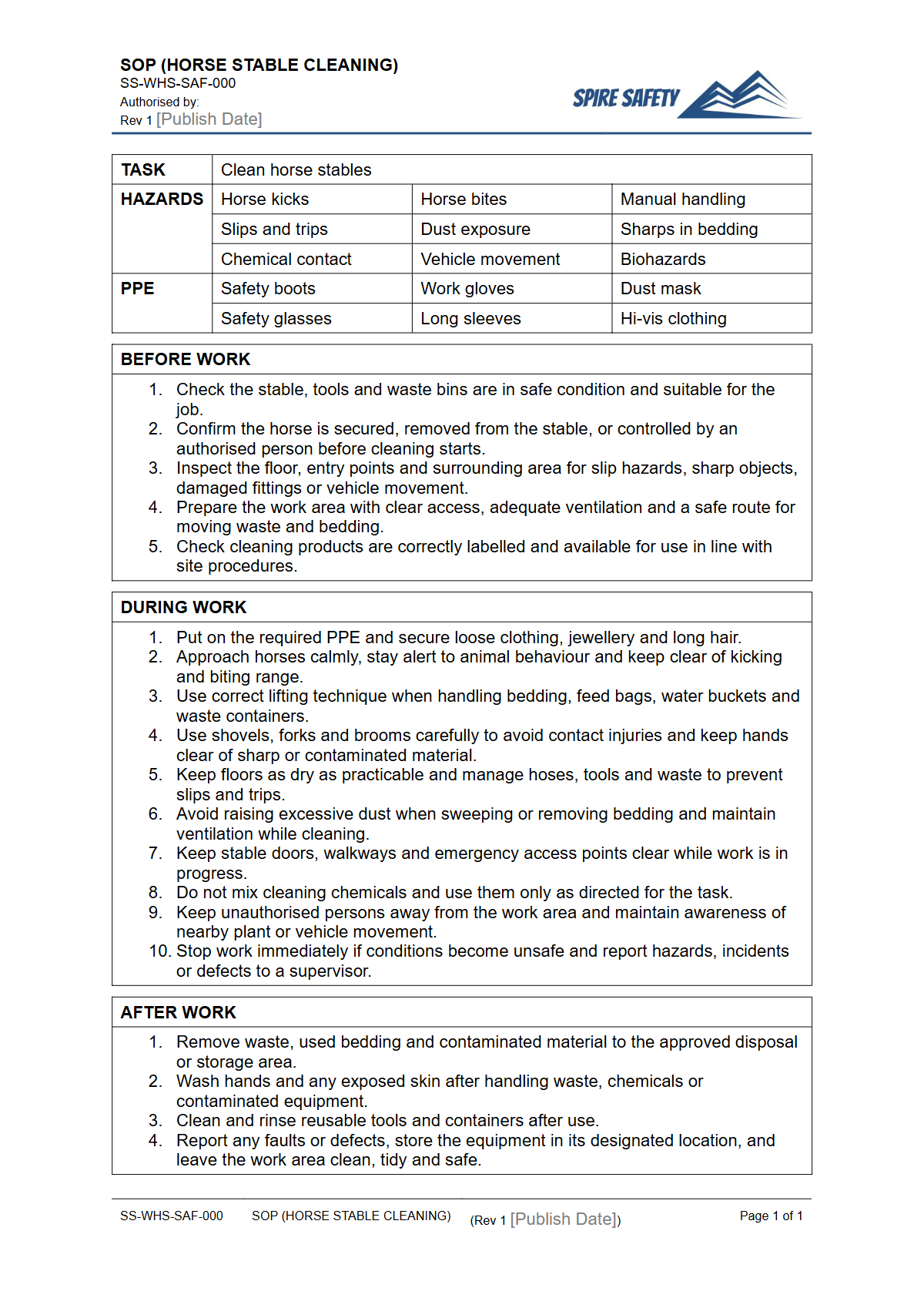
Download our free Safe Operating Procedure for horse stable cleaning. This customisable template helps you outline step-by-step WHS controls for your equestrian operations.
Free Safe Operating Procedure (Horse Stable Cleaning) Template
DOCX • 126 KB + PDF
Updated Oct 2026
No signup required
Purpose of the Free Safe Operating Procedure (Horse Stable Cleaning) Template
Working in an equestrian environment involves specific risks that must be carefully managed. This Free Safe Operating Procedure (Horse Stable Cleaning) Template provides a structured framework for documenting the safest way to perform stable cleaning tasks.
It helps persons conducting a business or undertaking (PCBUs) to identify hazards and implement control measures to protect workers. The SOP prompts consideration of risks such as manual handling injuries from lifting wet bedding, respiratory issues from dust and ammonia, slips and trips on wet floors, and potential injuries from handling horses.
A well-developed SOP is a critical component of your overall safety management documentation. It demonstrates a commitment to health and safety and forms an integral part of broader WHS management systems. This template helps you meet your duty of care by providing clear, step-by-step instructions for workers to follow, ensuring tasks are completed consistently and safely every time.
Video walkthrough
How to use the Free Safe Operating Procedure (Horse Stable Cleaning) Template
This document is a starting point designed for customisation. After downloading the DOCX or PDF file, you must adapt it to the specific conditions of your workplace.
This includes detailing the exact tools used (e.g., specific models of pitchforks, wheelbarrows, high-pressure cleaners), the types of bedding and cleaning chemicals involved, and the layout of your stables. Effective consultation is a key part of this process; involve your workers—the stable hands and grooms who perform the task daily—to ensure the procedure is practical and reflects how the work is actually done.
Important: We have developed this template as a guide. It is your responsibility to ensure it is tailored to the unique hazards and control measures relevant to your specific site, equipment, and personnel.
For assistance in customising safety documents to meet your specific operational needs, consider engaging professional WHS consulting services.
The SOP template covers key areas including:
- Pre-operational checks (e.g., ensuring tools are in good condition, checking ventilation)
- A step-by-step guide to the cleaning procedure
- Required Personal Protective Equipment (PPE)
- Potential hazards and their control measures
- Emergency procedures
When to use it
A Safe Operating Procedure for horse stable cleaning should be a living document integrated into your daily operations. It is essential for inducting and training new employees, ensuring they understand the approved safe method from day one.
It should also be used as a refresher for experienced staff and be readily accessible in the work area for quick reference. Furthermore, the SOP should be reviewed before undertaking non-routine cleaning tasks or when a change is introduced, such as new equipment or a different type of disinfectant.
For agricultural settings that involve more than just stable work, you might also require procedures for other machinery. For tasks like distributing new bedding or feed, our FREE Spreader SOP (Safe Operating Procedure) Template can provide a useful starting point for documenting safe machinery use.
Who should use it
This SOP is intended for all personnel involved in stable management and cleaning tasks. This includes stable hands, grooms, farm workers, and agricultural assistants.
Supervisors and managers also have a critical role; they must use the SOP to train staff, monitor work practices, and ensure the documented safety controls are being consistently applied. The document serves as a benchmark for performance and a tool for corrective action if unsafe behaviours are observed.
Supervisors can use the SOP as a checklist during regular workplace inspections to verify compliance. This process is a fundamental part of internal safety checks and prepares your organisation for formal WHS compliance auditing. If tools like air compressors are used for cleaning equipment after use, it's also wise to have a dedicated procedure, such as our Free Air Compressor SOP (Safe Operating Procedure) Template.
By standardising the procedure for this common but high-risk task, you create a safer and more organised work environment for everyone. For more templates and safety resources, browse our complete free WHS resources library.
Common mistakes
Common mistakes to avoid
- Using the downloaded template without customising it for specific site conditions, tools, and chemicals.
- Failing to consult with the workers who actually perform the stable cleaning tasks during the drafting process.
- Not providing the correct type or amount of Personal Protective Equipment (PPE) specified in the SOP.
- Treating the SOP as a 'set and forget' document instead of reviewing it regularly or after an incident.
Legal references
Legal considerations
The following legal requirements may be relevant to this type of work.
- Work Health and Safety Act (Harmonised) — Provides the primary duties for protecting workers and other people from work health and safety risks.
- Work Health and Safety Regulations (Harmonised) — Sets out requirements supporting the management of workplace hazards and risks.
The following codes may be relevant to this type of work.
- Managing WHS Risks Code of Practice — Provides practical guidance on identifying hazards, assessing risks and applying effective controls.
- Work Health and Safety Consultation, Cooperation and Coordination Code of Practice — Provides practical guidance on consulting workers and coordinating with other duty holders.
- Managing the Work Environment and Facilities Code of Practice — Provides practical guidance on safe work environments, workplace facilities and related controls.
Did you know
Respiratory Health Risk
Stable dust can contain over 50 different types of mould spores and endotoxins. Long-term exposure without adequate respiratory protection can lead to serious conditions like Farmer's Lung or Organic Dust Toxic Syndrome.
Manual Task Load
Mucking out a single horse stable can involve lifting and moving more than 50kg of soiled bedding and waste. This makes it a high-risk hazardous manual task if not managed with proper techniques and equipment.
FAQ
Frequently asked questions
01What are the main health and safety hazards in horse stable cleaning?
02What Personal Protective Equipment (PPE) is needed for cleaning stables?
03How often should a Safe Operating Procedure for stable cleaning be reviewed?
04Can this SOP template be used for training new stable hands?
Share this resource
Free Safe Operating Procedure (Horse Stable Cleaning) Template
Browse Categories
How To Use It
- 1Download and open in Word or PDF.
- 2Replace the placeholders with your business details.
- 3Get it reviewed by a WHS specialist before rollout.
Need it customised?
Our WHS consultants can adapt this template to your site, run a gap analysis, or audit what you already have in place.
Book a Free Consultation WHS consulting servicesor call 1300 156 382
Related templates
- Free Safe Operating Procedure (Horticultural Grafting) Template
- Free Safe Operating Procedure (Hose Blowout) Template
- Free Safe Operating Procedure (Hose Crimp Machine) Template
- Free Safe Operating Procedure (Hose Cutoff Saw) Template
- Free Safe Operating Procedure (Hose Flushing) Template
- Free Safe Operating Procedure (Hose Reel Use) Template