
Free Safe Operating Procedure (Hopper Cleaning) Template
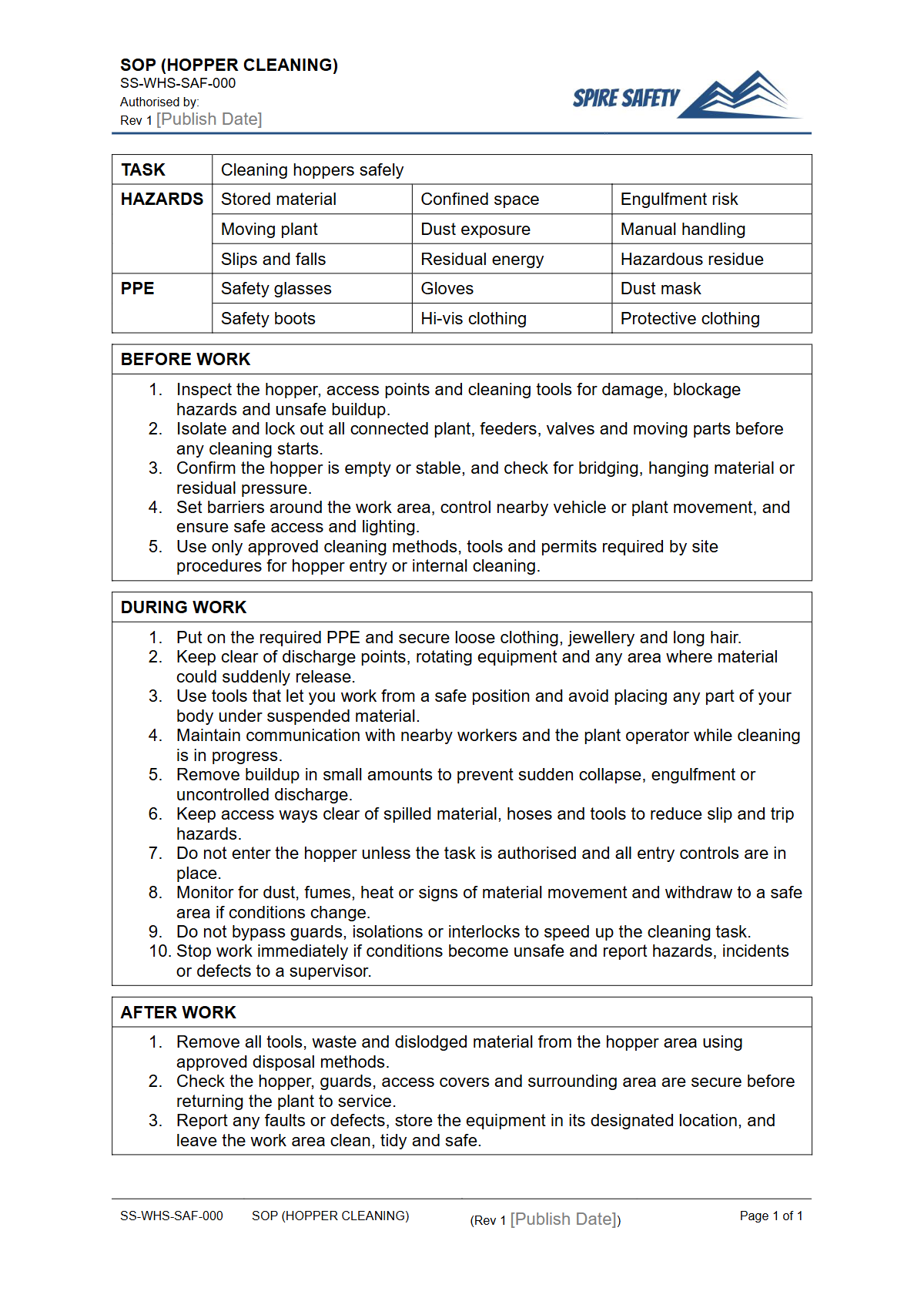
Need to document safe hopper cleaning processes? Download our Free Safe Operating Procedure (Hopper Cleaning) Template for a structured starting point.
Free Safe Operating Procedure (Hopper Cleaning) Template
DOCX • 126 KB + PDF
Updated Oct 2026
No signup required
Purpose of the Free Safe Operating Procedure (Hopper Cleaning) Template
A Safe Operating Procedure (SOP) for hopper cleaning is a critical safety document that provides clear, step-by-step instructions for workers. This task involves significant hazards, including engulfment, falls from height, hazardous atmospheres, unexpected equipment start-up, and contact with moving parts like augers or conveyors.
Using this template helps your organisation formalise a safe system of work to manage these risks effectively.
The purpose of this document is to provide a structured framework for identifying the hazards specific to your hoppers, implementing robust control measures like lock-out tag-out (LOTO), and defining the personal protective equipment (PPE) required. A well-developed SOP is a cornerstone of effective WHS management systems, demonstrating a commitment to proactive risk management and worker safety.
Video walkthrough
How to use the Free Safe Operating Procedure (Hopper Cleaning) Template
This document is provided in DOCX format for easy customisation. It is essential that you adapt this template to reflect the specific conditions of your workplace.
A generic procedure is not sufficient to ensure safety or demonstrate due diligence. You must add details about your specific hopper types, the materials they handle, the cleaning agents used, and the exact locations of energy isolation points.
For instance, if compressed air is used for cleaning, your procedure must detail safe pressure limits and required PPE, referencing principles found in resources like our Free Air Compressor SOP (Safe Operating Procedure) Template. Hoppers are often integrated into larger processing lines, so your procedure should align with those for connected machinery, such as what might be documented in a FREE Conveyer System SOP.
Important Note: This is a template we have created to be a guide. You must customise this document to the specific equipment, chemicals, and processes used in your workplace.
We are not liable for the outcomes of using this template; its effectiveness depends entirely on your thorough and accurate customisation.
When to use this Safe Operating Procedure
A formal SOP for hopper cleaning should be used consistently as part of your daily operational safety. It is a vital tool for training new employees and for periodic refresher training for existing staff, ensuring everyone understands the established safety protocols.
The SOP should be referenced during pre-task risk assessments (like a JSA or SWMS) before any cleaning operation begins.
Furthermore, this procedure serves as an authoritative reference during the work itself, especially if unforeseen issues arise. It is also a key document for toolbox talks and safety meetings, particularly before conducting non-routine or high-risk cleaning tasks.
The SOP should also be reviewed during periodic WHS compliance auditing to verify that safe practices are being consistently implemented on the ground.
Who should use this Safe Operating Procedure
This document is designed for anyone with responsibilities under WHS legislation. This includes Persons Conducting a Business or Undertaking (PCBUs), Health and Safety Managers, and Supervisors who are responsible for developing, implementing, and enforcing safe systems of work.
The most important users, however, are the operators and maintenance personnel who physically perform the cleaning tasks.
It is crucial that these frontline workers are involved in the drafting and review process of the SOP. Their practical experience is invaluable for creating a procedure that is not only safe but also workable and realistic. For complex operations or to validate your internal processes, organisations can seek external expertise through specialised WHS consulting. The principles of this SOP apply across many sectors, from food processing and mining to agriculture, where similar equipment is used, such as that detailed in our FREE Grain Drill SOP.
Common mistakes
Common mistakes to avoid
- Failing to implement a complete lock-out, tag-out (LOTO) procedure before any part of the body enters the hopper.
- Neglecting to test the atmosphere and treat the task as a potential confined space entry.
- Using a generic template without customising it for the specific hopper, material, and site conditions.
- Inadequate training and competency verification for workers assigned to perform the cleaning task.
Legal references
Legal considerations
The following legal requirements may be relevant to this type of work.
- Work Health and Safety Act (Harmonised) — Provides the primary duties for protecting workers and other people from work health and safety risks.
- Work Health and Safety Regulations (Harmonised) — Sets out requirements supporting the management of workplace hazards and risks.
The following codes may be relevant to this type of work.
- Managing WHS Risks Code of Practice — Provides practical guidance on identifying hazards, assessing risks and applying effective controls.
- Work Health and Safety Consultation, Cooperation and Coordination Code of Practice — Provides practical guidance on consulting workers and coordinating with other duty holders.
- Managing the Work Environment and Facilities Code of Practice — Provides practical guidance on safe work environments, workplace facilities and related controls.
Did you know
Engulfment Speed
Engulfment in free-flowing granular solids, such as grain or sand found in hoppers, can occur with surprising speed. A worker can be trapped in just a few seconds and completely submerged in less than 20 seconds, making prevention through isolation and entry procedures absolutely critical.
FAQ
Frequently asked questions
01What are the main hazards when cleaning a hopper?
02Does this SOP template cover confined space entry?
03How often should a Hopper Cleaning SOP be reviewed?
04Is an SOP a legal requirement for hopper cleaning in Australia?
Share this resource
Free Safe Operating Procedure (Hopper Cleaning) Template
Browse Categories
How To Use It
- 1Download and open in Word or PDF.
- 2Replace the placeholders with your business details.
- 3Get it reviewed by a WHS specialist before rollout.
Need it customised?
Our WHS consultants can adapt this template to your site, run a gap analysis, or audit what you already have in place.
Book a Free Consultation WHS consulting servicesor call 1300 156 382
Related templates
- Free Safe Operating Procedure (Horizontal Lifeline) Template
- Free Safe Operating Procedure (Horse Feeding) Template
- Free Safe Operating Procedure (Horse Stable Cleaning) Template
- Free Safe Operating Procedure (Horticultural Grafting) Template
- Free Safe Operating Procedure (Hose Blowout) Template
- Free Safe Operating Procedure (Hose Crimp Machine) Template