
Free Safe Operating Procedure (Hoist Sling Laundering) Template
Properly laundering hoist slings is crucial for safety and asset longevity. Download our free Safe Operating Procedure template to outline a safe process.
Free Safe Operating Procedure (Hoist Sling Laundering) Template
DOCX • 126 KB + PDF
Updated Oct 2026
No signup required
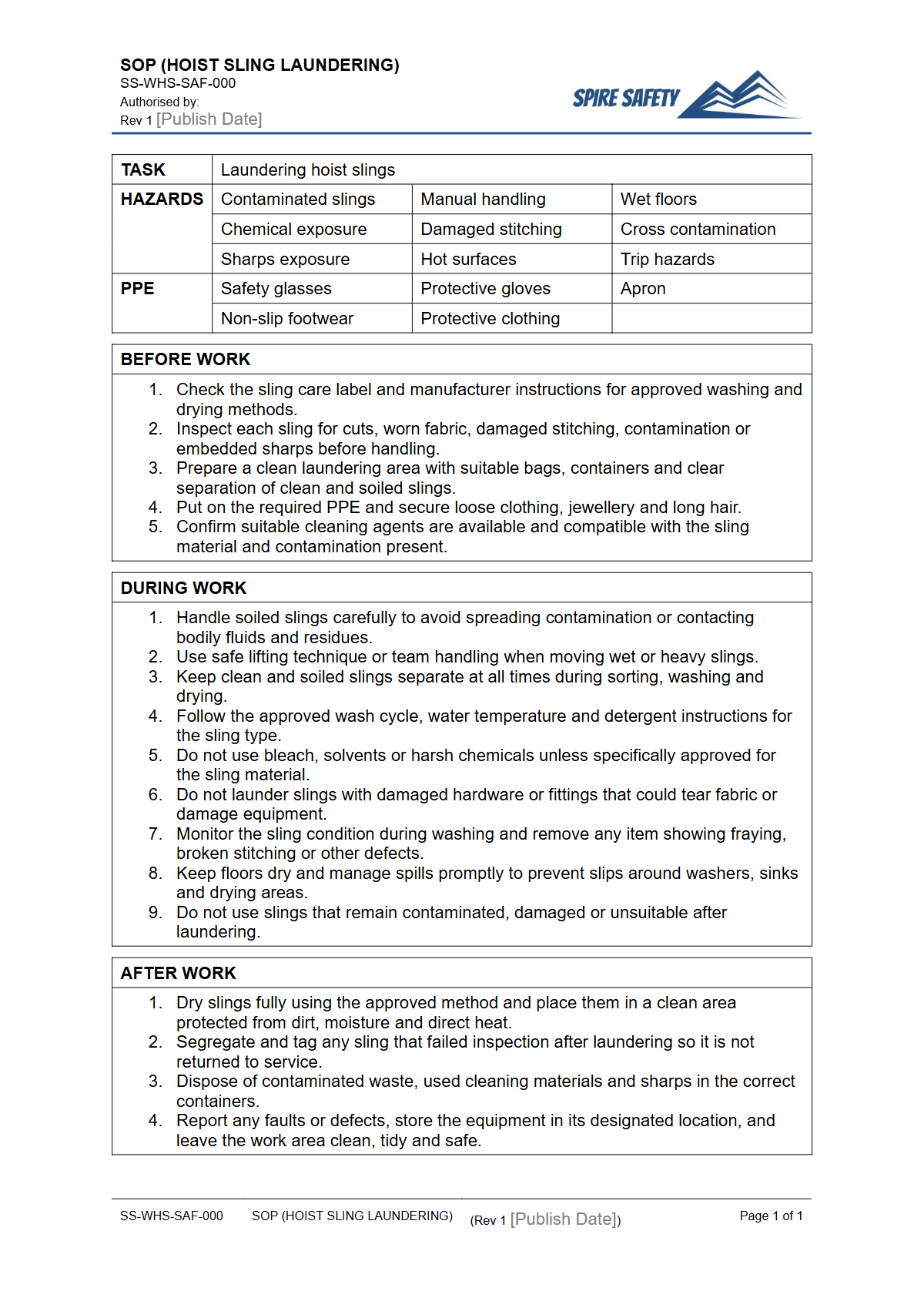
Purpose of the Free Safe Operating Procedure (Hoist Sling Laundering) Template
Maintaining the integrity of lifting equipment is a critical safety function. This Free Safe Operating Procedure (Hoist Sling Laundering) Template provides a structured framework for cleaning synthetic hoist slings without causing damage.
Incorrect laundering methods, such as using harsh chemicals, high-pressure washers, or excessive heat, can degrade the sling's fibres, invisibly compromising its strength and load-bearing capacity. Following a documented procedure ensures that cleaning is performed consistently and safely, preserving the service life of the equipment and protecting workers from catastrophic equipment failure.
An SOP is a fundamental component of a proactive safety culture. It formalises a safe system of work, provides a basis for training and competency assessment, and demonstrates due diligence in managing workplace risks.
Integrating this procedure into your broader WHS management systems helps create a holistic approach to asset maintenance and operator safety, ensuring all tasks are conducted according to best practice.
Video walkthrough
How to use the Free Safe Operating Procedure (Hoist Sling Laundering) Template
This template is designed for ease of use and customisation. Available in both DOCX and PDF formats, it allows you to adapt the content to your specific operational context.
Start by downloading the file and reviewing the outlined steps. You should then consult with workers, supervisors, and other stakeholders to incorporate site-specific details.
This includes specifying the exact types of slings used, the approved cleaning agents (detergents), washing machine settings (if applicable), drying methods, and the person responsible for each stage.
Please note: This document is a template and must be customised to suit the specific equipment, chemicals, and procedures in your workplace. We recommend a consultation process involving the workers who will perform the task to ensure the SOP is practical and effective.
While this document focuses on sling laundering, a similar systematic approach is vital for all plant and equipment. For instance, operating heavy machinery safely requires its own documented procedure, just like the process detailed in our FREE Telehandler SOP Template.
Customisation and Implementation Steps:
- Identify Hazards: Use the built-in risk assessment matrix to identify hazards associated with the laundering process, such as manual handling, exposure to chemicals, or contact with hot water.
- Define Controls: Document the control measures to mitigate identified risks, such as requiring specific personal protective equipment (PPE) like gloves and safety glasses.
- Detail the Procedure: Write clear, step-by-step instructions for pre-use inspection, washing, rinsing, drying, post-laundering inspection, and record-keeping.
- Training: Use the finalised SOP as a training tool for all personnel responsible for laundering hoist slings.
- Review: Schedule regular reviews of the SOP to ensure it remains current and effective, especially if new equipment or cleaning agents are introduced. Many industrial workshops use a variety of equipment, each requiring its own SOP, such as the one outlined in our Free Air Compressor SOP (Safe Operating Procedure) Template.
When to use this Safe Operating Procedure
This SOP should be implemented as the standard process whenever a hoist sling requires cleaning. The need for laundering can be triggered by several events.
Slings should be cleaned after being used in particularly dirty, greasy, or muddy environments to allow for a thorough visual inspection. They must also be cleaned immediately after any known or suspected contact with chemicals that could damage the synthetic fibres.
Furthermore, laundering can be integrated into a regular preventative maintenance schedule, with the frequency determined by the intensity and environment of use.
Documenting maintenance and operational processes is crucial for ensuring consistency and safety across all activities. A complex piece of equipment like an automated production line would similarly benefit from a clear, documented procedure, such as our FREE Conveyer System SOP (Safe Operating Procedure) Template.
Who should use this SOP
This Safe Operating Procedure is intended for use by multiple roles within an organisation. The Person Conducting a Business or Undertaking (PCBU) is ultimately responsible for ensuring safe systems of work are in place.
Managers and supervisors must use the SOP to train workers, supervise the task, and ensure the procedure is followed correctly. The workers tasked with cleaning and maintaining the hoist slings are the primary end-users, following the steps to perform their job safely and effectively.
Safety officers and WHS committees can also use this document as a reference during safety audits, incident investigations, and risk assessments. For organisations needing assistance in developing or reviewing their safety documentation, engaging external expertise through WHS consulting can provide valuable insight and ensure alignment with regulatory expectations. This SOP serves as a critical record, demonstrating that a formal process for equipment maintenance is established and followed. You can find more templates like this in our complete free WHS resources library.
Common mistakes
Common mistakes to avoid
- Using high-pressure washers, which can force dirt into the weave and damage fibres.
- Washing at temperatures above the manufacturer's recommendation, causing shrinkage or fibre damage.
- Failing to remove the sling from service when post-laundering inspection reveals damage like cuts or chemical burns.
- Neglecting to inspect the identification tag to ensure it remains legible after washing.
Legal references
Legal considerations
The following legal requirements may be relevant to this type of work.
- Work Health and Safety Act (Harmonised) — Provides the primary duties for protecting workers and other people from work health and safety risks.
- Work Health and Safety Regulations (Harmonised) — Sets out requirements supporting the management of workplace hazards and risks.
The following codes may be relevant to this type of work.
- Managing WHS Risks Code of Practice — Provides practical guidance on identifying hazards, assessing risks and applying effective controls.
- Work Health and Safety Consultation, Cooperation and Coordination Code of Practice — Provides practical guidance on consulting workers and coordinating with other duty holders.
- Managing the Work Environment and Facilities Code of Practice — Provides practical guidance on safe work environments, workplace facilities and related controls.
Did you know
Hidden Damage
Aggressive cleaning agents can reduce a synthetic sling's breaking strength by over 20% without any visible signs of damage, making adherence to proper laundering procedures a critical safety control.
The Importance of Drying
Storing a sling while it is still damp can promote the growth of mould and mildew, which can degrade fibres and mask underlying damage. Slings must be thoroughly air-dried away from direct sunlight before being returned to service.
FAQ
Frequently asked questions
01What should be included in a hoist sling laundering SOP?
02Why can't any detergent be used on synthetic hoist slings?
03How often should hoist slings be laundered?
04Does this SOP cover inspection as well as cleaning?
Share this resource
Free Safe Operating Procedure (Hoist Sling Laundering) Template
Browse Categories
How To Use It
- 1Download and open in Word or PDF.
- 2Replace the placeholders with your business details.
- 3Get it reviewed by a WHS specialist before rollout.
Need it customised?
Our WHS consultants can adapt this template to your site, run a gap analysis, or audit what you already have in place.
Book a Free Consultation WHS consulting servicesor call 1300 156 382
Related templates
- Free Safe Operating Procedure (Holiday Detector) Template
- Free Safe Operating Procedure (Hopper Cleaning) Template
- Free Safe Operating Procedure (Horizontal Lifeline) Template
- Free Safe Operating Procedure (Horse Feeding) Template
- Free Safe Operating Procedure (Horse Stable Cleaning) Template
- Free Safe Operating Procedure (Horticultural Grafting) Template