
Free Safe Operating Procedure (HEPA Vacuum) Template
Download our free Safe Operating Procedure (HEPA Vacuum) template to manage airborne hazards. This customisable DOCX and PDF helps you define safe work methods.
Free Safe Operating Procedure (HEPA Vacuum) Template
DOCX • 126 KB + PDF
Updated Oct 2026
No signup required
Purpose of the Free Safe Operating Procedure (HEPA Vacuum) Template
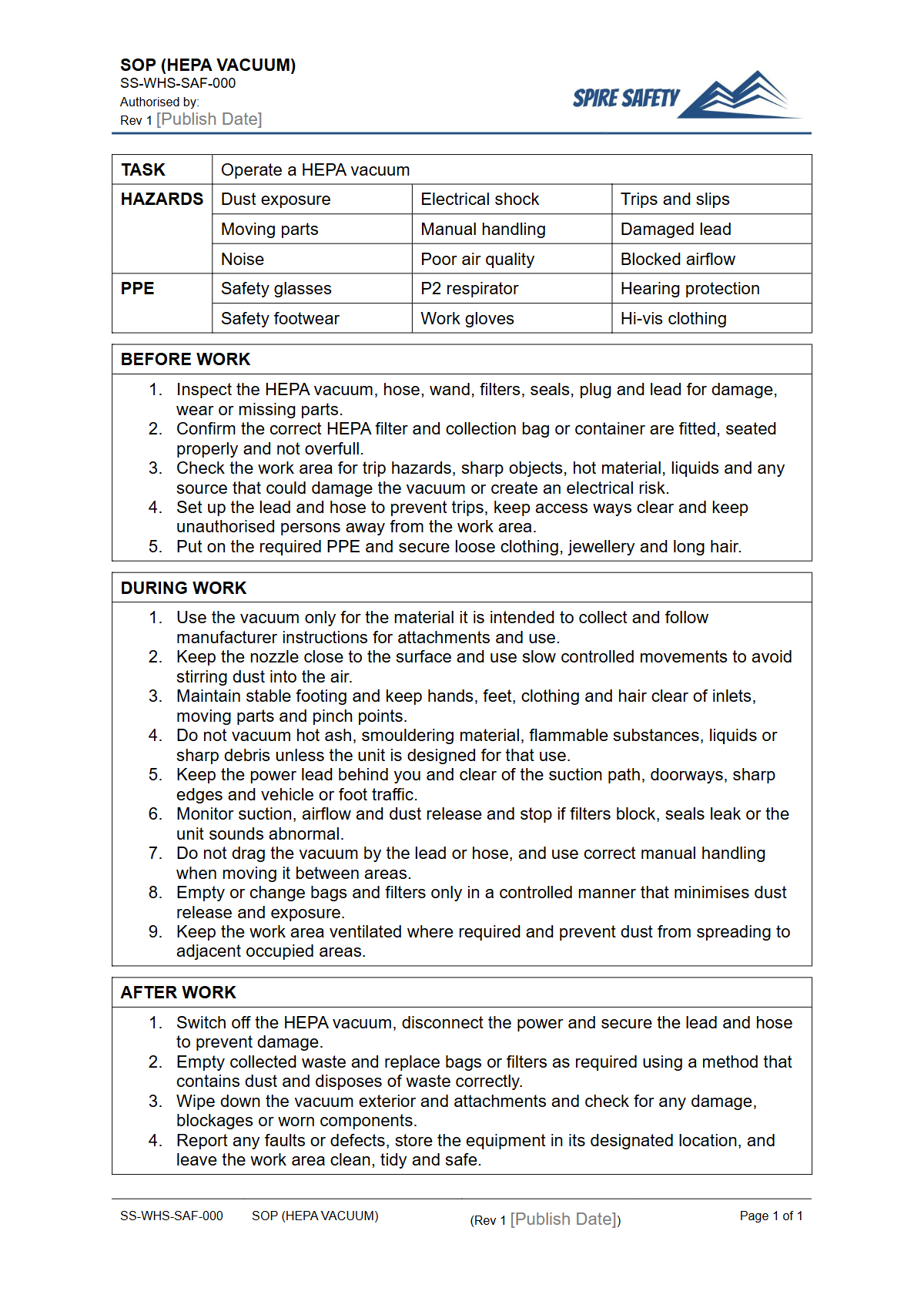
This Free Safe Operating Procedure (HEPA Vacuum) Template provides a structured framework for documenting the safe use of high-efficiency particulate air (HEPA) vacuums. These specialised vacuums are critical for controlling airborne hazards, particularly respirable dusts like silica, asbestos, lead, and other hazardous materials common in construction and remediation work.
Using a documented SOP helps your organisation meet its duty of care by ensuring workers understand the risks, required controls, and emergency procedures associated with the task. It standardises operator behaviour, simplifies training, and serves as a key component of your overall safety management system.
Video walkthrough
How to use the Free Safe Operating Procedure (HEPA Vacuum) Template
Download the template in your preferred format (DOCX or PDF) and adapt it to the specific context of your workplace. It's designed as a solid starting point, aligned with Australian WHS principles, but it is not a finished document.
You must customise the content to reflect the specific make and model of your HEPA vacuum, the types of hazardous materials you handle, and your site-specific risk controls. For large-scale industrial cleaning, the principles are similar but the equipment is different; you may find our FREE Vacuum Truck SOP Template more suitable for those applications.
Important: We have pre-filled this template with common steps and safety considerations. However, you are responsible for ensuring the final document is accurate and adequate for your workplace.
A generic procedure is not sufficient for managing high-risk tasks. Always conduct a site-specific risk assessment before finalising your SOP.
When to Use a HEPA Vacuum SOP
A documented Safe Operating Procedure for a HEPA vacuum should be used whenever this equipment is required to control exposure to hazardous dust. This is particularly crucial in industries like construction, demolition, manufacturing, and restoration.
Key tasks include cleaning up after cutting, grinding, or drilling concrete or masonry; asbestos removal activities; lead paint abatement; and general housekeeping in environments where hazardous dust is present. For tasks involving other dust-generating tools, it is best practice to have specific procedures for each, such as a circular saw SOP template, to ensure a comprehensive approach to dust management.
Who Should Use This Safe Operating Procedure
This SOP is intended for Persons Conducting a Business or Undertaking (PCBUs), site supervisors, safety managers, and the workers who operate the equipment. It should be used to:
- Train and assess workers on the safe operation of HEPA vacuums.
- Provide a clear, step-by-step guide for pre-start checks, operation, and shutdown.
- Communicate essential safety information, including required Personal Protective Equipment (PPE), filter maintenance, and safe dust disposal methods.
- Support toolbox talks and safety briefings before work commences.
Integrating this SOP into your broader safety framework is a key step towards proactive risk management. Effective WHS management systems rely on clear, practical documents like this to translate policy into safe on-the-ground practice.
Maintaining Equipment and Controls
Regular maintenance is non-negotiable for HEPA vacuums to ensure they perform as intended. A poorly maintained unit can fail to capture dust effectively or, worse, re-release it into the air.
Your SOP should detail the inspection and maintenance schedule, including checks for hoses, cords, filters, and collection bags. The procedure must also cover the correct, safe method for changing filters and disposing of collected dust, which is itself hazardous waste.
It is also important to consider all equipment on site; for example, an air compressor SOP template can help manage the risks associated with pneumatic tools often used alongside vacuums.
Periodic verification of the control's effectiveness, such as through air monitoring, may be necessary for high-risk activities. A regular WHS compliance auditing program can help verify that your documented procedures are being followed correctly in the field and are effectively controlling the risks.
This template is one of many resources designed to support Australian businesses. You can explore our complete free WHS resources library for more templates, checklists, and guides.
Common mistakes
Common mistakes to avoid
- Using a standard shop vacuum for hazardous materials like silica or asbestos dust.
- Failing to use a plastic bag liner, making safe disposal of collected dust difficult and dangerous.
- Changing filters or emptying the container without wearing appropriate PPE, causing personal exposure.
- Neglecting to inspect hoses, seals, and power cords for damage before each use.
Legal references
Legal considerations
The following legal requirements may be relevant to this type of work.
- Work Health and Safety Act (Harmonised) — Provides the primary duties for protecting workers and other people from work health and safety risks.
- Work Health and Safety Regulations (Harmonised) — Sets out requirements supporting the management of workplace hazards and risks.
The following codes may be relevant to this type of work.
- Managing WHS Risks Code of Practice — Provides practical guidance on identifying hazards, assessing risks and applying effective controls.
- Work Health and Safety Consultation, Cooperation and Coordination Code of Practice — Provides practical guidance on consulting workers and coordinating with other duty holders.
- Managing the Work Environment and Facilities Code of Practice — Provides practical guidance on safe work environments, workplace facilities and related controls.
Did you know
What does HEPA mean?
HEPA stands for High-Efficiency Particulate Air. To qualify, a filter must meet specific efficiency standards, such as capturing 99.97% of airborne particles at 0.3 microns in size.
Dust Classifications
Industrial vacuums are often rated L-Class (Low), M-Class (Medium), or H-Class (High). H-Class vacuums, which use HEPA filtration, are required for high-toxicity dusts like asbestos and other carcinogens.
FAQ
Frequently asked questions
01What is the difference between a standard vacuum and a HEPA vacuum?
02Is a Safe Operating Procedure legally required for a HEPA vacuum?
03How often should HEPA filters be changed?
04Can a HEPA vacuum be used for wet materials?
Share this resource
Free Safe Operating Procedure (HEPA Vacuum) Template
Browse Categories
How To Use It
- 1Download and open in Word or PDF.
- 2Replace the placeholders with your business details.
- 3Get it reviewed by a WHS specialist before rollout.
Need it customised?
Our WHS consultants can adapt this template to your site, run a gap analysis, or audit what you already have in place.
Book a Free Consultation WHS consulting servicesor call 1300 156 382
Related templates
- Free Safe Operating Procedure (Herbicide Mixing) Template
- Free Safe Operating Procedure (Hoist Sling Inspection) Template
- Free Safe Operating Procedure (Hoist Sling Laundering) Template
- Free Safe Operating Procedure (Holiday Detector) Template
- Free Safe Operating Procedure (Hopper Cleaning) Template
- Free Safe Operating Procedure (Horizontal Lifeline) Template