
Free Safe Operating Procedure (Herbicide Mixing) Template
Control risks associated with chemical handling using our free Safe Operating Procedure for herbicide mixing. Download the customisable DOCX and PDF today.
Free Safe Operating Procedure (Herbicide Mixing) Template
DOCX • 126 KB + PDF
Updated Oct 2026
No signup required
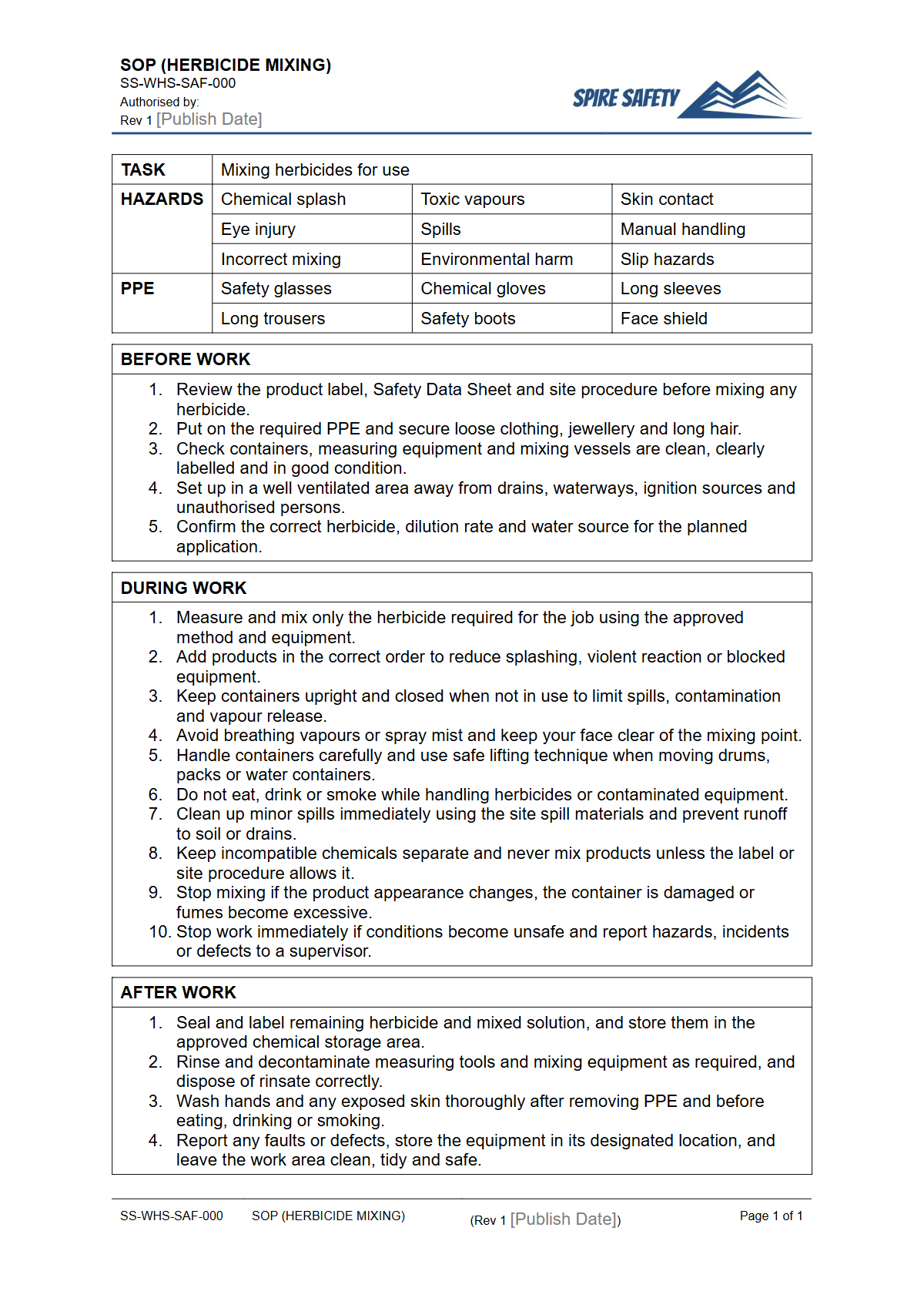
Purpose of the Free Safe Operating Procedure (Herbicide Mixing) Template
Handling and mixing herbicides presents significant health and environmental risks if not managed correctly. This Free Safe Operating Procedure (Herbicide Mixing) Template provides a structured framework for documenting the required steps to perform this task safely.
It helps organisations formalise controls for hazards such as chemical inhalation, skin absorption, eye contact, and environmental contamination from spills. A documented Safe Operating Procedure is a critical tool for training workers, enforcing safe work practices, and demonstrating due diligence in managing hazardous chemicals.
By systematically outlining pre-operational checks, personal protective equipment (PPE) requirements, the step-by-step mixing process, and emergency procedures, the template helps ensure a consistent and safe approach every time. Using this SOP can significantly reduce the likelihood of incidents, protecting both your workers and the environment.
It serves as a practical implementation of your risk assessment findings for this specific high-risk task. This structured approach is fundamental for tasks across various industries, whether you're using a free Spreader SOP for application or managing other agricultural processes.
Video walkthrough
How to use the Free Safe Operating Procedure (Herbicide Mixing) Template
This resource is available for download as a DOCX file for easy editing, or as a PDF for immediate use. The core value of this Safe Operating Procedure lies in its customisation.
To make it effective, you must adapt it to your specific operational context. This includes detailing the exact types of herbicides used, the specific mixing equipment on site, and the unique environmental considerations of your location.
IMPORTANT: This is a template only. We have provided a comprehensive starting point aligned with Australian WHS practice, but you must customise this Safe Operating Procedure to reflect the specific chemicals, equipment, PPE, and environmental controls at your workplace.
Always consult the manufacturer's Safety Data Sheet (SDS) for each chemical and integrate its specific requirements into the final document. The level of detail required is similar to what you would find in our Planter SOP template, where machine-specific details are vital.
When to use a Safe Operating Procedure
A Safe Operating Procedure for herbicide mixing should be used as a primary reference tool before and during the task. It is essential for inducting and training new workers assigned to handle chemicals, ensuring they understand the risks and control measures from the outset.
It should also be used as a pre-start checklist by experienced operators to confirm that all safety measures, such as PPE availability and spill kit readiness, are in place. Furthermore, supervisors can use the approved SOP as an audit and observation tool to verify that correct procedures are being followed consistently, forming a key part of your safety management system.
Who should use it
This Safe Operating Procedure is designed for any Person Conducting a Business or Undertaking (PCBU) whose workers handle and mix concentrated herbicides. It is essential for workers and supervisors in sectors such as agriculture, horticulture, landscaping, grounds maintenance, and pest control.
Any individual tasked with decanting, measuring, and mixing chemicals should be trained using a customised version of this document. Integrating specific SOPs like this into your broader safety framework is a core component of effective comprehensive WHS management systems.
The responsibility for implementing the SOP lies with management, but its practical use is in the hands of operators. For more complex chemical handling processes or for help embedding procedures into your daily operations, consider seeking specialist WHS consulting. Whether the task involves complex machinery documented in a Safe Operating Procedure for a grain drill or hazardous substances, a clear, documented process is non-negotiable.
Ultimately, a well-drafted SOP protects the people doing the work. You can find many other task-specific templates, from a Thresher SOP template to procedures for common workshop tools, in our free WHS resources library, all designed to provide a solid foundation for your workplace safety documentation.
Common mistakes
Common mistakes to avoid
- Failing to read the Safety Data Sheet (SDS) and product label before starting work.
- Using incorrect, damaged, or poorly maintained Personal Protective Equipment (PPE).
- Mixing chemicals in a poorly ventilated area or near uncovered drains and waterways.
- Not having a spill kit and clear emergency plan readily accessible at the mixing location.
Legal references
Legal considerations
The following legal requirements may be relevant to this type of work.
- Work Health and Safety Act (Harmonised) — Provides the primary duties for protecting workers and other people from work health and safety risks.
- Work Health and Safety Regulations (Harmonised) — Sets out requirements supporting the management of workplace hazards and risks.
The following codes may be relevant to this type of work.
- Managing WHS Risks Code of Practice — Provides practical guidance on identifying hazards, assessing risks and applying effective controls.
- Work Health and Safety Consultation, Cooperation and Coordination Code of Practice — Provides practical guidance on consulting workers and coordinating with other duty holders.
- Managing the Work Environment and Facilities Code of Practice — Provides practical guidance on safe work environments, workplace facilities and related controls.
Did you know
The Danger Zone
The highest risk of acute chemical exposure often occurs during the mixing and loading phase, not during application, as workers are handling the product in its most concentrated form.
FAQ
Frequently asked questions
01What is a Safe Operating Procedure for herbicide mixing?
02Is this template compliant with Australian WHS laws?
03What information do I need to add to the template?
04Who should review and approve the final Herbicide Mixing SOP?
Share this resource
Free Safe Operating Procedure (Herbicide Mixing) Template
Browse Categories
How To Use It
- 1Download and open in Word or PDF.
- 2Replace the placeholders with your business details.
- 3Get it reviewed by a WHS specialist before rollout.
Need it customised?
Our WHS consultants can adapt this template to your site, run a gap analysis, or audit what you already have in place.
Book a Free Consultation WHS consulting servicesor call 1300 156 382
Related templates
- Free Safe Operating Procedure (Hoist Sling Inspection) Template
- Free Safe Operating Procedure (Hoist Sling Laundering) Template
- Free Safe Operating Procedure (Holiday Detector) Template
- Free Safe Operating Procedure (Hopper Cleaning) Template
- Free Safe Operating Procedure (Horizontal Lifeline) Template
- Free Safe Operating Procedure (Horse Feeding) Template