
Free Safe Operating Procedure (Hedge Hand Trimming) Template
Formalise your safety protocols for manual hedge trimming with our structured Safe Operating Procedure template. Download the free DOCX and PDF to begin.
Free Safe Operating Procedure (Hedge Hand Trimming) Template
DOCX • 126 KB + PDF
Updated Oct 2026
No signup required
Purpose of the Free Safe Operating Procedure (Hedge Hand Trimming) Template
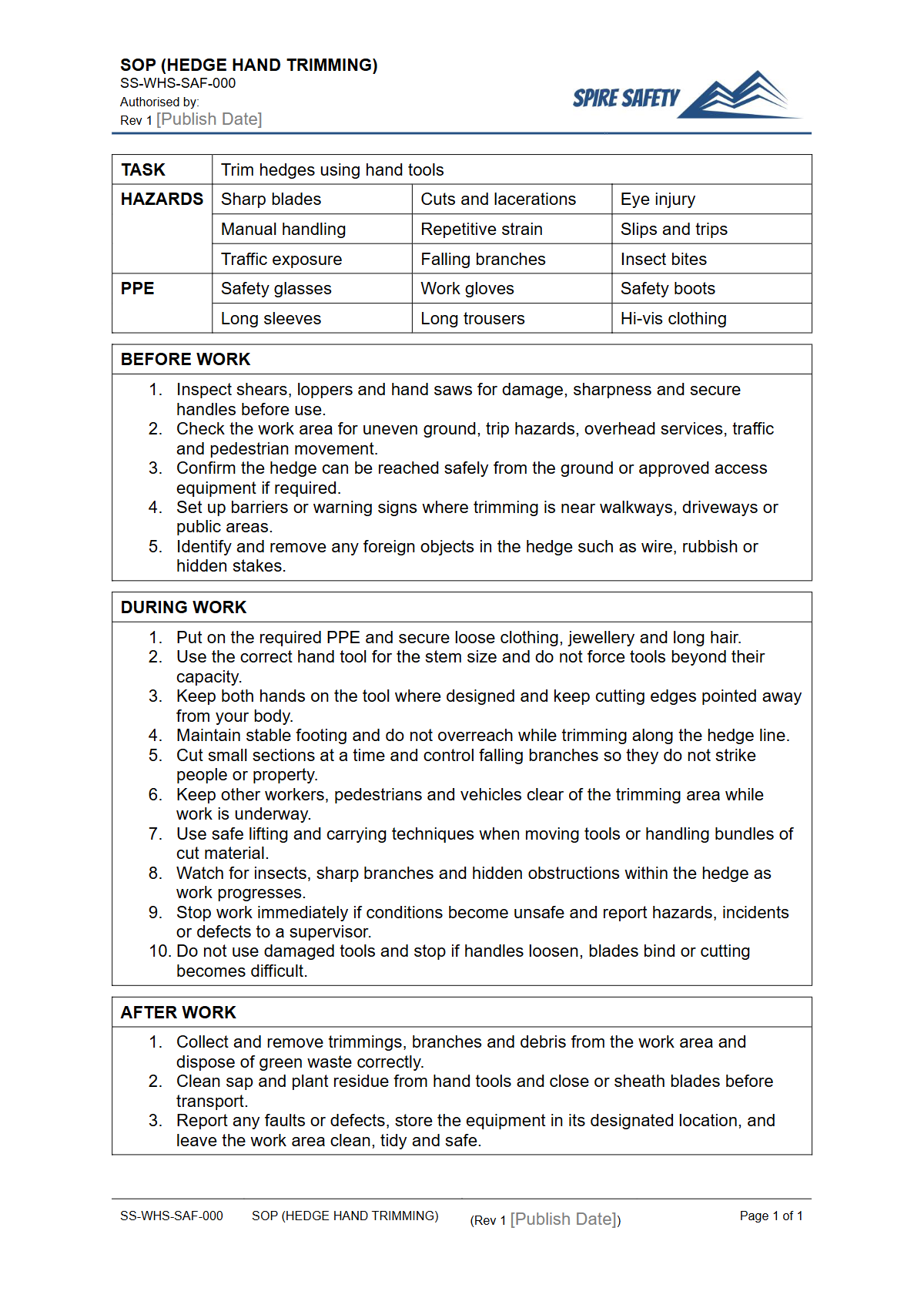
This Free Safe Operating Procedure (Hedge Hand Trimming) Template provides a structured framework for documenting the safe and correct way to perform manual hedge trimming tasks. Using hand tools like shears, loppers, and secateurs might seem straightforward, but they present real risks of cuts, musculoskeletal strain, and eye injuries.
A documented SOP is a critical tool for any Person Conducting a Business or Undertaking (PCBU) in the landscaping, gardening, or property maintenance industries.
The primary purpose of this SOP is to help you systematically identify hazards, implement risk controls, and standardise worker training. By establishing a clear, step-by-step process, you can significantly reduce the likelihood of incidents and demonstrate your commitment to workplace safety.
This document serves as a fundamental component within a broader WHS management system, ensuring that safety protocols are consistent, understood, and followed by all personnel.
Video walkthrough
How to use the Free Safe Operating Procedure (Hedge Hand Trimming) Template
Our template is designed for immediate use and customisation. It is provided in both DOCX and PDF formats, allowing you to easily edit and adapt the content to your specific operational needs.
Begin by downloading the file and reviewing its sections, which cover pre-operational checks, operational steps, post-operational procedures, and potential hazards.
It is crucial that you tailor this document to your workplace. We have provided a comprehensive starting point, but you must modify it to reflect the specific types of hand tools used, the unique environmental conditions of your work sites, and your organisation's emergency procedures.
Effective safety documents are never 'one-size-fits-all'. They must be living documents that accurately reflect your operations and are reviewed during WHS compliance audits to ensure ongoing relevance.
When to Use This Safe Operating Procedure
An SOP for hedge hand trimming should be a core part of your daily operations. It must be used as the primary training document for any new worker assigned to the task, ensuring they understand the approved methods and associated risks from day one.
It is also an invaluable tool for conducting refresher training for experienced staff, reinforcing safe work habits and communicating any updates to the procedure.
Furthermore, this document should be referenced during toolbox talks before a job begins and consulted during any incident investigation involving hedge trimming activities. Having a formal procedure in place provides a clear benchmark for expected behaviour and helps identify deviations that may have contributed to an incident.
This approach is consistent with managing risks for other handheld equipment, where a specific guide like a circular saw SOP is essential for operator safety.
Who Should Use It
This Safe Operating Procedure is intended for a range of personnel within an organisation. Responsibility for its implementation is shared across several roles:
- PCBU / Management: Responsible for ensuring adequate resources are allocated for implementing the SOP, including providing the correct PPE and training.
- Supervisors and Team Leaders: Responsible for training workers on the SOP, ensuring it is followed on-site, and conducting pre-start checks.
- WHS/HSE Officers: Responsible for developing, reviewing, and updating the SOP in consultation with workers, and integrating it into the overall safety management system. If your organisation lacks this internal expertise, you can engage expert WHS consultants to assist.
- Workers: Responsible for following the steps outlined in the SOP, using PPE correctly, and reporting any hazards or incidents to their supervisor immediately.
For organisations involved in larger scale grounds maintenance, it is important to develop procedures for all types of equipment. For example, alongside manual tasks, you may need a safe operating procedure for trenchers if your work involves installing irrigation or cabling.
You can find more templates in our extensive library of free WHS resources to build out your safety documentation.
Common mistakes
Common mistakes to avoid
- Using the template without customising it for the specific workplace, tools, and environment.
- Failing to provide practical training and competency assessment on the SOP for all relevant workers.
- Neglecting to specify required Personal Protective Equipment (PPE) based on a formal risk assessment.
- Not reviewing or updating the procedure after an incident, near miss, or when new equipment is acquired.
Legal references
Legal considerations
The following legal requirements may be relevant to this type of work.
- Work Health and Safety Act (Harmonised) — Provides the primary duties for protecting workers and other people from work health and safety risks.
- Work Health and Safety Regulations (Harmonised) — Sets out requirements supporting the management of workplace hazards and risks.
The following codes may be relevant to this type of work.
- Managing WHS Risks Code of Practice — Provides practical guidance on identifying hazards, assessing risks and applying effective controls.
- Work Health and Safety Consultation, Cooperation and Coordination Code of Practice — Provides practical guidance on consulting workers and coordinating with other duty holders.
- Managing the Work Environment and Facilities Code of Practice — Provides practical guidance on safe work environments, workplace facilities and related controls.
Did you know
Ergonomic Risks
Repetitive motions common in gardening and landscaping, including manual hedge trimming, are a leading cause of musculoskeletal disorders. Proper technique, tool maintenance, and taking regular breaks are crucial for prevention.
Sharp Tool Safety
According to Safe Work Australia, being hit by moving objects (including hand tools) is a common cause of serious injury claims. Ensuring tools are sharp and well-maintained can reduce the force required, lowering ergonomic and laceration risks.
FAQ
Frequently asked questions
01What are the main hazards of hand trimming hedges?
02Is a Safe Operating Procedure legally required for hedge trimming in Australia?
03How often should a hedge trimming SOP be reviewed?
04What PPE is needed for trimming hedges by hand?
Share this resource
Free Safe Operating Procedure (Hedge Hand Trimming) Template
Browse Categories
How To Use It
- 1Download and open in Word or PDF.
- 2Replace the placeholders with your business details.
- 3Get it reviewed by a WHS specialist before rollout.
Need it customised?
Our WHS consultants can adapt this template to your site, run a gap analysis, or audit what you already have in place.
Book a Free Consultation WHS consulting servicesor call 1300 156 382
Related templates
- Free Safe Operating Procedure (Hedge Trimmer) Template
- Free Safe Operating Procedure (HEPA Vacuum) Template
- Free Safe Operating Procedure (Herbicide Mixing) Template
- Free Safe Operating Procedure (Hoist Sling Inspection) Template
- Free Safe Operating Procedure (Hoist Sling Laundering) Template
- Free Safe Operating Procedure (Holiday Detector) Template