
Free Safe Operating Procedure (Heat Stress Monitor) Template
Effectively manage heat-related risks in your workplace with our structured template. Download your free Safe Operating Procedure to get started today.
Free Safe Operating Procedure (Heat Stress Monitor) Template
DOCX • 126 KB + PDF
Updated Oct 2026
No signup required
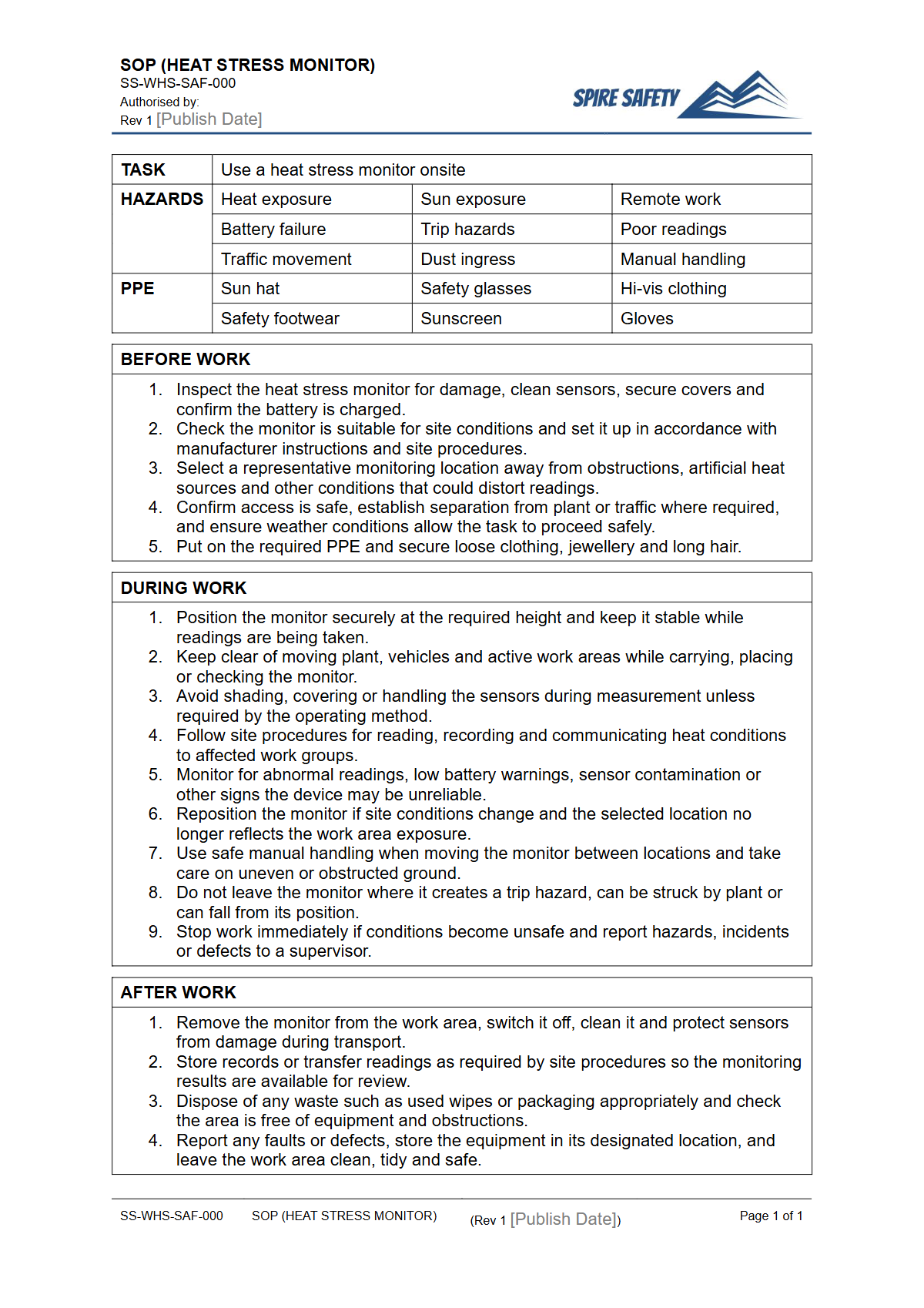
Purpose of the Free Safe Operating Procedure (Heat Stress Monitor) Template
Managing the risks of working in heat is a critical part of workplace safety, particularly in Australia's varied climates. Our Free Safe Operating Procedure (Heat Stress Monitor) Template provides a structured framework for the correct and consistent use of this essential monitoring equipment.
This document helps your organisation establish clear steps for preparing, using, and interpreting data from a heat stress monitor, ensuring that environmental conditions are accurately assessed and appropriate controls are implemented in a timely manner.
Using a formal SOP ensures that all responsible personnel follow the same methodology, reducing the risk of errors in measurement and response. It forms a key component of a broader heat management plan, helping you meet your duties to provide a safe working environment.
By formalising this process, you create a reliable system for identifying when thermal conditions pose a risk to workers' health and safety, enabling proactive rather than reactive measures. This process is fundamental to the development of comprehensive WHS management systems that effectively address environmental hazards.
Video walkthrough
How to use the Free Safe Operating Procedure (Heat Stress Monitor) Template
This document is designed to be a starting point, providing a logical structure based on Australian WHS principles. It is not a complete, off-the-shelf solution.
To make it effective, you must adapt it to your specific operational context.
Please note: This document is a template and must be customised for your specific workplace. We have included prompts and standard sections, but you are responsible for adding details relevant to your specific heat stress monitor model, your workplace's established trigger points (e.g., based on thermal work limit or WBGT), and your site-specific control measures.
This ensures the final SOP is a practical and relevant tool for your team.
Implementation Steps:
- Download: Select the DOCX format for easy editing or the PDF for straightforward printing.
- Customise: Populate the template with your company name, the specific make and model of your heat stress monitor, and site-specific details. Define the roles and responsibilities, pre-operational checks, and the exact steps for taking measurements.
- Define Triggers and Controls: Clearly document your organisation’s action levels. Specify what actions must be taken when the monitor indicates low, moderate, high, or extreme risk (e.g., mandatory hydration breaks, job rotation, stopping work).
- Train Personnel: Ensure all workers and supervisors who will use the monitor or act on its readings are trained on the finalised SOP. Competency is key to its successful implementation. For other high-risk tasks, you might use a similar process, like that outlined in our SOP for telehandlers.
- Review and Refine: Schedule regular reviews of the SOP (e.g., annually or after an incident) to ensure it remains current and effective.
When to use a Heat Stress Monitor
A heat stress monitor should be used proactively as part of your overall heat management strategy. It is not just for days that are obviously hot. Usage is recommended:
- When ambient temperatures are forecast to exceed a predetermined trigger point (e.g., 28°C).
- During tasks involving high physical exertion, regardless of the ambient temperature.
- In indoor or enclosed environments with poor ventilation or sources of radiant heat (e.g., foundries, kitchens, laundries).
- As part of a scheduled monitoring program during warmer months (e.g., daily checks at the start of a shift and mid-day).
- Following any reports from workers of heat-related discomfort or symptoms.
Integrating environmental monitoring with task-based risk assessments provides a more complete picture of workplace hazards. Similar documented procedures are vital for heavy machinery, as seen in our free Grader SOP template.
Who should use this Safe Operating Procedure
This SOP should be used by personnel who have been deemed competent and are authorised to conduct environmental monitoring. This typically includes:
- WHS Managers/Advisors: For overseeing the heat management program and analysing data trends.
- Site Supervisors and Team Leaders: For conducting on-the-ground monitoring and implementing immediate controls based on the SOP's action levels.
- Designated WHS Representatives: As part of their function in monitoring workplace conditions.
Only individuals trained in the specific operation of the monitor, its calibration, and the interpretation of its readings should be assigned these tasks. If you lack in-house expertise, consider engaging external WHS consulting services to assist with developing your heat management plan.
This ensures your procedures are robust and based on expert knowledge. You can explore other templates for different equipment in our free WHS resources library to build out your safety documentation.
Common mistakes
Common mistakes to avoid
- Failing to calibrate the monitor according to the manufacturer's instructions, leading to inaccurate readings.
- Using the monitor to collect data but failing to act on the results by implementing necessary controls.
- Not customising the SOP with site-specific trigger levels and control measures.
- Assigning monitoring tasks to personnel who have not been trained on how to use the device or interpret its data correctly.
Legal references
Legal considerations
The following legal requirements may be relevant to this type of work.
- Work Health and Safety Act (Harmonised) — Provides the primary duties for protecting workers and other people from work health and safety risks.
- Work Health and Safety Regulations (Harmonised) — Sets out requirements supporting the management of workplace hazards and risks.
The following codes may be relevant to this type of work.
- Managing WHS Risks Code of Practice — Provides practical guidance on identifying hazards, assessing risks and applying effective controls.
- Work Health and Safety Consultation, Cooperation and Coordination Code of Practice — Provides practical guidance on consulting workers and coordinating with other duty holders.
- Managing the Work Environment and Facilities Code of Practice — Provides practical guidance on safe work environments, workplace facilities and related controls.
Did you know
More Than Just Temperature
Heat stress is influenced by four key environmental factors: air temperature, humidity, radiant heat, and air speed. A simple thermometer only measures the first, which is why specialised heat stress monitors are essential for an accurate risk assessment.
A Serious Risk
Between 2015 and 2019, Safe Work Australia accepted 1,774 workers’ compensation claims for heat-related illness or injury, highlighting the significant and preventable risk that working in heat poses to Australian workers.
FAQ
Frequently asked questions
01What is a heat stress monitor and what does it measure?
02Does this SOP template cover all legal requirements for heat stress management?
03How often should we use a heat stress monitor at our workplace?
04Who needs to be trained on this Safe Operating Procedure?
Share this resource
Free Safe Operating Procedure (Heat Stress Monitor) Template
Browse Categories
How To Use It
- 1Download and open in Word or PDF.
- 2Replace the placeholders with your business details.
- 3Get it reviewed by a WHS specialist before rollout.
Need it customised?
Our WHS consultants can adapt this template to your site, run a gap analysis, or audit what you already have in place.
Book a Free Consultation WHS consulting servicesor call 1300 156 382
Related templates
- Free Safe Operating Procedure (Heat Treatment Blanket) Template
- Free Safe Operating Procedure (Hedge Hand Trimming) Template
- Free Safe Operating Procedure (Hedge Trimmer) Template
- Free Safe Operating Procedure (HEPA Vacuum) Template
- Free Safe Operating Procedure (Herbicide Mixing) Template
- Free Safe Operating Procedure (Hoist Sling Inspection) Template