
Free Safe Operating Procedure (Heat Knife) Template
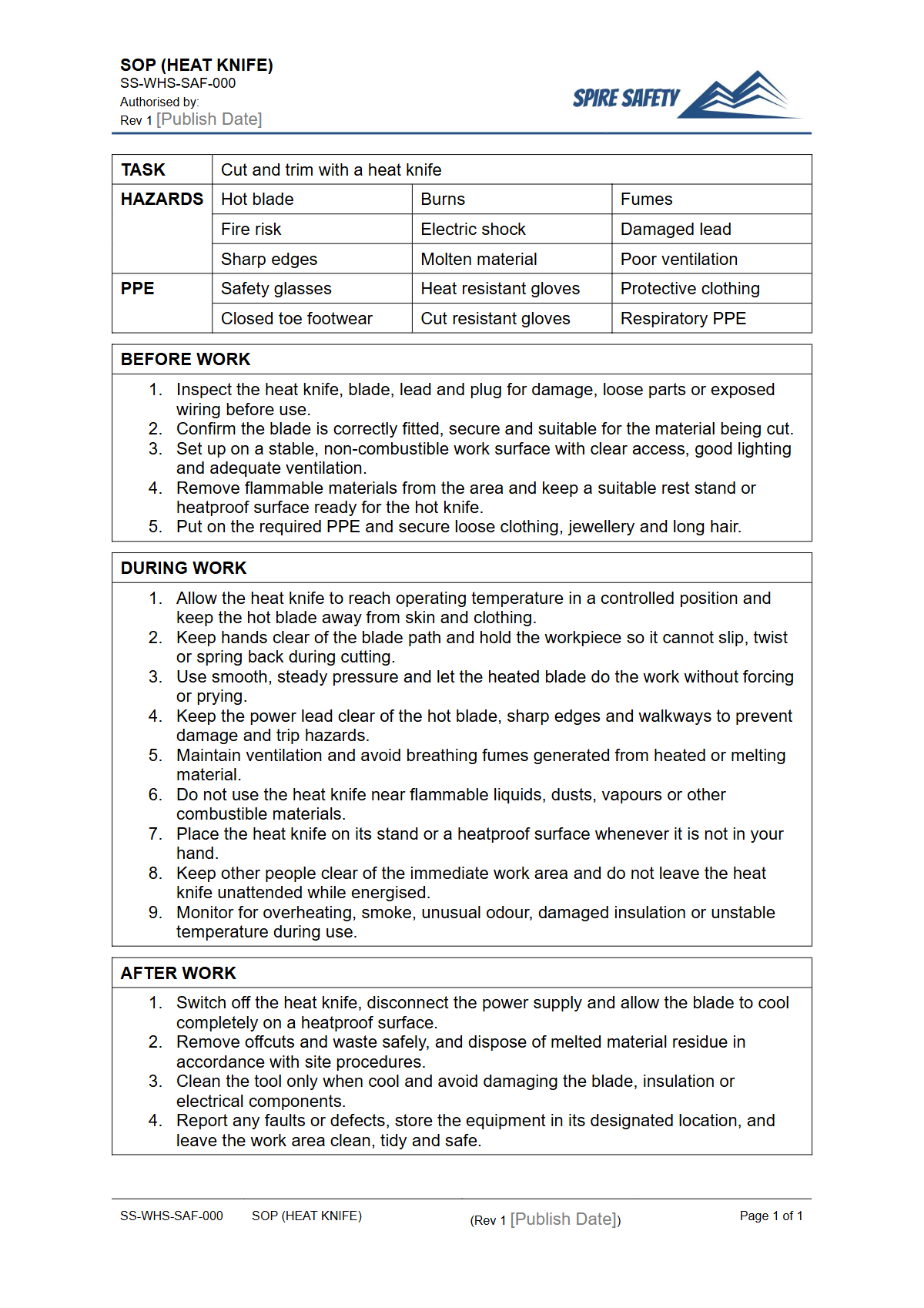
Download our free Safe Operating Procedure (Heat Knife) template to control risks associated with this high-heat tool. Get your customisable DOCX and PDF now.
Free Safe Operating Procedure (Heat Knife) Template
DOCX • 126 KB + PDF
Updated Oct 2026
No signup required
Purpose of the Free Safe Operating Procedure (Heat Knife) Template
A heat knife, also known as a hot knife or thermal cutter, is a valuable tool for cleanly cutting synthetic materials like rope, webbing, fabric, and foam. However, its operation involves significant risks, including severe thermal burns, electrical shock, and exposure to hazardous fumes.
This free Safe Operating Procedure (Heat Knife) template provides a structured framework for documenting the safest way to perform this task in your workplace. By establishing clear, step-by-step instructions, you can standardise safe work practices, assist in worker training, and demonstrate due diligence in managing workplace hazards.
Using a documented SOP helps your organisation meet its duty of care under Australian WHS laws by implementing a formal safe system of work. It systematically addresses the specific hazards associated with the equipment, much like a Safe Operating Procedure for a deep fryer manages risks from hot oil and surfaces.
The procedure encourages a proactive approach to safety, prompting users to consider potential risks before they begin work, rather than reacting to incidents after they occur.
What this Safe Operating Procedure covers
This template is designed to guide you in creating a comprehensive document that includes:
- Hazard identification related to the tool and task
- Required Personal Protective Equipment (PPE)
- Pre-operational safety checks
- Step-by-step instructions for safe operation
- Post-operational procedures, including cleaning and storage
- Emergency procedures
Video walkthrough
How to use the Free Safe Operating Procedure (Heat Knife) Template
This template is provided in both DOCX and PDF formats for your convenience. The DOCX file is fully editable, allowing for complete customisation to align with your specific operational context.
Integrating this procedure is a critical step in building robust WHS management systems that protect your workers and your business.
To get started, download the document and work through each section. You must consult with the workers who will be using the heat knife to ensure the procedure is practical and reflects the realities of the task.
Involve supervisors and health and safety representatives in the review process to gain their valuable input.
Please note: This is a template that we have created to be a starting point. You must customise it to reflect the specific heat knife models, materials being cut, work environments, and control measures present in your workplace.
Generic procedures are insufficient for ensuring safety.
When to use a Heat Knife SOP
A Safe Operating Procedure for a heat knife should be a living document integrated into your daily operations. It is not a file to be created once and forgotten.
Its primary use is during the training and induction of new workers, ensuring they learn the correct, safe method from the outset. It should also be readily available in the work area as a quick reference for all operators.
The SOP is a vital tool for supervisors conducting pre-start meetings or safety observations. Furthermore, it should be formally reviewed and updated on a regular basis, after any incident or near-miss, or whenever a new type of heat knife, material, or work process is introduced.
This ensures it remains relevant and effective, similar to the routine checks you would document in a free Air Compressor SOP for other workshop equipment.
Who should use this Procedure
The responsibility for using and maintaining a heat knife SOP extends across several roles within an organisation:
- Persons Conducting a Business or Undertaking (PCBUs) are responsible for providing safe systems of work, and a customised SOP is a key part of fulfilling this obligation.
- Supervisors and Managers must use the SOP to train workers, monitor compliance, and enforce safe work practices on the floor.
- Workers who operate the heat knife are the primary users. They must read, understand, and consistently follow the outlined procedure to protect themselves and their colleagues.
- WHS Managers and Safety Officers utilise the SOP as a cornerstone of the safety management system, using it as a benchmark during routine workplace inspections and formal WHS compliance auditing.
By defining clear instructions for high-risk equipment, your organisation establishes a consistent safety standard. Documenting procedures for powered hand tools is a common requirement; for instance, you might use a similar process for our FREE Circular Saw SOP Template to manage different but equally serious hazards. For a wider selection of procedural documents, you can browse our complete free WHS resources library.
Common mistakes
Common mistakes to avoid
- Using the heat knife in a poorly ventilated area, leading to fume inhalation.
- Placing the hot tool on a flammable surface or leaving it unattended while still hot.
- Failing to conduct pre-use inspections of the power cord and tool body for damage.
- Using the incorrect blade temperature or type for the material, resulting in poor cuts and increased fume production.
Legal references
Legal considerations
The following legal requirements may be relevant to this type of work.
- Work Health and Safety Act (Harmonised) — Provides the primary duties for protecting workers and other people from work health and safety risks.
- Work Health and Safety Regulations (Harmonised) — Sets out requirements supporting the management of workplace hazards and risks.
The following codes may be relevant to this type of work.
- Managing WHS Risks Code of Practice — Provides practical guidance on identifying hazards, assessing risks and applying effective controls.
- Work Health and Safety Consultation, Cooperation and Coordination Code of Practice — Provides practical guidance on consulting workers and coordinating with other duty holders.
- Managing the Work Environment and Facilities Code of Practice — Provides practical guidance on safe work environments, workplace facilities and related controls.
Did you know
Fume Hazards
Cutting plastics like PVC or ABS with a heat knife can release toxic fumes, including hydrogen chloride and hydrogen cyanide. Proper ventilation and respiratory protection are critical controls for this often-underestimated hazard.
Burn Severity
The blades of industrial heat knives can reach temperatures exceeding 500°C. Contact with a blade at this temperature, even for a fraction of a second, can cause severe third-degree burns requiring immediate medical intervention.
FAQ
Frequently asked questions
01What PPE is required when using a heat knife?
02How often should a Safe Operating Procedure for a heat knife be reviewed?
03Can a heat knife SOP cover different models and brands?
04What are the main hazards of using a heat knife?
Share this resource
Free Safe Operating Procedure (Heat Knife) Template
Browse Categories
How To Use It
- 1Download and open in Word or PDF.
- 2Replace the placeholders with your business details.
- 3Get it reviewed by a WHS specialist before rollout.
Need it customised?
Our WHS consultants can adapt this template to your site, run a gap analysis, or audit what you already have in place.
Book a Free Consultation WHS consulting servicesor call 1300 156 382
Related templates
- Free Safe Operating Procedure (Heat Press) Template
- Free Safe Operating Procedure (Heat Sealer) Template
- Free Safe Operating Procedure (Heat Shrink Tunnel) Template
- Free Safe Operating Procedure (Heat Stress Monitor) Template
- Free Safe Operating Procedure (Heat Treatment Blanket) Template
- Free Safe Operating Procedure (Hedge Hand Trimming) Template