
Free Safe Operating Procedure (Heat Sealer) Template
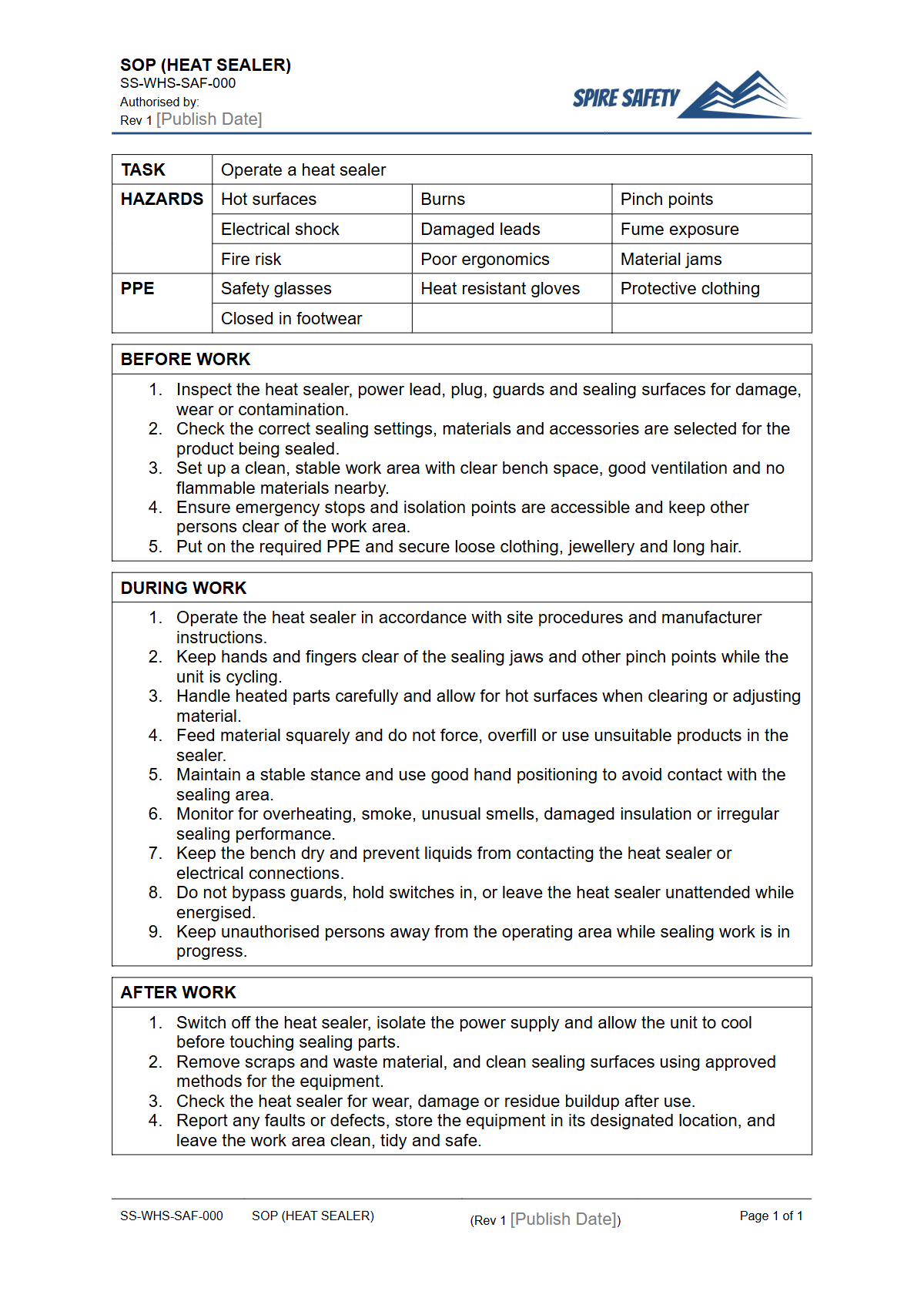
Formalise your safety protocols with our free Safe Operating Procedure (Heat Sealer) template. Download the customisable DOCX to define safe work methods.
Free Safe Operating Procedure (Heat Sealer) Template
DOCX • 126 KB + PDF
Updated Oct 2026
No signup required
Purpose of the Free Safe Operating Procedure (Heat Sealer) Template
This Free Safe Operating Procedure (Heat Sealer) Template provides a structured framework for documenting the risks and control measures associated with operating heat sealing equipment. Using a heat sealer introduces hazards such as severe burns from contact with hot surfaces, electrical shock, and potential entanglement in moving parts.
A documented SOP is a fundamental tool for ensuring workers are aware of these risks and understand the required steps to perform their tasks safely. It serves as a critical component within broader WHS management systems, helping your organisation meet its primary duty of care.
By clearly outlining pre-start checks, operational steps, and shutdown procedures, this template helps standardise safe work practices across all shifts and users. It forms the basis for consistent training and competency assessment, ensuring every operator handles the equipment in the same safe, predictable manner.
A well-developed SOP also provides a clear reference point during incident investigations or workplace inspections, demonstrating proactive risk management for common workshop equipment like heat sealers and air compressors. You can find a similar document with our free Air Compressor SOP template if needed.
What is a Safe Operating Procedure?
A Safe Operating Procedure (SOP) is a written document that provides step-by-step instructions on how to safely perform a specific task or operate a piece of machinery. It identifies potential hazards and outlines the control measures required to eliminate or minimise the risk of injury or illness.
An SOP is not just a technical manual; it is a practical safety tool used directly by workers at the point of operation.
Video walkthrough
How to use the Free Safe Operating Procedure (Heat Sealer) Template
This template is provided as a starting point in DOCX and PDF formats. It is designed to be adapted to the specific heat sealer models and work environments in your business.
To implement it effectively, you should consult with the workers and supervisors who operate the equipment daily. Their direct experience is invaluable for identifying all relevant hazards and practical control measures.
Follow these steps:
- Download the DOCX file.
- Review the content and add or remove sections to match your specific heat sealer (e.g., impulse sealer, continuous band sealer, vacuum sealer).
- Incorporate details such as brand, model, location, and unique operational steps or safety features.
- Define the required Personal Protective Equipment (PPE), such as heat-resistant gloves and safety glasses.
- Outline the procedure for clearing jams or performing routine cleaning.
- Have the final document reviewed and approved by a competent person, such as a supervisor or WHS manager.
- Train all relevant workers on the finalised SOP and keep records of this training.
Important: We have created this document as a guide based on common WHS principles. You must customise this Safe Operating Procedure to reflect the actual equipment, processes, and risks in your workplace.
This might include integrating it with procedures for associated machinery, such as those outlined in a Conveyer System SOP if the sealer is part of a production line.
When to use a Safe Operating Procedure
An SOP for a heat sealer should be a living document that is used actively within your workplace. It is not meant to be filed away and forgotten. Key times to use the SOP include:
- Worker Training and Induction: Use it as the primary training document for new operators to ensure they learn the correct, safe method from the start.
- Pre-operational Checks: Operators should reference the SOP's checklist before starting the machine to ensure safety guards are in place and the equipment is in good working order.
- Refresher Training: Periodically review the SOP with experienced workers to prevent complacency and reinforce safe behaviour.
- During Audits and Inspections: A current and well-utilised SOP is key evidence of a functioning safety system during formal WHS compliance auditing.
- Incident Investigations: If an incident or near miss occurs, the SOP should be reviewed to determine if the procedure was followed and if it needs to be updated to prevent a recurrence.
Who should use this Safe Operating Procedure
This document is intended for use by several groups within an organisation to ensure a comprehensive approach to safety.
- Operators: The primary users are the workers who operate the heat sealer daily. The SOP provides them with clear, accessible instructions to perform their job safely.
- Supervisors and Team Leaders: Supervisors use the SOP to train staff, monitor compliance, and enforce safe work practices on the floor. They are responsible for ensuring the procedures are understood and followed.
- WHS Managers and Personnel: Safety professionals use the SOP as a tool for risk assessment, training development, and auditing. They are often responsible for developing, reviewing, and updating the document in consultation with workers.
- Maintenance Staff: The SOP should include instructions on safe shutdown and lockout/tagout procedures, which are critical for anyone performing cleaning, maintenance, or repairs. In environments with multiple types of heating equipment, it's vital to have specific procedures for each, from industrial sealers to commercial kitchen appliances like those covered in a deep fryer SOP.
By implementing this procedure, you are taking a crucial step towards creating a safer work environment. For more templates and safety resources, explore our complete free WHS resources library.
Common mistakes
Common mistakes to avoid
- Using a generic template without customising it for the specific heat sealer model and workplace tasks.
- Failing to specify appropriate PPE, especially the type and rating of heat-resistant gloves.
- Neglecting to include lockout/tagout procedures for cleaning, clearing jams, and maintenance activities.
- Forgetting to schedule and conduct regular reviews of the SOP, leading to outdated and ineffective procedures.
Legal references
Legal considerations
The following legal requirements may be relevant to this type of work.
- Work Health and Safety Act (Harmonised) — Provides the primary duties for protecting workers and other people from work health and safety risks.
- Work Health and Safety Regulations (Harmonised) — Sets out requirements supporting the management of workplace hazards and risks.
The following codes may be relevant to this type of work.
- Managing WHS Risks Code of Practice — Provides practical guidance on identifying hazards, assessing risks and applying effective controls.
- Work Health and Safety Consultation, Cooperation and Coordination Code of Practice — Provides practical guidance on consulting workers and coordinating with other duty holders.
- Managing the Work Environment and Facilities Code of Practice — Provides practical guidance on safe work environments, workplace facilities and related controls.
Did you know
Burn Severity
Contact with a surface at just 70°C can cause a full-thickness burn in less than one second. Heat sealer bars can operate at temperatures well over 150°C, making immediate, severe injury a significant risk.
FAQ
Frequently asked questions
01What are the main hazards of using a heat sealer?
02How often should a heat sealer SOP be reviewed?
03Is specific training required to operate a heat sealer?
04What personal protective equipment (PPE) is needed for heat sealing?
Share this resource
Free Safe Operating Procedure (Heat Sealer) Template
Browse Categories
How To Use It
- 1Download and open in Word or PDF.
- 2Replace the placeholders with your business details.
- 3Get it reviewed by a WHS specialist before rollout.
Need it customised?
Our WHS consultants can adapt this template to your site, run a gap analysis, or audit what you already have in place.
Book a Free Consultation WHS consulting servicesor call 1300 156 382
Related templates
- Free Safe Operating Procedure (Heat Shrink Tunnel) Template
- Free Safe Operating Procedure (Heat Stress Monitor) Template
- Free Safe Operating Procedure (Heat Treatment Blanket) Template
- Free Safe Operating Procedure (Hedge Hand Trimming) Template
- Free Safe Operating Procedure (Hedge Trimmer) Template
- Free Safe Operating Procedure (HEPA Vacuum) Template