
Free Safe Operating Procedure (Hearing Aid Cleaning) Template
Standardise the safe cleaning of hearing aids in aged care or clinical settings with our structured template. Download your free SOP to get started today.
Free Safe Operating Procedure (Hearing Aid Cleaning) Template
DOCX • 126 KB + PDF
Updated Oct 2026
No signup required
Purpose of the Free Safe Operating Procedure (Hearing Aid Cleaning) Template
Proper cleaning and maintenance of hearing aids is a critical task in aged care facilities, audiology clinics, and home care settings. It directly impacts user health through infection control, extends the life of expensive devices, and ensures they function correctly.
This Free Safe Operating Procedure (Hearing Aid Cleaning) Template provides a structured framework for documenting a clear, step-by-step process. Using a standardised procedure helps your organisation ensure all workers perform the task consistently and safely, minimising risks to both the carer and the hearing aid user.
Implementing documented procedures like this SOP is a fundamental part of creating a robust safety culture. A formal SOP serves as a key document within broader WHS management systems, demonstrating a commitment to managing risks and providing clear instruction for high-frequency tasks.
It acts as a reliable training and reference tool, ensuring quality and safety standards are understood and met by every team member responsible for this duty of care.
Video walkthrough
How to use the Free Safe Operating Procedure (Hearing Aid Cleaning) Template
This template is available for download as a DOCX file for easy editing and customisation, as well as a PDF for quick reference. The goal is to adapt this document to your specific operational context.
You should detail the exact type of hearing aids serviced, the specific cleaning agents and tools approved for use in your facility, and the precise steps your workers must follow. Once customised, this Safe Operating Procedure becomes an official workplace document for training and daily use.
It is important to note that this template provides a starting point only. We have left sections blank for you to fill in, and you must customise the document to reflect the specific equipment, chemicals, and procedures used in your workplace. If you require assistance in tailoring this document or developing other WHS procedures, our WHS consulting services can provide expert guidance to ensure your documentation is fit for purpose.
What's Included in this SOP Template
Our template is logically structured to guide the user through the cleaning process safely. It is organised into sections that align with standard WHS practice for procedural documents.
Key Sections Include:
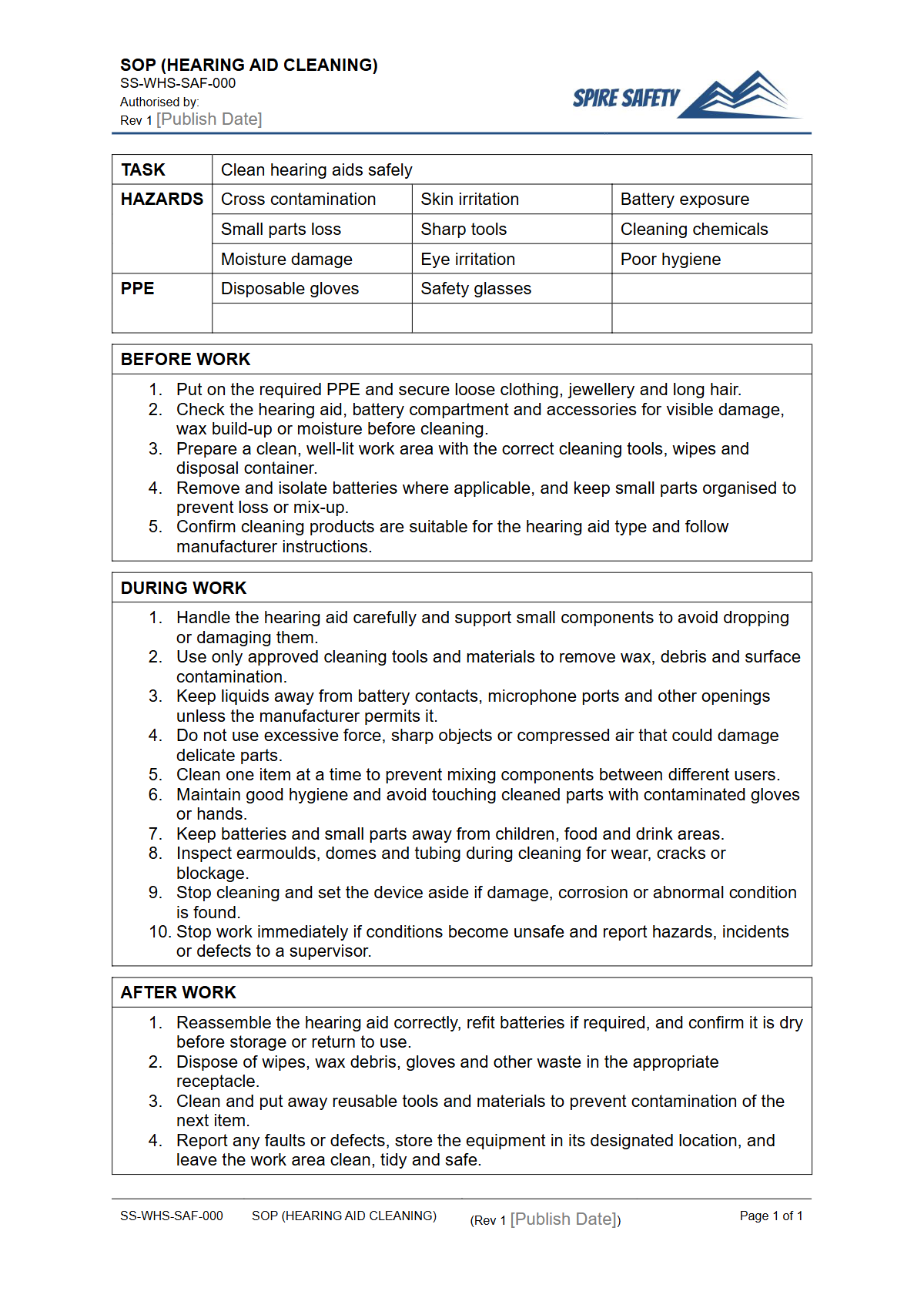
- Hazards & Risks: Identifies potential dangers such as biological exposure, chemical contact, and ergonomic strains.
- Personal Protective Equipment (PPE): Specifies necessary PPE, typically including disposable gloves, to ensure infection control.
- Pre-operational Checks: Outlines steps to take before cleaning begins, such as preparing a clean workspace and gathering the correct tools (soft cloth, brushes, wax picks).
- Step-by-Step Procedure: Provides a clear, sequential guide for the cleaning process itself, from wiping the exterior to clearing wax from vents and replacing filters.
- Post-cleaning Actions: Details procedures for waste disposal, tool sanitation, and safe storage of the hearing aid.
The principles of documenting a safe process are universal, whether for delicate clinical tasks or operating powerful equipment. Just as this SOP details a specific cleaning method, our FREE Circular Saw SOP Template outlines safe usage for high-risk machinery, demonstrating how the SOP format is adapted to manage different hazards.
When to use it
A well-developed Safe Operating Procedure should be integrated into your daily operations. It is not a document to be filed away and forgotten.
Its primary uses include being a core part of induction and training for new employees, serving as a refresher for existing staff, and acting as a quick-reference guide on the job. It provides a clear, authoritative source of information that minimises ambiguity and reinforces correct behaviour.
Furthermore, this SOP serves as critical evidence of your risk management processes during formal workplace inspections or WHS compliance audits. It demonstrates that your organisation has identified the risks associated with hearing aid cleaning and has implemented a controlled, documented procedure to manage them effectively, fulfilling key duties under WHS legislation.
Who should use it
This Safe Operating Procedure is designed for any individual tasked with cleaning and maintaining hearing aids. This includes a range of roles such as Personal Care Assistants (PCAs) in aged care, Registered Nurses, Audiologists, audiology support staff, and family carers trained by a professional.
Supervisors and managers should also use the document to oversee training and verify that the established procedures are being followed correctly.
For organisations seeking higher levels of certification, documented processes are non-negotiable. Procedures like this SOP form the foundational evidence needed for ISO 45001 consulting and accreditation, proving that operational activities are controlled and aligned with international safety standards.
Many clinics and care facilities use a variety of equipment beyond hearing aids. For instance, some audiology labs use compressed air for cleaning and drying processes.
For such equipment, a separate, specific SOP is essential, much like our Free Air Compressor SOP Template, to ensure every task is managed safely.
By implementing this SOP, your team can confidently perform their duties, ensuring the health and safety of clients while protecting the integrity of valuable devices. To find more templates for your workplace, browse our complete free WHS resources library.
Common mistakes
Common mistakes to avoid
- Using household cleaners, alcohol, or solvents which can damage the hearing aid's casing and electronics.
- Forgetting to regularly check and replace disposable parts like wax guards and domes, leading to blockages.
- Allowing moisture to enter the microphone or receiver ports during cleaning.
- Using sharp, improper tools like pins or paperclips to clear blockages, which can cause permanent damage.
Legal references
Legal considerations
The following legal requirements may be relevant to this type of work.
- Work Health and Safety Act (Harmonised) — Provides the primary duties for protecting workers and other people from work health and safety risks.
- Work Health and Safety Regulations (Harmonised) — Sets out requirements supporting the management of workplace hazards and risks.
The following codes may be relevant to this type of work.
- Managing WHS Risks Code of Practice — Provides practical guidance on identifying hazards, assessing risks and applying effective controls.
- Work Health and Safety Consultation, Cooperation and Coordination Code of Practice — Provides practical guidance on consulting workers and coordinating with other duty holders.
- Managing the Work Environment and Facilities Code of Practice — Provides practical guidance on safe work environments, workplace facilities and related controls.
Did you know
Hearing Aid Lifespan
Proper, regular cleaning and maintenance can significantly extend the life of a hearing aid, which typically lasts between three to seven years, preventing costly premature replacements.
Australian Hearing Loss
Over 3.6 million Australians are affected by hearing loss. This figure highlights the growing importance of related care services, including the proper maintenance of hearing devices in clinical and aged care settings.
FAQ
Frequently asked questions
01Why do I need a formal SOP for cleaning a hearing aid?
02Can I use this template in an aged care facility in NSW?
03What are the main hazards when cleaning hearing aids?
04How often should a Safe Operating Procedure be reviewed?
Share this resource
Free Safe Operating Procedure (Hearing Aid Cleaning) Template
Browse Categories
How To Use It
- 1Download and open in Word or PDF.
- 2Replace the placeholders with your business details.
- 3Get it reviewed by a WHS specialist before rollout.
Need it customised?
Our WHS consultants can adapt this template to your site, run a gap analysis, or audit what you already have in place.
Book a Free Consultation WHS consulting servicesor call 1300 156 382
Related templates
- Free Safe Operating Procedure (Heat Knife) Template
- Free Safe Operating Procedure (Heat Press) Template
- Free Safe Operating Procedure (Heat Sealer) Template
- Free Safe Operating Procedure (Heat Shrink Tunnel) Template
- Free Safe Operating Procedure (Heat Stress Monitor) Template
- Free Safe Operating Procedure (Heat Treatment Blanket) Template