
Free Safe Operating Procedure (Hay Bale Handling) Template
Handling hay bales presents significant risks. Our free Safe Operating Procedure for Hay Bale Handling template helps you document controls. Download now.
Free Safe Operating Procedure (Hay Bale Handling) Template
DOCX • 126 KB + PDF
Updated Oct 2026
No signup required
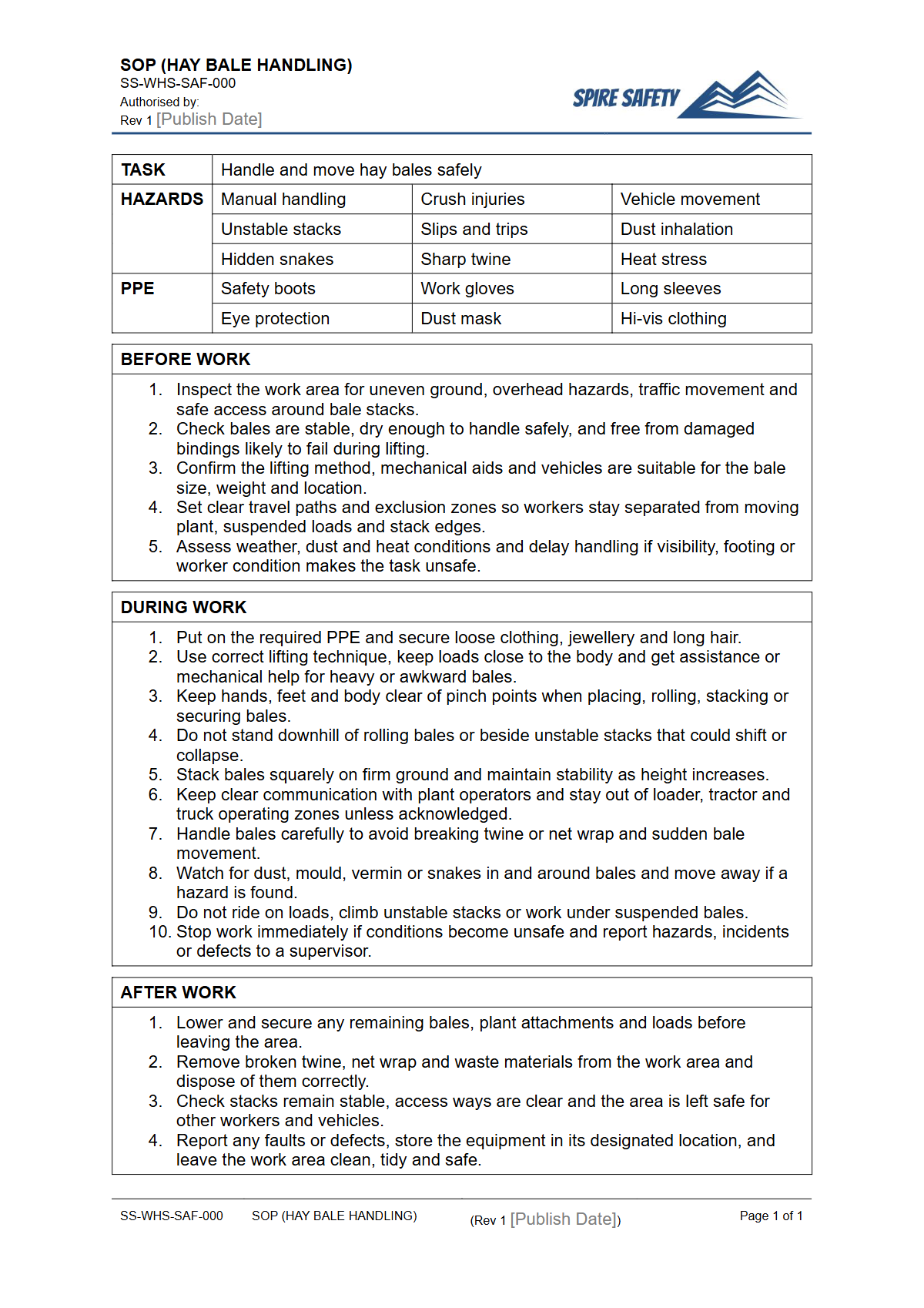
Purpose of the Free Safe Operating Procedure (Hay Bale Handling) Template
Working with hay bales, whether round or square, is a high-risk activity common in agricultural settings. This free Safe Operating Procedure (Hay Bale Handling) Template provides a structured starting point for documenting the hazards and control measures associated with this task.
Bales can be extremely heavy and unstable, creating risks of crushing, musculoskeletal injuries from manual handling, vehicle incidents, and even fire from spontaneous combustion. Using a formal SOP helps a Person Conducting a Business or Undertaking (PCBU) meet their primary duty of care by establishing and communicating a safe system of work.
This template is designed to help you outline step-by-step instructions for tasks such as loading, unloading, transporting, and stacking hay bales. It prompts consideration of machinery use, personal protective equipment (PPE), emergency procedures, and training requirements.
By formalising these processes, you create a clear, consistent, and safe approach that can be used to induct and train workers, reducing the likelihood of serious incidents.
Video walkthrough
How to use the Free Safe Operating Procedure (Hay Bale Handling) Template
This document serves as a comprehensive template, not a finished procedure. To use it effectively, download the DOCX file and adapt it to the specific context of your farm or workplace.
This process involves a thorough risk assessment of your hay handling operations.
You must customise the content to reflect your unique circumstances. We have no way of knowing your specific equipment, bale types and sizes, site conditions, or worker competency levels. Your customisation should detail:
- The specific makes and models of machinery used (e.g., tractors, loaders).
- The attachments required for the job (e.g., bale spikes, grabs).
- Procedures for handling both round and square bales, as they require different techniques.
- Site-specific hazards, such as uneven ground, slopes, or proximity to overhead power lines.
- Your organisation’s specific emergency and first aid procedures.
Integrating this SOP into your broader safety framework is crucial for its effectiveness. A well-documented procedure is a key component of robust WHS management systems, demonstrating a commitment to proactive risk management.
When to use it
A Safe Operating Procedure for hay bale handling should be developed and implemented before any related work commences. It is a foundational document that forms part of your overall safety planning.
It should be used as a primary reference tool during worker training and inductions to ensure everyone understands the established safe work method. Supervisors should use the SOP to monitor work practices and ensure procedures are being followed correctly.
The SOP should also be reviewed and referenced before each major hay handling period, such as during baling season or when transporting large quantities of feed. It is a living document that should be updated whenever a new hazard is identified, after an incident occurs, or when new machinery is introduced.
Regular reviews, often as part of routine WHS compliance auditing, ensure the procedure remains relevant and effective.
Who should use it
This SOP should be used by all individuals involved in hay bale handling operations. This includes:
- PCBUs and Farm Owners: To fulfil their legal obligation to provide a safe working environment and safe systems of work.
- Managers and Supervisors: To train, instruct, and supervise workers, ensuring they adhere to the documented safety procedures.
- Workers and Operators: As a practical guide for performing their tasks safely. They should be actively involved in the development and review of the SOP, as their hands-on experience is invaluable for identifying practical risks and controls.
Competency is critical when operating machinery for bale handling. For example, if a telehandler is used, operators must be trained and competent.
Our FREE Telehandler SOP Template can be used alongside this document to provide machine-specific guidance. Similarly, other common agricultural tasks require documented procedures, such as those outlined in our FREE Spreader SOP Template, which can complement your overall farm safety system.
This ensures all high-risk activities are managed with the same level of diligence. For more specialised seeding operations, our FREE Grain Drill SOP Template offers a dedicated framework.
You can explore our entire free WHS resources library for more templates to support your operations.
Common mistakes
Common mistakes to avoid
- Using incorrect or poorly maintained handling equipment, such as the wrong tractor attachments.
- Building unstable stacks by going too high, on uneven ground, or by not interlocking bales correctly.
- Failing to check for overhead power lines and other obstructions before stacking or loading.
- Allowing untrained personnel, visitors, or children near active bale handling operations.
Legal references
Legal considerations
The following legal requirements may be relevant to this type of work.
- Work Health and Safety Act (Harmonised) — Provides the primary duties for protecting workers and other people from work health and safety risks.
- Work Health and Safety Regulations (Harmonised) — Sets out requirements supporting the management of workplace hazards and risks.
The following codes may be relevant to this type of work.
- Managing WHS Risks Code of Practice — Provides practical guidance on identifying hazards, assessing risks and applying effective controls.
- Work Health and Safety Consultation, Cooperation and Coordination Code of Practice — Provides practical guidance on consulting workers and coordinating with other duty holders.
- Managing the Work Environment and Facilities Code of Practice — Provides practical guidance on safe work environments, workplace facilities and related controls.
Did you know
Bale Weight
A single large round hay bale can weigh over 800 kilograms, posing a significant crush risk if it becomes unstable or rolls unexpectedly.
Fire Risk
Hay bales can spontaneously combust if baled with high moisture content (over 20%). The internal heat generated by microbial activity can reach ignition temperatures without an external spark.
FAQ
Frequently asked questions
01What are the main hazards of handling hay bales?
02Does this SOP cover both round and square hay bales?
03Is a Safe Operating Procedure a legal requirement for handling hay bales in Australia?
04What PPE is recommended for handling hay bales?
Share this resource
Free Safe Operating Procedure (Hay Bale Handling) Template
Browse Categories
How To Use It
- 1Download and open in Word or PDF.
- 2Replace the placeholders with your business details.
- 3Get it reviewed by a WHS specialist before rollout.
Need it customised?
Our WHS consultants can adapt this template to your site, run a gap analysis, or audit what you already have in place.
Book a Free Consultation WHS consulting servicesor call 1300 156 382
Related templates
- Free Safe Operating Procedure (Hay Bale Stacking) Template
- Free Safe Operating Procedure (Hazardous Waste Intake) Template
- Free Safe Operating Procedure (Hearing Aid Cleaning) Template
- Free Safe Operating Procedure (Heat Knife) Template
- Free Safe Operating Procedure (Heat Press) Template
- Free Safe Operating Procedure (Heat Sealer) Template