
Free Safe Operating Procedure (Hay Bale Stacking) Template
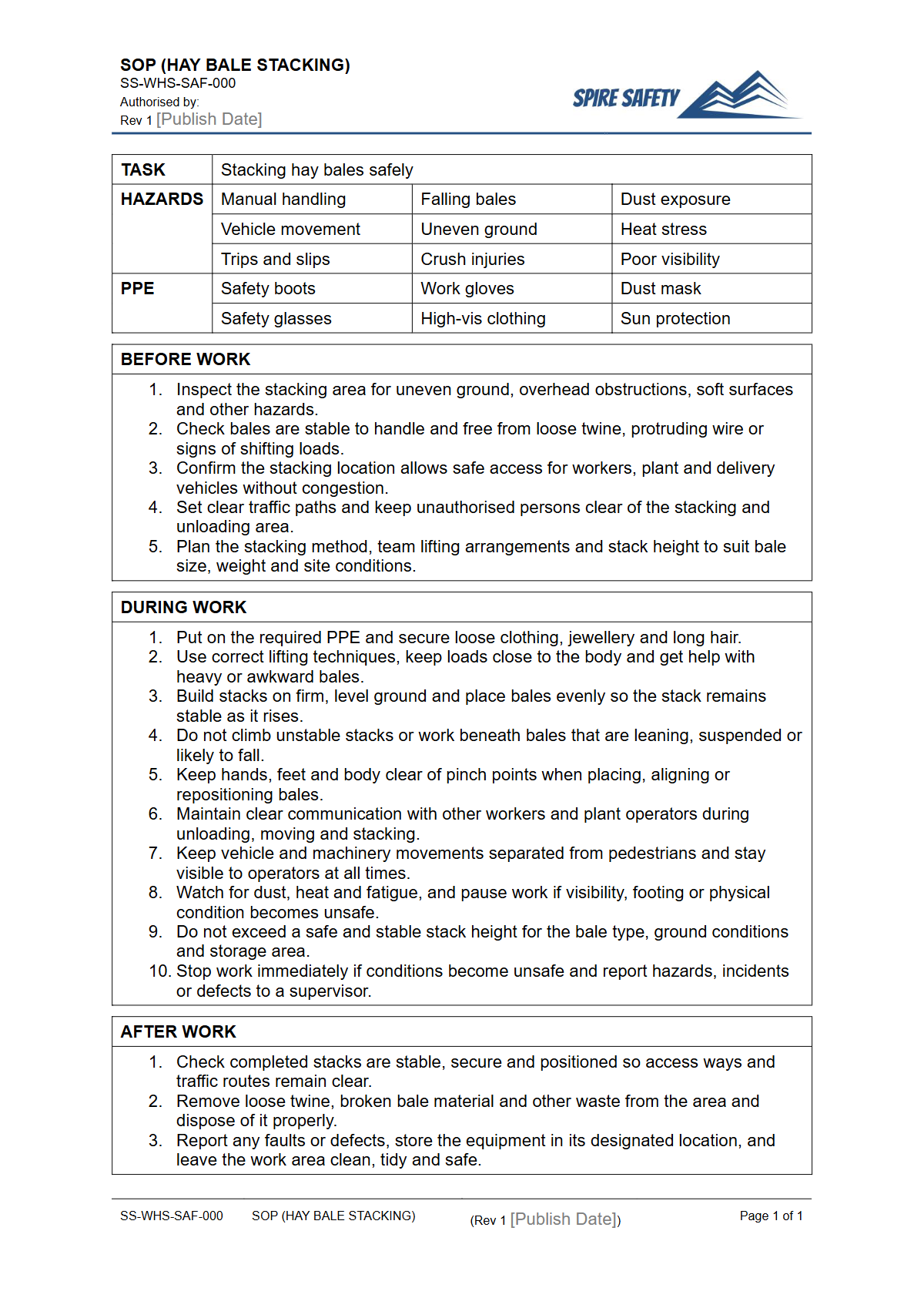
Download our free Safe Operating Procedure for hay bale stacking to formalise your safety processes.
Free Safe Operating Procedure (Hay Bale Stacking) Template
DOCX • 126 KB + PDF
Updated Oct 2026
No signup required
Purpose of the Free Safe Operating Procedure (Hay Bale Stacking) Template
Working with hay bales, whether large round or square, presents significant safety risks that must be managed. This free Safe Operating Procedure (Hay Bale Stacking) Template provides a structured framework for documenting the required steps to perform the task safely.
Stacking hay is a high-risk activity involving potential for stack collapse, falls from height, fire from spontaneous combustion, and incidents with heavy machinery. Implementing a formal SOP helps a Person Conducting a Business or Undertaking (PCBU) fulfil their primary duty of care under Australian WHS legislation by controlling these known hazards.
A documented procedure ensures that all workers, from new starters to experienced hands, follow a consistent, pre-approved method for stacking. It serves as a critical training tool and a reference point for safe work practices.
By outlining key steps, required personal protective equipment (PPE), and emergency responses, this SOP helps embed safety into your farm's daily operations, reducing the likelihood of serious incidents and injuries. Using this template helps formalise your risk management process for one of the most common tasks in agriculture.
Video walkthrough
How to use the Free Safe Operating Procedure (Hay Bale Stacking) Template
This resource is available for immediate download as a DOCX file, which can be easily edited in Microsoft Word or other compatible software, and as a PDF for easy printing and distribution. The template is designed as a foundation, outlining the typical sections of an SOP, including task description, risk assessment, control measures, and pre-operational checks.
Your first step is to download the document and thoroughly review its contents against your specific operational context.
Important: You must customise this template to your specific workplace, equipment, bale types (round, square, high-density), and local conditions. We've provided a structured starting point aligned with Australian WHS principles, but you are responsible for conducting a site-specific risk assessment and integrating its findings into the final document.
This includes integrating it with other procedures, such as a specific telehandler SOP template if that machinery is used for stacking.
When to use a Safe Operating Procedure
A Safe Operating Procedure for hay bale stacking should be a living document within your safety management system. It is not a 'set and forget' tool.
It should be used consistently during worker induction and training to establish a baseline for safe performance. It also serves as an essential guide for pre-task planning, allowing supervisors and workers to review hazards and controls before work begins.
The SOP should be readily accessible in the work area for quick reference.
Furthermore, it should be reviewed and updated periodically, especially after an incident or near-miss, when new machinery is introduced, or when work practices change. Regular reviews ensure the procedure remains relevant and effective.
A robust set of SOPs forms a critical part of larger WHS management systems, demonstrating proactive risk management to regulators and stakeholders.
Who should use it
This template is designed for anyone with health and safety responsibilities in an agricultural setting. This includes farm owners, managers, and supervisors who are responsible for developing and implementing safe work systems.
They can use this SOP to train workers, monitor compliance, and meet their WHS obligations. The procedure is also a vital tool for workers and machinery operators who perform the task of stacking hay, as it clearly communicates the expected safety standards and steps they must follow to protect themselves and others.
Developing an effective SOP should always involve consultation with the workers who actually perform the task. Their direct experience is invaluable for identifying practical hazards and effective control measures.
If you require specialised guidance in adapting this template or developing procedures for other high-risk tasks, engaging professional WHS consulting services can provide tailored support for your business.
Beyond stacking, safe machinery operation is paramount across all farm activities, which is why having procedures like a grain drill SOP is equally important for managing risks associated with specific equipment. The principles of identifying hazards, assessing risks, and implementing controls are universal across all agricultural tasks. Similar principles of pre-operational checks and safe handling apply to other equipment, as detailed in resources like our spreader SOP.
By systematically addressing risks through documented procedures, you build a stronger safety culture and a more resilient farming operation. For more templates and guides to support your safety efforts, we encourage you to explore our entire free WHS resources library, which covers a wide range of equipment and high-risk work.
Common mistakes
Common mistakes to avoid
- Stacking bales on uneven, soft, or sloping ground, compromising stack stability.
- Failing to monitor bale moisture content, leading to an increased risk of mould and spontaneous combustion.
- Using an unstable stacking pattern instead of an interlocking or stepped method to tie the stack together.
- Allowing untrained or unauthorised personnel to operate machinery or work in the vicinity of stacking operations.
Legal references
Legal considerations
The following legal requirements may be relevant to this type of work.
- Work Health and Safety Act (Harmonised) — Provides the primary duties for protecting workers and other people from work health and safety risks.
- Work Health and Safety Regulations (Harmonised) — Sets out requirements supporting the management of workplace hazards and risks.
The following codes may be relevant to this type of work.
- Managing WHS Risks Code of Practice — Provides practical guidance on identifying hazards, assessing risks and applying effective controls.
- Work Health and Safety Consultation, Cooperation and Coordination Code of Practice — Provides practical guidance on consulting workers and coordinating with other duty holders.
- Managing the Work Environment and Facilities Code of Practice — Provides practical guidance on safe work environments, workplace facilities and related controls.
Did you know
Spontaneous Combustion
Hay bales can spontaneously combust if stacked with a moisture content over 20%. The internal heat generated by microbial activity can build up to the point of ignition, creating a serious fire risk.
Bale Weight
A single large round or square hay bale can weigh from 500 kg to over 800 kg. A falling or rolling bale poses a significant crush risk to anyone nearby.
FAQ
Frequently asked questions
01What are the main hazards of stacking hay bales?
02How high can you legally stack hay bales in Australia?
03Does this SOP template cover using specific machinery like a telehandler?
04Why can't I just use this template as is for my farm?
Share this resource
Free Safe Operating Procedure (Hay Bale Stacking) Template
Browse Categories
How To Use It
- 1Download and open in Word or PDF.
- 2Replace the placeholders with your business details.
- 3Get it reviewed by a WHS specialist before rollout.
Need it customised?
Our WHS consultants can adapt this template to your site, run a gap analysis, or audit what you already have in place.
Book a Free Consultation WHS consulting servicesor call 1300 156 382
Related templates
- Free Safe Operating Procedure (Hazardous Waste Intake) Template
- Free Safe Operating Procedure (Hearing Aid Cleaning) Template
- Free Safe Operating Procedure (Heat Knife) Template
- Free Safe Operating Procedure (Heat Press) Template
- Free Safe Operating Procedure (Heat Sealer) Template
- Free Safe Operating Procedure (Heat Shrink Tunnel) Template