
Free Safe Operating Procedure (Harvester Head) Template
Our Free Safe Operating Procedure (Harvester Head) Template provides a structured starting point for managing risks. Download your free DOCX and PDF now.
Free Safe Operating Procedure (Harvester Head) Template
DOCX • 126 KB + PDF
Updated Oct 2026
No signup required
Purpose of the Free Safe Operating Procedure (Harvester Head) Template
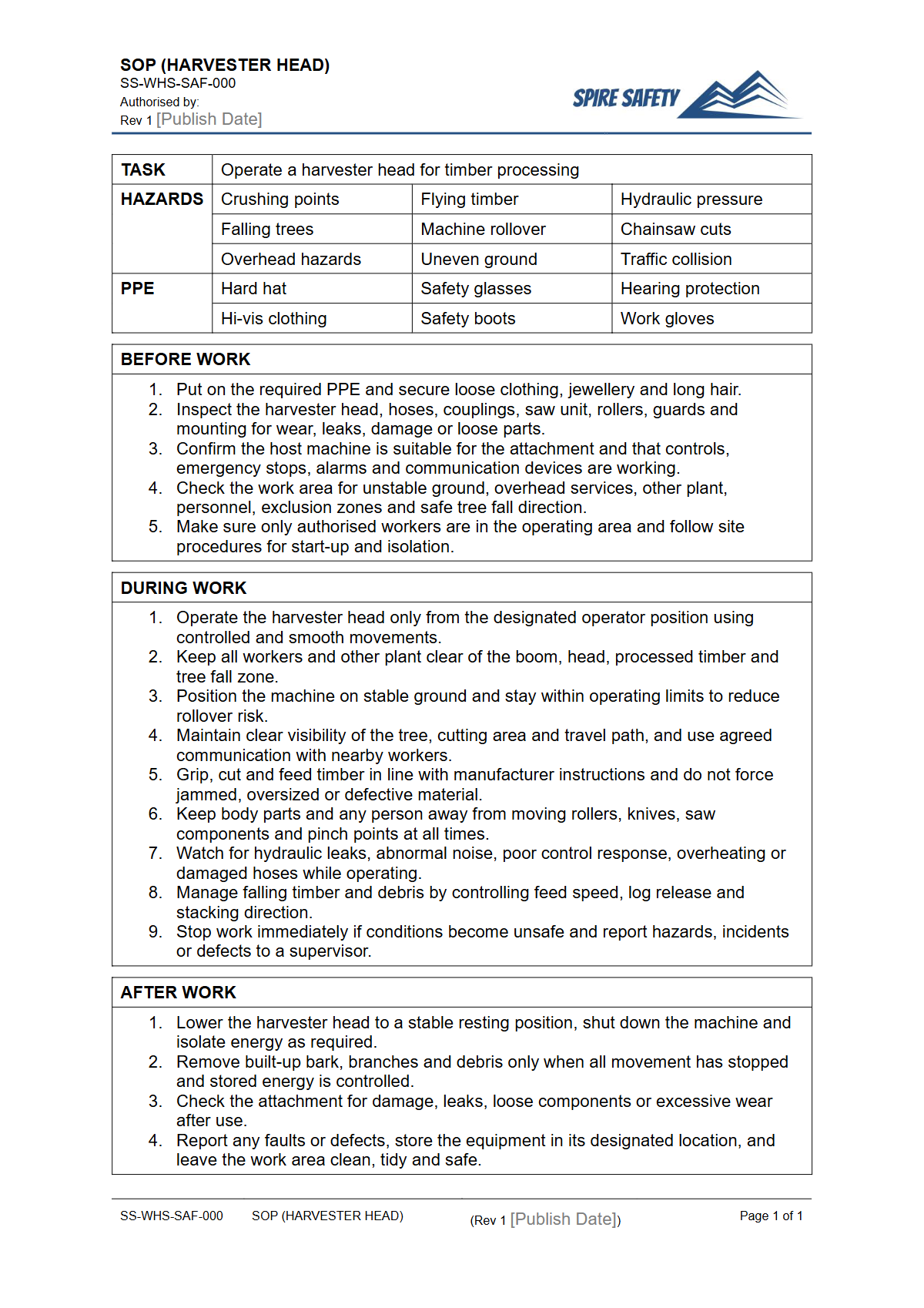
Operating a harvester head involves significant risks, from entanglement in moving parts to being struck by ejected material or the machine itself. This free Safe Operating Procedure (Harvester Head) Template provides a framework for documenting a formal, step-by-step process to perform tasks safely.
Using this Safe Operating Procedure helps organisations meet their primary duty of care by identifying hazards, implementing risk controls, and providing clear instructions to operators. It is a critical component for managing high-risk work associated with mechanised logging, land clearing, and agricultural operations.
A documented SOP ensures that safety is approached consistently across all shifts and operators. It covers pre-start checks, operational steps, shutdown procedures, and emergency responses, forming a vital part of your overall safety framework.
Integrating such procedures is a cornerstone of effective WHS management systems, demonstrating a proactive commitment to workplace health and safety.
Video walkthrough
How to use the Free Safe Operating Procedure (Harvester Head) Template
This template is provided as a starting point in both DOCX and PDF formats. Download the DOCX file to edit and adapt it to the specific machinery and operational context of your workplace.
It is essential to conduct a site-specific risk assessment for your harvester head and the tasks it performs, incorporating the findings into the final document. This process should involve consultation with operators and other relevant workers who have direct experience with the equipment.
Important: This is a template and not a complete Safe Operating Procedure. We have populated it with common headings and sections, but you must customise it with details specific to your machinery, site conditions, and legal obligations.
Your final SOP should reflect the manufacturer's operating manual and any specific safety features or hazards of your model. Similar to how you would adapt our FREE Telehandler SOP Template, the value comes from tailoring the content to your environment.
When to use a Safe Operating Procedure
A Safe Operating Procedure for a harvester head should be a core document used throughout the equipment's lifecycle at your workplace. It is not a document to be filed away and forgotten.
It must be used during the induction and training of new operators to establish a baseline of safe behaviour. The SOP should be readily available in the work area for quick reference by experienced operators, especially when tasks are non-routine.
Furthermore, the SOP serves as a key reference tool for refresher training sessions and for toolbox talks focusing on specific hazards. Following any incident, near miss, or significant change in work procedures (such as acquiring a new type of harvester head), the SOP must be reviewed and updated to ensure it remains relevant and effective.
Engaging professional guidance through WHS consulting can assist in developing robust review triggers and incident investigation processes.
Who should use this Safe Operating Procedure
This document is intended for use by anyone responsible for safety in environments where harvester heads are operated. This includes Persons Conducting a Business or Undertaking (PCBUs), who have the ultimate responsibility for ensuring a safe workplace.
It is also a critical tool for frontline leaders, such as supervisors and team leaders, who oversee daily operations and must enforce safe work practices.
Most importantly, the SOP is for the machinery operators themselves. It provides them with clear, unambiguous instructions on how to operate the equipment safely, protecting themselves and others in the vicinity. WHS managers and safety officers will also use this template as part of a broader library of procedural documents, just as they might use a FREE Grain Drill SOP Template for agricultural tasks. Ensuring all relevant personnel are trained on and have access to the SOP is fundamental to its success.
Common mistakes
Common mistakes to avoid
- Failing to establish and maintain a proper exclusion zone around the machine during operation.
- Attempting to clear jams or perform maintenance without fully de-energising and isolating the machine's power sources.
- Neglecting daily pre-start checks, particularly inspections of hydraulic hoses, cutting chains, and safety guards.
- Operating the machine on ground that is too steep or unstable for its specifications, leading to rollovers.
Legal references
Legal considerations
The following legal requirements may be relevant to this type of work.
- Work Health and Safety Act (Harmonised) — Provides the primary duties for protecting workers and other people from work health and safety risks.
- Work Health and Safety Regulations (Harmonised) — Sets out requirements supporting the management of workplace hazards and risks.
The following codes may be relevant to this type of work.
- Managing WHS Risks Code of Practice — Provides practical guidance on identifying hazards, assessing risks and applying effective controls.
- Work Health and Safety Consultation, Cooperation and Coordination Code of Practice — Provides practical guidance on consulting workers and coordinating with other duty holders.
- Managing the Work Environment and Facilities Code of Practice — Provides practical guidance on safe work environments, workplace facilities and related controls.
Did you know
Extreme Forces
Modern harvester heads can delimb and cut a tree to length in seconds. The feed rollers can pull a tree trunk through at speeds exceeding 5 metres per second, generating immense power and requiring strict exclusion zones.
Industry Risk
The forestry and logging industry consistently ranks as one of the most hazardous industries in Australia. Effective risk management, including the use of detailed SOPs for machinery, is critical to preventing serious injuries and fatalities.
FAQ
Frequently asked questions
01What are the primary hazards associated with operating a harvester head?
02Is a Safe Operating Procedure a legal requirement for harvester heads in Australia?
03How often should a harvester head SOP be reviewed?
04Can a generic SOP be used for different models of harvester heads?
Share this resource
Free Safe Operating Procedure (Harvester Head) Template
Browse Categories
How To Use It
- 1Download and open in Word or PDF.
- 2Replace the placeholders with your business details.
- 3Get it reviewed by a WHS specialist before rollout.
Need it customised?
Our WHS consultants can adapt this template to your site, run a gap analysis, or audit what you already have in place.
Book a Free Consultation WHS consulting servicesor call 1300 156 382
Related templates
- Free Safe Operating Procedure (Hay Bale Handling) Template
- Free Safe Operating Procedure (Hay Bale Stacking) Template
- Free Safe Operating Procedure (Hazardous Waste Intake) Template
- Free Safe Operating Procedure (Hearing Aid Cleaning) Template
- Free Safe Operating Procedure (Heat Knife) Template
- Free Safe Operating Procedure (Heat Press) Template