
Free Safe Operating Procedure (Hardscape Cleaning) Template
Establish clear safety protocols for cleaning hardscapes like concrete, pavers, and stone with pressure washers. Download our free template to get started.
Free Safe Operating Procedure (Hardscape Cleaning) Template
DOCX • 126 KB + PDF
Updated Oct 2026
No signup required
Purpose of the Free Safe Operating Procedure (Hardscape Cleaning) Template
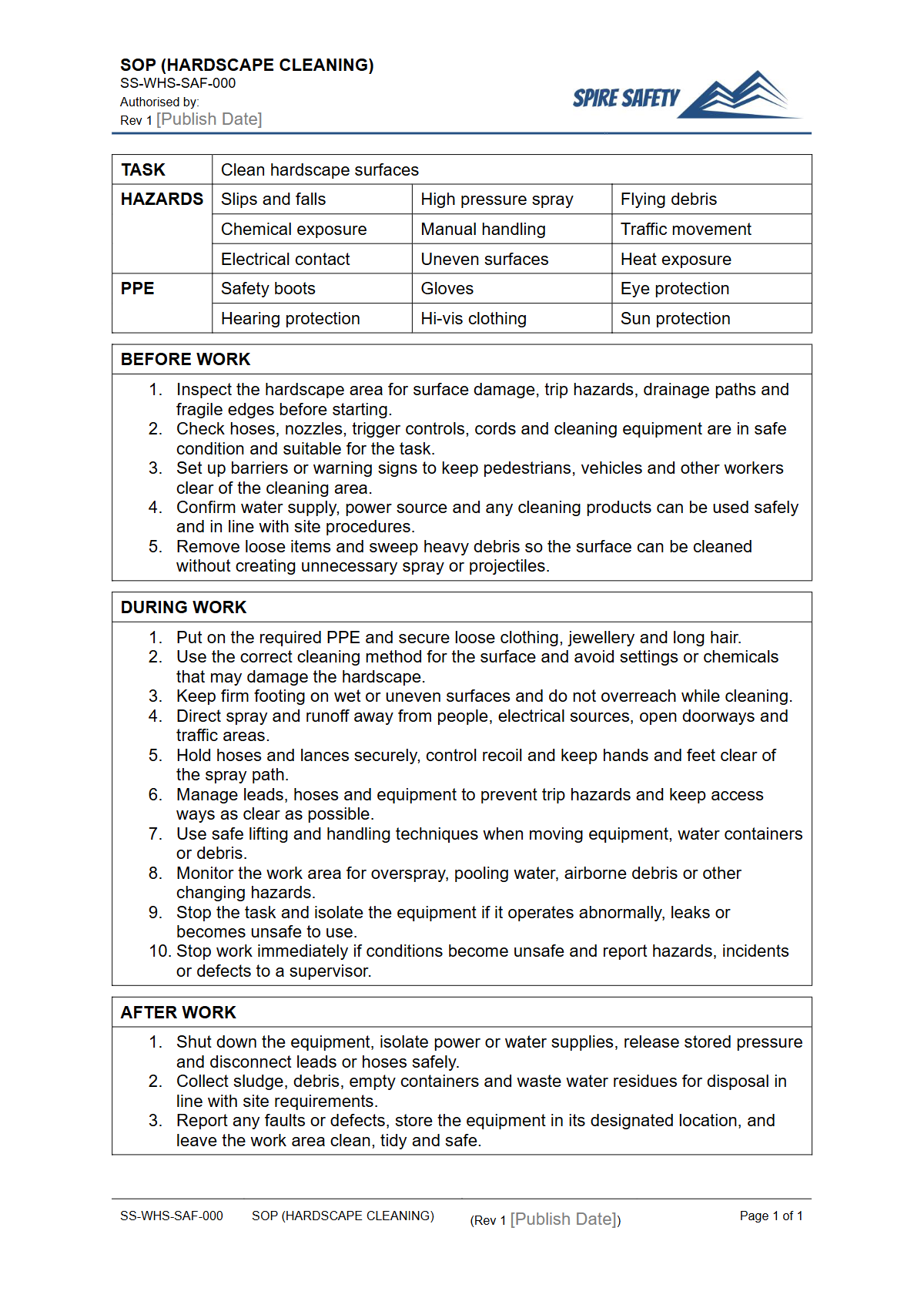
This Free Safe Operating Procedure (Hardscape Cleaning) Template provides a structured framework for documenting the required steps to safely clean exterior hard surfaces. Hardscape cleaning, which often involves high-pressure water jetting and chemical agents, presents significant risks, including high-pressure injection injuries, chemical exposure, slips and trips, and noise-induced hearing loss.
Using a Safe Operating Procedure (SOP) helps to control these hazards by standardising work methods, outlining required personal protective equipment (PPE), and ensuring all workers are trained on a consistent, safe process. A well-developed SOP is a critical component of a proactive safety culture and an effective tool for meeting your Work Health and Safety (WHS) obligations.
Implementing documented procedures for high-risk tasks like hardscape cleaning is a fundamental part of a holistic safety framework. These individual documents serve as practical, on-the-ground tools that support broader WHS management systems, ensuring that organisational safety policies are translated into safe work practices.
Key Hazards in Hardscape Cleaning
- High-Pressure Water Injection: Water jets from commercial pressure washers can easily pierce skin and underlying tissues, causing severe injuries that require immediate medical attention.
- Chemical Exposure: Cleaning agents, acids, or degreasers can cause skin burns, eye damage, or respiratory issues if handled improperly.
- Slips, Trips, and Falls: Wet surfaces and trailing hoses create a significant risk of falls.
- Electric Shock: Using electrical equipment in wet environments poses a serious risk of electrocution if equipment is not properly maintained or used.
- Noise: Petrol or diesel-powered pressure washers can generate high noise levels, potentially leading to permanent hearing damage over time.
- Flying Debris: High-pressure jets can dislodge dirt, gravel, and other projectiles, creating a risk of eye or impact injuries.
Video walkthrough
How to use the Free Safe Operating Procedure (Hardscape Cleaning) Template
Our Free Safe Operating Procedure (Hardscape Cleaning) Template is provided as a fully editable DOCX file and a print-ready PDF. It is designed as a comprehensive starting point, aligned with the principles of Australia's model WHS framework.
To use it effectively, download the document and integrate the specific details of your workplace's equipment, chemicals, and environment.
Important: This is a template only. We have provided a structured guide, but you must customise this document to reflect your unique operational context.
This includes specifying the make and model of your pressure washer, listing the exact chemicals used (and referencing their Safety Data Sheets), identifying site-specific hazards, and detailing your emergency procedures. The final SOP should be reviewed and approved by a competent person before being issued to workers.
If you need assistance with this customisation and risk assessment process, our WHS consulting team can provide expert support.
Key Customisation Areas
- Plant and Equipment: List the specific make and model of pressure washers, lances, nozzles, and any other equipment used.
- Chemicals: Name all cleaning chemicals used. Reference the location of their Safety Data Sheets (SDS) and summarise key handling precautions, first aid, and PPE requirements. li>Personal Protective Equipment (PPE): Detail the mandatory PPE, such as impact-rated safety glasses or goggles, waterproof steel-toed boots, hearing protection, gloves, and any required respiratory protection.
- Site-Specific Hazards: Add any hazards unique to your work areas, such as proximity to the public, overhead power lines, or sensitive environmental receptors.
- Emergency Procedures: Outline steps for responding to incidents like chemical spills, high-pressure injection injuries, or electric shock.
When to use this Safe Operating Procedure
An SOP for hardscape cleaning should be a living document used throughout the work cycle. It is not a 'file and forget' exercise.
Use it for initial worker training and competency assessment, as a guide for pre-start equipment inspections, and as a reference document for toolbox talks to refresh knowledge on hazards and controls. The SOP also serves as a critical piece of evidence during safety investigations or formal WHS compliance auditing to demonstrate that you have defined safe systems of work.
Who should use this Safe Operating Procedure
This document is intended for use by anyone involved in the management or execution of hardscape cleaning tasks. This includes:
- Persons Conducting a Business or Undertaking (PCBUs): To meet their primary duty of care to ensure safe systems of work.
- Managers and Supervisors: To train workers, supervise tasks, and enforce safety standards.
- Workers and Operators: As a clear guide on how to perform their job safely and to understand the associated risks and controls.
- WHS Professionals: As a tool for risk management, training development, and compliance activities.
For organisations whose work involves a range of outdoor plant and equipment, documenting procedures for each high-risk task is vital. This could include tasks covered by our FREE Trencher SOP Template or other machinery-specific documents. While pressure washers may seem simple, their associated noise and pressure hazards are often underestimated, making them similar in risk profile to other powered equipment like that covered in our Free Air Compressor SOP Template. You can find more templates like these in our complete free WHS resources library.
Common mistakes
Common mistakes to avoid
- Using the template without customising it for site-specific equipment, chemicals, and hazards.
- Failing to consult the Safety Data Sheet (SDS) for each cleaning chemical before use.
- Neglecting pre-start inspections of hoses, nozzles, electrical cords, and safety features.
- Not considering environmental risks, such as contaminated water runoff into stormwater drains.
Legal references
Legal considerations
The following legal requirements may be relevant to this type of work.
- Work Health and Safety Act (Harmonised) — Provides the primary duties for protecting workers and other people from work health and safety risks.
- Work Health and Safety Regulations (Harmonised) — Sets out requirements supporting the management of workplace hazards and risks.
The following codes may be relevant to this type of work.
- Managing WHS Risks Code of Practice — Provides practical guidance on identifying hazards, assessing risks and applying effective controls.
- Work Health and Safety Consultation, Cooperation and Coordination Code of Practice — Provides practical guidance on consulting workers and coordinating with other duty holders.
- Managing the Work Environment and Facilities Code of Practice — Provides practical guidance on safe work environments, workplace facilities and related controls.
Did you know
Water Injection Injury
A high-pressure water stream from a pressure washer can penetrate skin and tissue, causing a serious water injection injury. These injuries often look minor on the surface but can lead to severe internal damage and infection, requiring immediate specialist medical treatment.
Noise Exposure
A typical commercial pressure washer can operate at 85-100 decibels (dB). Under Australian WHS regulations, exposure to noise levels above 85 dB over an eight-hour period requires the implementation of hearing protection and other noise controls to prevent permanent hearing loss.
FAQ
Frequently asked questions
01What is a Safe Operating Procedure for hardscape cleaning?
02Does this template cover both pressure washing and chemical cleaning?
03Who is responsible for creating and implementing an SOP at a workplace?
04How often should a hardscape cleaning SOP be reviewed?
Share this resource
Free Safe Operating Procedure (Hardscape Cleaning) Template
Browse Categories
How To Use It
- 1Download and open in Word or PDF.
- 2Replace the placeholders with your business details.
- 3Get it reviewed by a WHS specialist before rollout.
Need it customised?
Our WHS consultants can adapt this template to your site, run a gap analysis, or audit what you already have in place.
Book a Free Consultation WHS consulting servicesor call 1300 156 382
Related templates
- Free Safe Operating Procedure (Harvester Head) Template
- Free Safe Operating Procedure (Hay Bale Handling) Template
- Free Safe Operating Procedure (Hay Bale Stacking) Template
- Free Safe Operating Procedure (Hazardous Waste Intake) Template
- Free Safe Operating Procedure (Hearing Aid Cleaning) Template
- Free Safe Operating Procedure (Heat Knife) Template