
Free Safe Operating Procedure (Hardness Tester) Template
Download our free Safe Operating Procedure (Hardness Tester) template to formalise safe work practices. This user-friendly DOCX and PDF helps you start now.
Free Safe Operating Procedure (Hardness Tester) Template
DOCX • 126 KB + PDF
Updated Oct 2026
No signup required
Purpose of the Free Safe Operating Procedure (Hardness Tester) Template
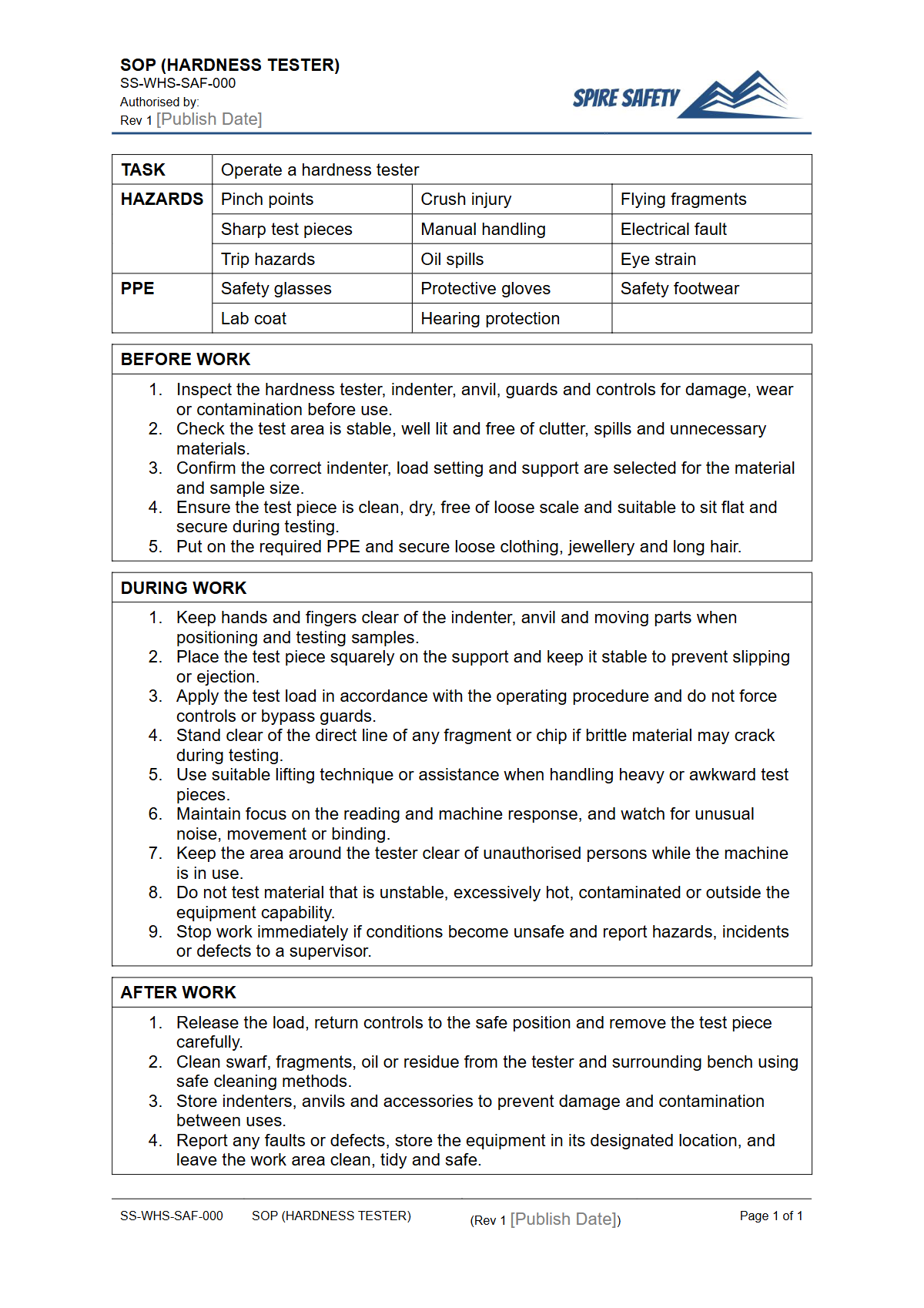
This free Safe Operating Procedure (Hardness Tester) template provides a structured starting point for developing a site-specific document for your workplace. A Safe Operating Procedure (SOP) is a fundamental administrative control that outlines step-by-step instructions for performing a task safely.
For equipment like a hardness tester, an SOP is crucial for minimising risks such as pinch points, electrical hazards, and projectiles from shattered specimens. This template is designed to help you identify these hazards, document control measures, and ensure operators are equipped with the knowledge to work safely and consistently.
Using a standardised SOP helps your organisation meet its duty of care under Australian WHS legislation. It formalises pre-operational checks, the testing sequence, and shutdown procedures, creating a clear and auditable record of your safe work methods.
Integrating such documents into a comprehensive safety framework is a core component of effective WHS management systems, promoting a proactive safety culture rather than a reactive one.
Video walkthrough
How to use the Free Safe Operating Procedure (Hardness Tester) Template
To effectively use this Safe Operating Procedure (Hardness Tester) template, download the DOCX file and begin adapting it to your specific equipment and operational context. A generic procedure is not sufficient; customisation is essential for ensuring the document is relevant and effective.
Involve the people who actually use the hardness tester in the drafting and review process—their hands-on experience is invaluable for identifying practical challenges and effective controls.
Important: This is a template only. You must customise it to reflect the specific hazards and control measures relevant to your workplace, equipment, and processes.
We recommend a consultation process involving operators, supervisors, and any relevant safety personnel to ensure the final SOP is comprehensive and practical.
Once customised, the SOP should be formally approved, and all relevant personnel must be trained on its contents. This training should cover every aspect of the procedure, from pre-start checks to emergency responses.
Keep a record of this training as evidence of competency. The process of regular review ensures the SOP remains a living document that reflects current practice, which can be verified during a WHS compliance auditing program.
What to include in your SOP
When customising the template, ensure you cover all critical aspects of operation. This includes:
- Hazards and Risks: List all potential hazards associated with the hardness tester (e.g., crushing, electrical, sharp edges, material failure).
- Required PPE: Specify the personal protective equipment required, such as safety glasses, gloves, or protective footwear.
- Pre-Operational Checks: Detail the visual inspections and functional tests operators must perform before use, such as checking the indenter, anvil, and guards.
- Step-by-Step Operating Instructions: Provide a clear, sequential guide for setting up the machine, securing the test piece, applying the load, and taking a reading.
- Post-Operational Procedures: Outline the correct shutdown, cleaning, and storage steps.
- Emergency Procedures: Detail the immediate actions to take in case of malfunction, injury, or other emergencies.
In many workshops and laboratories, hardness testers are just one piece of equipment among many. It is good practice to maintain consistent safety documentation across all plant.
If your workplace also uses compressed air systems, you might find our Free Air Compressor SOP a useful addition to your safety library.
When to use it
A Safe Operating Procedure for a hardness tester should be a primary reference document used in several key situations. It must be consulted by operators before using the equipment, especially if they use it infrequently.
The SOP serves as the foundational text for initial training and induction of new workers and is an essential tool for periodic refresher training to prevent procedural drift. It should also be reviewed as part of any incident investigation involving the equipment to determine if the procedure was followed and if it remains adequate.
Who should use it
This document is intended for multiple roles within an organisation. Machine operators are the primary users, relying on the SOP for direct guidance on safe operation.
Supervisors and team leaders use it to induct new staff, monitor correct usage, and enforce safe work standards. WHS managers and safety officers use the SOP as a key element of the overall risk management system, ensuring that documented procedures are in place for hazardous tasks. The principles of creating clear, task-specific instructions are universal for workshop tools, whether it's for metal analysis or for woodworking tasks covered by our FREE Circular Saw SOP.
For larger industrial environments, ensuring material flows safely to and from testing stations is also part of the overall system of work. Documenting procedures for associated machinery, such as with a FREE Conveyer System SOP, helps build a more holistic approach to safety.
By providing clear guidance for each piece of equipment, you create a network of controls that reduces overall workplace risk. You can find these and more templates in our free WHS resources library.
Common mistakes
Common mistakes to avoid
- Using a generic template without customising it for the specific machine and workplace.
- Failing to adequately train workers on the contents of the finalised SOP.
- Not reviewing or updating the SOP after an incident or a change in procedure.
- Storing the SOP in an office, making it inaccessible to operators at the point of use.
Legal references
Legal considerations
The following legal requirements may be relevant to this type of work.
- Work Health and Safety Act (Harmonised) — Provides the primary duties for protecting workers and other people from work health and safety risks.
- Work Health and Safety Regulations (Harmonised) — Sets out requirements supporting the management of workplace hazards and risks.
The following codes may be relevant to this type of work.
- Managing WHS Risks Code of Practice — Provides practical guidance on identifying hazards, assessing risks and applying effective controls.
- Work Health and Safety Consultation, Cooperation and Coordination Code of Practice — Provides practical guidance on consulting workers and coordinating with other duty holders.
- Managing the Work Environment and Facilities Code of Practice — Provides practical guidance on safe work environments, workplace facilities and related controls.
Did you know
Multiple Measurement Scales
Hardness testers use various scales like Rockwell, Brinell, Vickers, and Knoop. Each method uses a different indenter shape and load, requiring specific procedures detailed in the SOP.
Consultation is a Legal Duty
Under Australia's model WHS laws, PCBUs have a legal duty to consult with workers on matters related to their health and safety. This includes the development and review of Safe Operating Procedures.
FAQ
Frequently asked questions
01What should be included in a Safe Operating Procedure for a hardness tester?
02Is a hardness tester considered high-risk equipment?
03Who is responsible for writing a hardness tester SOP?
04How often should an SOP for a hardness tester be reviewed?
Share this resource
Free Safe Operating Procedure (Hardness Tester) Template
Browse Categories
How To Use It
- 1Download and open in Word or PDF.
- 2Replace the placeholders with your business details.
- 3Get it reviewed by a WHS specialist before rollout.
Need it customised?
Our WHS consultants can adapt this template to your site, run a gap analysis, or audit what you already have in place.
Book a Free Consultation WHS consulting servicesor call 1300 156 382
Related templates
- Free Safe Operating Procedure (Hardscape Cleaning) Template
- Free Safe Operating Procedure (Harvester Head) Template
- Free Safe Operating Procedure (Hay Bale Handling) Template
- Free Safe Operating Procedure (Hay Bale Stacking) Template
- Free Safe Operating Procedure (Hazardous Waste Intake) Template
- Free Safe Operating Procedure (Hearing Aid Cleaning) Template