
Free Safe Operating Procedure (Hard Waste Collection) Template
Manage the risks of hard waste collection with our free Safe Operating Procedure template. A structured starting point for Australian workplaces.
Free Safe Operating Procedure (Hard Waste Collection) Template
DOCX • 126 KB + PDF
Updated Oct 2026
No signup required
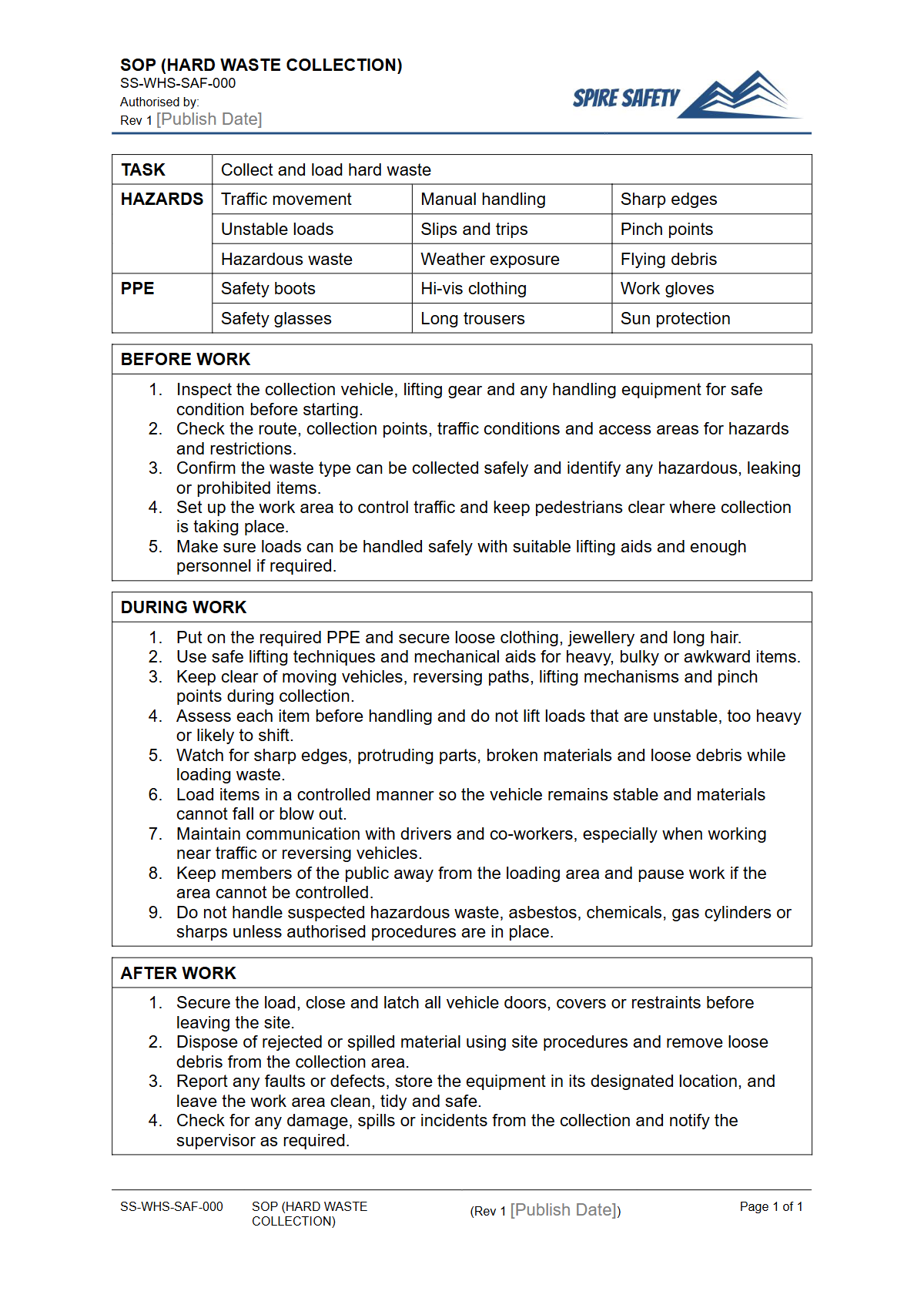
Purpose of the Free Safe Operating Procedure (Hard Waste Collection) Template
Hard waste collection is a high-risk activity involving hazardous manual tasks, vehicle operation, and interaction with unknown materials. This Free Safe Operating Procedure (Hard Waste Collection) Template provides a structured framework to help you document a safe system of work.
Using a clear SOP is essential for managing WHS risks, training workers, and demonstrating that your organisation is committed to providing a safe working environment. It helps formalise procedures for identifying, assessing, and controlling hazards specific to collecting bulky, heavy, or unpredictable waste items from kerbsides or properties.
A documented SOP helps standardise behaviour and provides a clear benchmark for performance. It is a critical component for businesses looking to develop robust WHS management systems that are integrated into daily operations.
By clearly outlining steps for everything from pre-start vehicle checks to safe lifting techniques and handling suspect materials, this Safe Operating Procedure helps reduce the likelihood of musculoskeletal injuries, lacerations, and vehicle-related incidents.
Video walkthrough
How to use the Free Safe Operating Procedure (Hard Waste Collection) Template
This resource is available for immediate download in both DOCX and PDF formats. The DOCX version is fully editable, allowing you to tailor the content to the specific equipment, environment, and processes used in your workplace.
A well-implemented SOP is a powerful tool, but its effectiveness depends entirely on its customisation and practical application.
Important: This is a template, not a finished document. We cannot know the specific machinery, environment, and risks of your workplace.
You must adapt this SOP by conducting a site-specific risk assessment and consulting with your workers who perform the task. Once customised, it should be used for training, supervision, and be periodically reviewed through processes like regular WHS compliance auditing to ensure it remains current and effective.
When to use it
A Safe Operating Procedure for hard waste collection should be a core part of your daily operational safety. It should be used during the induction and training of any new employee tasked with waste collection duties.
It also serves as a critical reference for refresher training to prevent complacency and reinforce safe work habits. The SOP must be reviewed and referred to following any near-miss or incident to identify gaps in the procedure.
Furthermore, it should be a live document, updated whenever new equipment is introduced, a process is changed, or new hazards are identified.
For tasks that involve specific vehicles, this SOP should be used alongside other relevant procedures. For example, the operation of the collection vehicle itself would be covered by a document like our free Body Truck SOP template, while this procedure focuses on the collection and loading tasks.
Who should use it
This Safe Operating Procedure is intended for multiple roles within an organisation.
Workers and Drivers
Frontline employees should use the SOP as a step-by-step guide to perform their tasks safely. It acts as a ready reference on the correct procedures for manual handling, identifying hazards, and operating equipment.
Supervisors and Team Leaders
Supervisors are responsible for ensuring work is performed according to the SOP. They should use it as a tool for training their teams, conducting pre-start briefings, and monitoring on-the-job performance to correct unsafe behaviours.
Managers and WHS Personnel
Management and WHS officers use the SOP to establish a consistent safety standard across the organisation. They are responsible for ensuring the procedure is properly developed through risk assessment and consultation, and that it is reviewed and updated as required.
For operations involving larger machinery to move waste at a depot, a specific Telehandler SOP would also be necessary.
Key Hazards in Hard Waste Collection
Customising your SOP starts with identifying hazards. Hard waste collection presents a unique combination of risks that must be managed. Key hazards include:
- Musculoskeletal Disorders (MSDs): From lifting heavy, awkward, or unstable items like furniture, whitegoods, and mattresses.
- Cuts and Lacerations: From sharp objects hidden within waste, such as broken glass, scrap metal, and improperly discarded tools.
- Hazardous Substances: Exposure to unknown chemicals, pesticides, asbestos in old building materials, or biological waste.
- Vehicle and Traffic Interaction: Risks associated with working on or near roadways, including collisions with other vehicles and pedestrians. This risk extends to the final disposal site, where a Dozer SOP for landfill operations might be relevant.
- Crush Injuries: Caused by unstable loads shifting during loading or transport, or from being caught between the vehicle and other objects.
- Slips, Trips, and Falls: Working on uneven ground, cluttered kerbsides, or in adverse weather conditions increases the risk of falls.
Explore more ways to document and control risks by browsing our complete free WHS resources library, which includes a wide range of templates and guides.
Common mistakes
Common mistakes to avoid
- Failing to conduct a site-specific risk assessment before customising the template.
- Neglecting to consult with workers who actually perform the collection tasks during the drafting process.
- Using the SOP for initial training only, instead of as a live document for ongoing supervision and review.
- Not providing the specific Personal Protective Equipment (PPE) that is detailed in the SOP.
Legal references
Legal considerations
The following legal requirements may be relevant to this type of work.
- Work Health and Safety Act (Harmonised) — Provides the primary duties for protecting workers and other people from work health and safety risks.
- Work Health and Safety Regulations (Harmonised) — Sets out requirements supporting the management of workplace hazards and risks.
The following codes may be relevant to this type of work.
- Managing WHS Risks Code of Practice — Provides practical guidance on identifying hazards, assessing risks and applying effective controls.
- Work Health and Safety Consultation, Cooperation and Coordination Code of Practice — Provides practical guidance on consulting workers and coordinating with other duty holders.
- Managing the Work Environment and Facilities Code of Practice — Provides practical guidance on safe work environments, workplace facilities and related controls.
Did you know
MSDs in Waste Collection
The waste collection industry has one of the highest rates of serious workers' compensation claims in Australia, with musculoskeletal disorders (MSDs) from hazardous manual tasks being a primary cause.
Hidden Hazards
Hard waste can contain unexpected dangers like asbestos in old building materials, unmarked chemical containers, or medical sharps, making thorough hazard identification and PPE critical.
FAQ
Frequently asked questions
01What should be included in a hard waste collection SOP?
02Is a Safe Operating Procedure a legal requirement in Australia?
03How often should we review our hard waste collection SOP?
04Can this template be used for both residential and commercial hard waste?
Share this resource
Free Safe Operating Procedure (Hard Waste Collection) Template
Browse Categories
How To Use It
- 1Download and open in Word or PDF.
- 2Replace the placeholders with your business details.
- 3Get it reviewed by a WHS specialist before rollout.
Need it customised?
Our WHS consultants can adapt this template to your site, run a gap analysis, or audit what you already have in place.
Book a Free Consultation WHS consulting servicesor call 1300 156 382
Related templates
- Free Safe Operating Procedure (Hard Waste Sorting) Template
- Free Safe Operating Procedure (Hardness Tester) Template
- Free Safe Operating Procedure (Hardscape Cleaning) Template
- Free Safe Operating Procedure (Harvester Head) Template
- Free Safe Operating Procedure (Hay Bale Handling) Template
- Free Safe Operating Procedure (Hay Bale Stacking) Template