
Free Safe Operating Procedure (Hangar Door Operation) Template
Download our free Safe Operating Procedure for Hangar Door Operation.
Free Safe Operating Procedure (Hangar Door Operation) Template
DOCX • 126 KB + PDF
Updated Oct 2026
No signup required
Purpose of the Free Safe Operating Procedure (Hangar Door Operation) Template
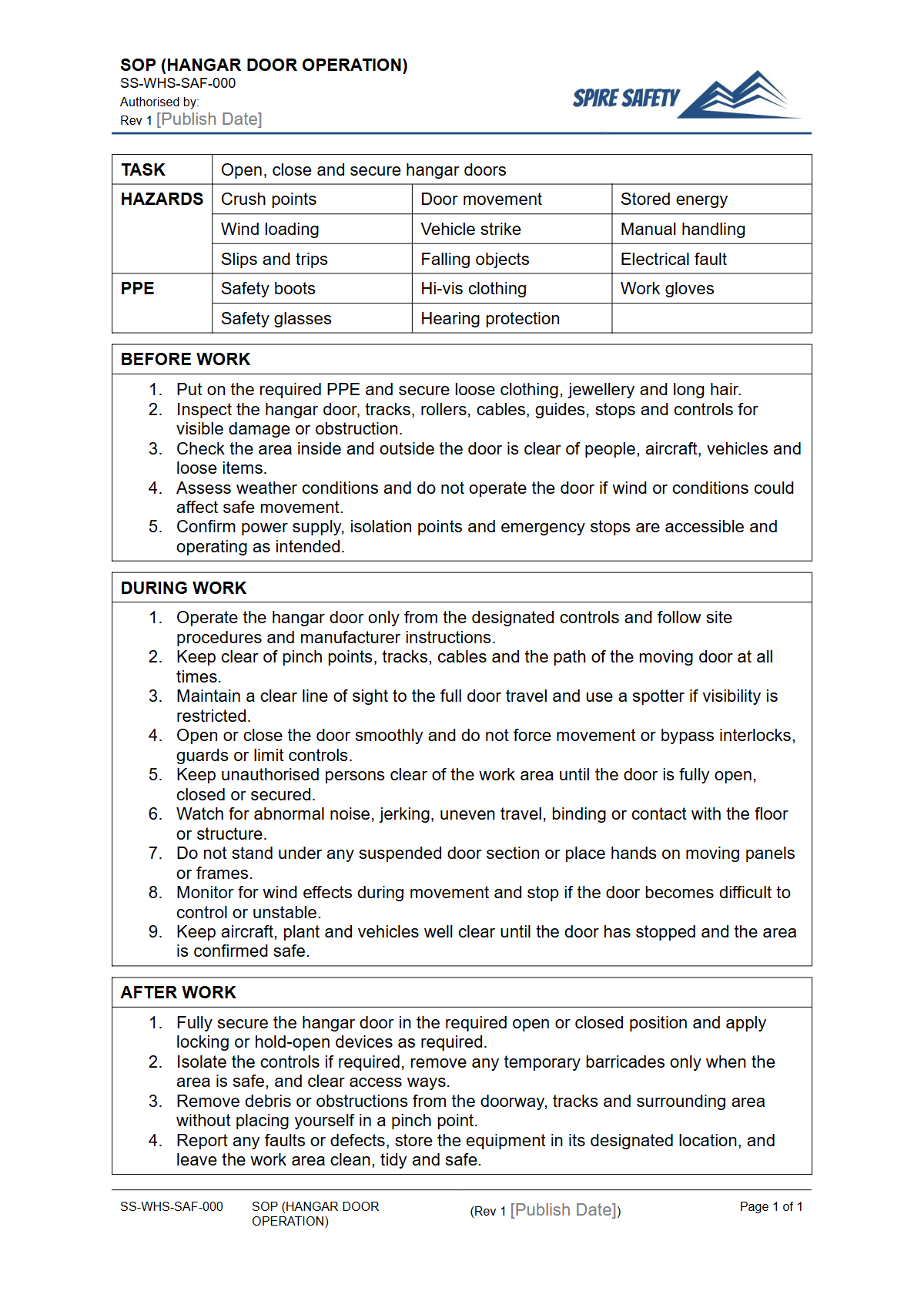
Hangar doors are large, heavy, and often automated pieces of equipment that pose significant risks if not operated correctly. This Safe Operating Procedure (SOP) template provides a structured framework for documenting the required steps to operate hangar doors safely, minimising the risk of crush injuries, equipment damage, and operational disruptions.
Using a formal SOP helps ensure all personnel follow a consistent, approved process, which is a fundamental component of effective WHS management systems. This document is designed to help your organisation meet its duty of care under Australian WHS regulations by providing clear instructions to workers.
This template assists in identifying hazards associated with hangar door operation, such as moving parts, electrical systems, wind loading, and potential for personnel being caught in the door's path. It prompts you to outline specific control measures, including pre-operational checks, communication protocols, emergency procedures, and exclusion zones.
By clearly defining these elements, you create a safer working environment for everyone in the vicinity of the hangar.
Video walkthrough
How to use the Free Safe Operating Procedure (Hangar Door Operation) Template
This document is available for download as a DOCX file for easy editing and as a PDF for straightforward distribution. To effectively use this resource, a Person Conducting a Business or Undertaking (PCBU) or a manager should lead a customisation process involving consultation with operators and maintenance personnel.
The goal is to adapt the template to reflect the specific type of hangar doors at your facility—be they bifold, hydraulic, or sliding—and the unique environmental and operational context of your workplace.
You must fill in the blank sections with site-specific information, including the make and model of the door, emergency contact details, and a detailed, step-by-step sequence for operation. It's crucial to integrate your findings from any relevant risk assessments.
The procedure should be clear, concise, and easy for all authorised users to understand. This process is similar for other types of heavy machinery, as shown in our FREE Telehandler SOP (Safe Operating Procedure) Template.
Important Customisation Note
This is a template only. It is not a complete or ready-to-use document.
You must customise this Safe Operating Procedure to the specific equipment, personnel, and risks present in your workplace. A generic procedure is not sufficient to meet your WHS obligations.
We are not liable for any incidents arising from the use of this document.
When to use it
A Safe Operating Procedure for hangar doors should be used every time the doors are operated, without exception. It serves as a primary reference and training document for all authorised personnel.
The SOP should be formally reviewed whenever there is a change to the equipment, the operating environment, or the procedure itself. Regular reviews are also necessary after any incident or near miss involving the hangar doors, or as part of a scheduled periodic review (e.g., annually).
Conducting routine checks on the implementation of such procedures is a key activity during WHS compliance auditing to ensure ongoing effectiveness.
This SOP should also form a core part of the induction and training program for any new staff or contractors who may be required to operate or work near the hangar doors. Refresher training should be provided at regular intervals to ensure competency is maintained.
It's also wise to have similar documented procedures for other critical workshop equipment, and our Free Air Compressor SOP (Safe Operating Procedure) Template provides a good example for smaller plant.
Who should use it
This Safe Operating Procedure is intended for use by trained and authorised personnel who are responsible for operating the hangar doors. This may include aircraft maintenance engineers, ground support staff, and facility managers.
Supervisors and WHS managers should use the document to oversee operations, conduct training, and verify compliance with established safety protocols. It is not intended for untrained staff or the general public.
Management should ensure that the finalised SOP is readily accessible to all relevant workers at or near the point of operation. Its development should involve consultation with the workers who will actually use it, as their practical knowledge is invaluable for creating a procedure that is both safe and workable. The principles of documenting safe operation for large, automated systems also apply to other equipment, such as those covered in the Free Safe Operating Procedure (Conveyor Belt Operation) Template. For more guides and templates, you can browse our complete free WHS resources library.
Common mistakes
Common mistakes to avoid
- Failing to conduct thorough pre-start inspections of tracks, cables, and sensors.
- Operating the door while personnel or equipment are within the marked exclusion zone.
- Neglecting to report minor faults, damage, or unusual noises, which can escalate into major failures.
- Assuming operators are competent without providing formal, task-specific training and assessment.
Legal references
Legal considerations
The following legal requirements may be relevant to this type of work.
- Work Health and Safety Act (Harmonised) — Provides the primary duties for protecting workers and other people from work health and safety risks.
- Work Health and Safety Regulations (Harmonised) — Sets out requirements supporting the management of workplace hazards and risks.
The following codes may be relevant to this type of work.
- Managing WHS Risks Code of Practice — Provides practical guidance on identifying hazards, assessing risks and applying effective controls.
- Work Health and Safety Consultation, Cooperation and Coordination Code of Practice — Provides practical guidance on consulting workers and coordinating with other duty holders.
- Managing the Work Environment and Facilities Code of Practice — Provides practical guidance on safe work environments, workplace facilities and related controls.
Did you know
Incredible Forces
Large hangar doors can weigh over 50 tonnes and must be designed to withstand significant wind loads, which can exert immense pressure across their surface. A sudden failure can release a catastrophic amount of energy.
Automation Risks
Modern hangar doors often use complex sensor and interlock systems to prevent movement when obstructions are detected. The failure or incorrect calibration of these safety-critical systems is a leading cause of incidents.
FAQ
Frequently asked questions
01What key information should be included in a hangar door SOP?
02How often should hangar door safety procedures be reviewed?
03Who is responsible for enforcing the hangar door SOP?
04Can this template be used for all types of hangar doors, like bifold or hydraulic?
Share this resource
Free Safe Operating Procedure (Hangar Door Operation) Template
Browse Categories
How To Use It
- 1Download and open in Word or PDF.
- 2Replace the placeholders with your business details.
- 3Get it reviewed by a WHS specialist before rollout.
Need it customised?
Our WHS consultants can adapt this template to your site, run a gap analysis, or audit what you already have in place.
Book a Free Consultation WHS consulting servicesor call 1300 156 382
Related templates
- Free Safe Operating Procedure (Hard Waste Collection) Template
- Free Safe Operating Procedure (Hard Waste Sorting) Template
- Free Safe Operating Procedure (Hardness Tester) Template
- Free Safe Operating Procedure (Hardscape Cleaning) Template
- Free Safe Operating Procedure (Harvester Head) Template
- Free Safe Operating Procedure (Hay Bale Handling) Template