
Free Safe Operating Procedure (Handheld Metal Detector) Template
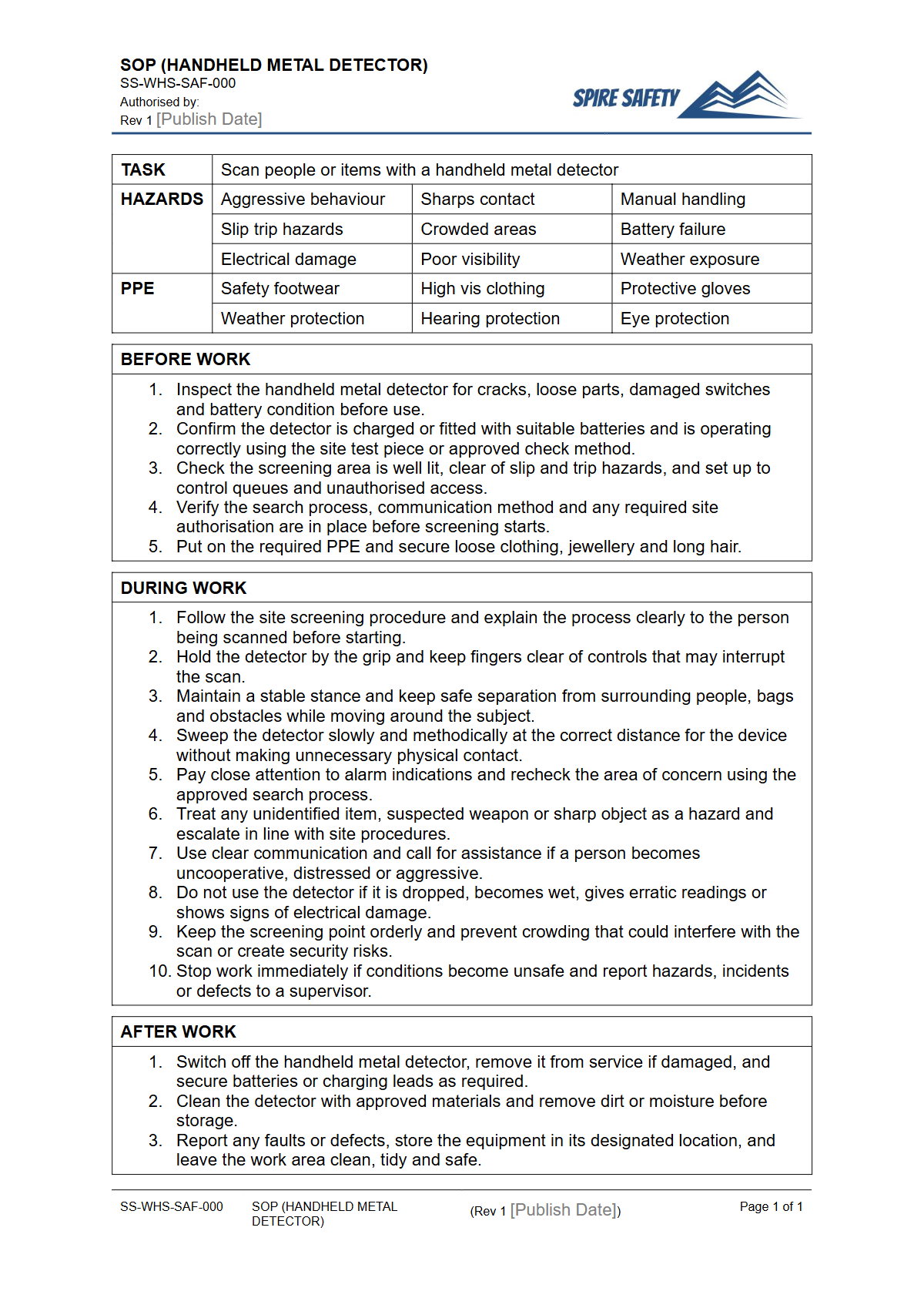
Get a structured start on safety with our free Safe Operating Procedure (Handheld Metal Detector) template. Customise the DOCX or PDF to fit your site.
Free Safe Operating Procedure (Handheld Metal Detector) Template
DOCX • 126 KB + PDF
Updated Oct 2026
No signup required
Purpose of the Free Safe Operating Procedure (Handheld Metal Detector) Template
A formalised Safe Operating Procedure (SOP) is crucial for ensuring handheld metal detectors are used consistently and safely in security and loss prevention settings. This Free Safe Operating Procedure (Handheld Metal Detector) Template provides a comprehensive starting point for your organisation.
By documenting the process, you can standardise training, manage risks, and demonstrate your commitment to a safe working environment for both your staff and the public.
The primary purpose of this template is to help you create a workplace-specific SOP for using handheld metal detectors. A documented procedure provides clear, step-by-step instructions for operators, minimising confusion and reducing the risk of procedural errors.
It establishes a benchmark for performance, outlines pre-operational checks, describes the correct scanning technique, and details post-use maintenance. Implementing a formal SOP is a key part of an effective WHS management system, ensuring all workers follow the same approved process.
This consistency is vital in security applications where reliability and thoroughness are paramount.
Video walkthrough
How to use the Free Safe Operating Procedure (Handheld Metal Detector) Template
This SOP template is provided in both DOCX and PDF formats for your convenience. To get started, download the DOCX file and open it in a word processor like Microsoft Word or Google Docs.
You can then add, remove, and edit sections to align with your specific equipment, environment, and organisational policies. It is essential to conduct a site-specific risk assessment before finalising the document.
Important: This is a template only.
To be effective, you must customise this document to reflect the actual hazards and control measures in your workplace. We are not liable for any incidents that may occur from the use of this template.
It is your responsibility as the PCBU (Person Conducting a Business or Undertaking) to ensure your procedures are safe and suitable for your unique operational needs.
Once customised, the SOP should be used as a key training tool for all personnel authorised to operate the equipment. Consider pairing it with other procedural documents, such as our Free Safe Operating Procedure (Defibrillator Operation) Template for emergency preparedness.
When to use it
A Safe Operating Procedure for handheld metal detectors should be implemented wherever this equipment is used as a control measure. Common scenarios include:
- Screening patrons at public events, concerts, or sporting venues.
- Access control for sensitive or high-security buildings and facilities.
- Loss prevention checks for employees or contractors exiting a warehouse, distribution centre, or retail environment.
- Screening individuals in correctional facilities or judicial settings.
The SOP serves as a daily reference for operators and a formal record of your organisation's approved safety methods. It should be readily accessible in the work area and reviewed regularly as part of your overall safety processes.
For complex sites, regular safety reviews might be part of a broader WHS consulting engagement to ensure ongoing effectiveness.
Who should use it
This SOP is designed for use by any worker tasked with operating a handheld metal detector. This typically includes:
- Security guards and officers.
- Event staff and venue personnel.
- Loss prevention officers.
- Correctional and law enforcement officers.
Furthermore, WHS managers, supervisors, and team leaders should use the finalised SOP to induct new staff, conduct refresher training, and perform competency observations. It provides an objective standard against which an operator's performance can be measured.
Documenting procedures for all equipment, even simple items, is a fundamental part of workplace safety. For instance, even basic tasks require clear guidance, as shown in our FREE Step Ladder SOP Template.
For a wider range of procedural documents covering various plant and equipment, browse our complete free WHS resources library.
Common mistakes
Common mistakes to avoid
- Forgetting to test the device on a known metal object before starting a shift.
- Scanning too quickly or holding the detector too far away from the person, reducing its effectiveness.
- Not having a clear, calm, and consistent communication script for interacting with people being screened.
- Failing to develop and train staff on the procedure for managing a positive detection and potential conflict.
Legal references
Legal considerations
The following legal requirements may be relevant to this type of work.
- Work Health and Safety Act (Harmonised) — Provides the primary duties for protecting workers and other people from work health and safety risks.
- Work Health and Safety Regulations (Harmonised) — Sets out requirements supporting the management of workplace hazards and risks.
The following codes may be relevant to this type of work.
- Managing WHS Risks Code of Practice — Provides practical guidance on identifying hazards, assessing risks and applying effective controls.
- Work Health and Safety Consultation, Cooperation and Coordination Code of Practice — Provides practical guidance on consulting workers and coordinating with other duty holders.
- Managing the Work Environment and Facilities Code of Practice — Provides practical guidance on safe work environments, workplace facilities and related controls.
Did you know
Presidential Origins
The first electromagnetic metal detector was hastily invented by Alexander Graham Bell in 1881 in an attempt to locate the bullet lodged in U.S. President James A. Garfield after an assassination attempt.
Competing Technologies
Most handheld security wands use Pulse Induction (PI) technology, which is effective at detecting all metal types and is less affected by mineralised ground or saltwater than other types.
FAQ
Frequently asked questions
01What should be included in an SOP for a handheld metal detector?
02Is training required to use a handheld metal detector?
03How often should handheld metal detectors be checked or calibrated?
04Can this SOP template be used for walk-through metal detectors too?
Share this resource
Free Safe Operating Procedure (Handheld Metal Detector) Template
Browse Categories
How To Use It
- 1Download and open in Word or PDF.
- 2Replace the placeholders with your business details.
- 3Get it reviewed by a WHS specialist before rollout.
Need it customised?
Our WHS consultants can adapt this template to your site, run a gap analysis, or audit what you already have in place.
Book a Free Consultation WHS consulting servicesor call 1300 156 382
Related templates
- Free Safe Operating Procedure (Handrail Cleaning) Template
- Free Safe Operating Procedure (Hangar Cleaning) Template
- Free Safe Operating Procedure (Hangar Door Operation) Template
- Free Safe Operating Procedure (Hard Waste Collection) Template
- Free Safe Operating Procedure (Hard Waste Sorting) Template
- Free Safe Operating Procedure (Hardness Tester) Template