
Free Safe Operating Procedure (Handrail Cleaning) Template
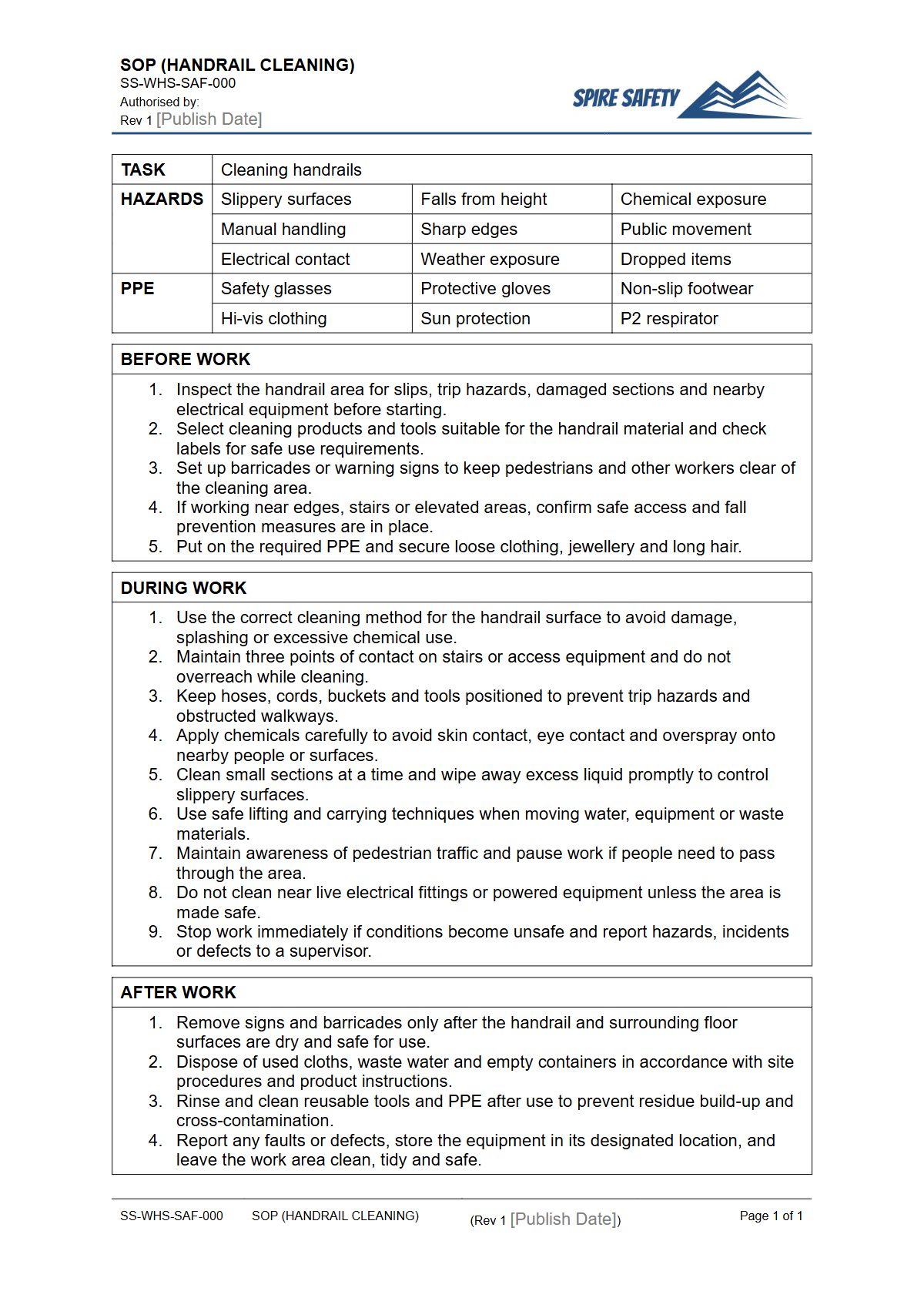
Download our free Safe Operating Procedure (Handrail Cleaning) template. This customisable DOCX & PDF helps standardise cleaning tasks and manage risks.
Free Safe Operating Procedure (Handrail Cleaning) Template
DOCX • 126 KB + PDF
Updated Oct 2026
No signup required
Purpose of the Free Safe Operating Procedure (Handrail Cleaning) Template
Maintaining a clean and hygienic workplace is a fundamental aspect of work health and safety. This Free Safe Operating Procedure (Handrail Cleaning) Template provides a structured framework for documenting the correct, safe, and consistent method for cleaning handrails and other high-touch surfaces.
An effective SOP helps your organisation manage risks associated with cleaning tasks, such as chemical exposure, slips, trips, falls, and ergonomic injuries. It serves as a vital tool for worker training, ensuring everyone understands their responsibilities and follows an approved process.
By standardising this common but critical task, you create a safer environment for both cleaning staff and all other workplace personnel. Documenting procedures like this is a cornerstone of effective WHS management systems, demonstrating a clear commitment to proactive risk management.
Video walkthrough
How to use the Free Safe Operating Procedure (Handrail Cleaning) Template
This template is designed for easy adoption and customisation. After downloading the DOCX file, you should adapt it to the specific context of your business.
This involves consulting with the workers who will actually perform the task, as well as their supervisors, to ensure the procedure is practical and addresses all relevant hazards.
Key customisation steps include:
- Identifying the specific cleaning chemicals used and referencing their Safety Data Sheets (SDS).
- Detailing the type of Personal Protective Equipment (PPE) required (e.g., specific glove types, safety glasses).
- Outlining the exact step-by-step process relevant to your facility, from preparation to clean-up.
- Adding any site-specific warnings, such as dealing with wet floors or working near public access areas.
Important: This is a template only. We have developed it as a starting point, and you must customise it to reflect the specific hazards, risks, equipment, and environment of your workplace.
If you require assistance in developing site-specific documentation, our WHS consulting team can provide expert support.
When to use this Safe Operating Procedure
A documented SOP for handrail cleaning is not just for daily routines. It should be actively used in several situations:
- Routine Cleaning: As the primary guide for scheduled daily or weekly cleaning tasks.
- Worker Training: For inducting new employees or refreshing the skills of existing staff to ensure consistency.
- Increased Hygiene Protocols: During periods of heightened health concerns, such as flu season or a pandemic, to ensure enhanced cleaning protocols are followed correctly.
- Incident Investigation: As a reference point if an incident or near-miss occurs during cleaning operations.
Who should use it
This Safe Operating Procedure is relevant for multiple roles within an organisation:
- WHS Managers/Coordinators: To establish and formalise safe work practices as part of the overall safety system.
- Facility or Operations Managers: To ensure standards of cleanliness and hygiene are met safely and efficiently.
- Supervisors: As a tool for training, monitoring, and enforcing safe work practices among their cleaning teams.
- Workers/Cleaners: As a clear, step-by-step guide to follow to perform their job safely and protect themselves and others from harm.
Key elements of a Handrail Cleaning SOP
A comprehensive SOP for this task should cover several critical stages of the work. Our template prompts you to consider and document the full lifecycle of the task.
This includes pre-operational checks like ensuring the correct cleaning agent is selected and inspecting the work area for hazards. If cleaning involves reaching higher areas, a separate procedure for safe access, such as that detailed in our Free Step Ladder SOP Template, may also be required.
The SOP should also cover the step-by-step cleaning process, waste disposal, and post-task clean-up, ensuring equipment is stored correctly and any warning signs are removed.
Documenting simple procedural tasks is just as important as managing complex machinery. Having clear instructions for a range of workplace activities, like our defibrillator operation template, builds a robust safety culture.
You can explore hundreds of similar documents in our free WHS resources library to support your safety management system.
Common mistakes
Common mistakes to avoid
- Using a generic procedure without customising it for the specific workplace environment and chemicals.
- Failing to train workers on the SOP or verify their understanding of the procedures.
- Not providing or enforcing the use of the specific Personal Protective Equipment (PPE) required.
- Neglecting to update the SOP when cleaning agents, equipment, or work practices change.
Legal references
Legal considerations
The following legal requirements may be relevant to this type of work.
- Work Health and Safety Act (Harmonised) — Provides the primary duties for protecting workers and other people from work health and safety risks.
- Work Health and Safety Regulations (Harmonised) — Sets out requirements supporting the management of workplace hazards and risks.
The following codes may be relevant to this type of work.
- Managing WHS Risks Code of Practice — Provides practical guidance on identifying hazards, assessing risks and applying effective controls.
- Work Health and Safety Consultation, Cooperation and Coordination Code of Practice — Provides practical guidance on consulting workers and coordinating with other duty holders.
- Managing the Work Environment and Facilities Code of Practice — Provides practical guidance on safe work environments, workplace facilities and related controls.
Did you know
Surface Survival
Many viruses and bacteria can survive on surfaces like stainless steel handrails for several hours to several days, making regular and effective cleaning a critical infection control measure.
Slips, Trips, and Falls
Slips, trips, and falls are a leading cause of serious workplace injuries in Australia. Cleaning activities, which often involve wet floors and equipment, are a common contributor to these incidents.
FAQ
Frequently asked questions
01Why do I need a specific SOP for cleaning handrails?
02What hazards are involved in handrail cleaning?
03Is this template suitable for all types of cleaning chemicals?
04How often should a Safe Operating Procedure be reviewed?
Share this resource
Free Safe Operating Procedure (Handrail Cleaning) Template
Browse Categories
How To Use It
- 1Download and open in Word or PDF.
- 2Replace the placeholders with your business details.
- 3Get it reviewed by a WHS specialist before rollout.
Need it customised?
Our WHS consultants can adapt this template to your site, run a gap analysis, or audit what you already have in place.
Book a Free Consultation WHS consulting servicesor call 1300 156 382
Related templates
- Free Safe Operating Procedure (Hangar Cleaning) Template
- Free Safe Operating Procedure (Hangar Door Operation) Template
- Free Safe Operating Procedure (Hard Waste Collection) Template
- Free Safe Operating Procedure (Hard Waste Sorting) Template
- Free Safe Operating Procedure (Hardness Tester) Template
- Free Safe Operating Procedure (Hardscape Cleaning) Template