
Free Safe Operating Procedure (Hand Unloading Freight) Template
Download our free Safe Operating Procedure (Hand Unloading Freight) template. This customisable DOCX & PDF helps you document safe manual handling tasks.
Free Safe Operating Procedure (Hand Unloading Freight) Template
DOCX • 126 KB + PDF
Updated Oct 2026
No signup required
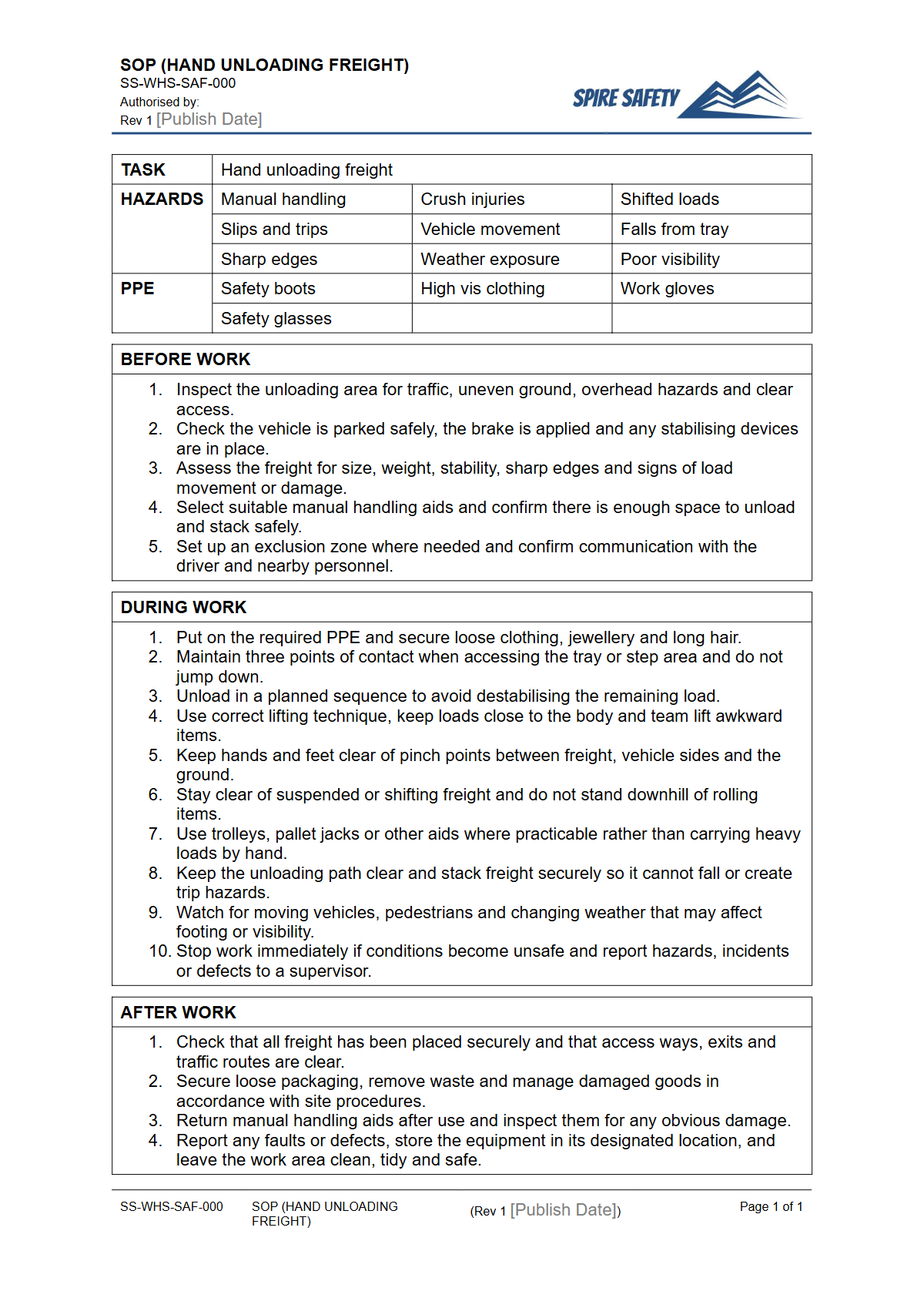
Purpose of the Free Safe Operating Procedure (Hand Unloading Freight) Template
Hand unloading freight from trucks, containers, and pallets is a common task in many Australian workplaces, but it comes with significant risks. This free Safe Operating Procedure (Hand Unloading Freight) template provides a structured starting point for documenting the approved, safe method for these tasks.
Its primary purpose is to help your organisation control hazards and minimise the risk of injury, particularly musculoskeletal disorders (MSDs) which are common in manual handling.
A well-developed SOP is a critical tool for any Person Conducting a Business or Undertaking (PCBU). It serves as a clear instruction manual for workers, a training resource for new starters, and a benchmark for workplace supervision.
By formally documenting safe work practices, you create a consistent, repeatable process that reduces reliance on individual memory and drives predictable safety outcomes. This procedure should form a key component of your overall WHS management system, demonstrating a commitment to proactive risk management.
Video walkthrough
How to use the Free Safe Operating Procedure (Hand Unloading Freight) Template
This Safe Operating Procedure (Hand Unloading Freight) template is designed to be a comprehensive starting point, aligned with Australian WHS principles. However, it is not a finished document.
To be effective and defensible, it must be customised to reflect the specific realities of your workplace.
Follow these steps to implement it correctly:
- Download and Review: Start by downloading the DOCX or PDF and familiarising yourself with its structure.
- Consult: This is the most critical step. Engage with the workers and supervisors who perform the unloading tasks daily. Their practical experience is invaluable for identifying the real-world hazards and effective control measures.
- Customise: Adapt the template by adding site-specific information. This includes details about your loading dock layout, the types of freight handled (weight, size, stability), the specific mechanical aids available (e.g., pallet jacks, trolleys, conveyors), and environmental conditions.
- Approve: Once customised, the SOP should be formally reviewed and approved by a competent person within your organisation.
- Train and Implement: Use the finalised SOP as the basis for training all relevant workers. Ensure they understand the steps, hazards, and controls before they undertake the task.
Important: We have drafted this template based on common industry practices and model WHS guidelines. However, you are ultimately responsible for ensuring the final document is appropriate for the specific risks at your site.
If you are unsure how to conduct the necessary risk assessments or customise this procedure, seeking external support from a qualified professional is recommended. Spire Safety offers expert WHS consulting to help businesses refine their safety documentation.
When to use this Safe Operating Procedure
An SOP for hand unloading freight should be treated as a live, active document integrated into your daily operations. It should be used during:
- Worker Inductions: To train new employees or contractors on the standard procedure before they begin work.
- Toolbox Talks: As a basis for short, focused safety discussions to reinforce key safety points.
- Task Planning: As a reference for supervisors and workers planning a non-routine or complex unloading job.
- Refresher Training: For periodic training sessions to prevent complacency and ensure practices remain consistent.
- Incident Investigations: To compare what should have happened against what actually occurred, helping to identify root causes.
Who should use this procedure
Safety is a shared responsibility, and an effective SOP involves multiple roles within an organisation:
- WHS Managers and Advisors: To develop, implement, and review safety procedures as part of the wider safety management system.
- Supervisors and Team Leaders: To train their teams, enforce the procedure, monitor for compliance, and provide feedback for updates.
- Workers: To understand how to perform their job safely, recognise hazards, and follow the documented control measures. They are the primary end-users.
- Health and Safety Representatives (HSRs): To participate in the consultation process and review the effectiveness of the controls.
The document also outlines emergency procedures. In the event of a medical emergency like a sudden cardiac arrest, having clear instructions is vital. Ensure your team is also trained on emergency equipment, which can be documented in a specific Free Safe Operating Procedure (Defibrillator Operation) template.
Regularly reviewing the SOP's effectiveness is crucial. This can be part of your internal review cycle or formal WHS compliance auditing schedule to ensure it remains current and effective.
Certain unloading tasks may require workers to access areas at height, such as the back of a truck. Where this cannot be avoided, specific controls are needed. If portable ladders are used, they must be selected and used correctly, a process that can be managed with a dedicated FREE Step Ladder SOP Template.
This SOP is just one of many templates available to support your safety goals. You can browse our entire free WHS resources library for more tools to help you manage workplace risk.
Common mistakes
Common mistakes to avoid
- Using a generic template without adding site-specific hazards and controls.
- Failing to consult with the workers who perform the task, missing crucial practical insights.
- Treating the SOP as a one-time document instead of using it for ongoing training and review.
- Not clearly defining when mechanical aids (like pallet jacks or trolleys) become mandatory.
Legal references
Legal considerations
The following legal requirements may be relevant to this type of work.
- Work Health and Safety Act (Harmonised) — Provides the primary duties for protecting workers and other people from work health and safety risks.
- Work Health and Safety Regulations (Harmonised) — Sets out requirements supporting the management of workplace hazards and risks.
The following codes may be relevant to this type of work.
- Managing WHS Risks Code of Practice — Provides practical guidance on identifying hazards, assessing risks and applying effective controls.
- Work Health and Safety Consultation, Cooperation and Coordination Code of Practice — Provides practical guidance on consulting workers and coordinating with other duty holders.
- Managing the Work Environment and Facilities Code of Practice — Provides practical guidance on safe work environments, workplace facilities and related controls.
Did you know
Manual Task Injuries
Hazardous manual tasks are a leading cause of workplace injury in Australia. They are responsible for more than one-third of all serious workers' compensation claims.
FAQ
Frequently asked questions
01What should be included in a hand unloading freight SOP?
02Is a Safe Operating Procedure legally required for manual handling in Australia?
03How often should we review our hand unloading SOP?
04What is the difference between a SWMS and an SOP for hand unloading?
Share this resource
Free Safe Operating Procedure (Hand Unloading Freight) Template
Browse Categories
How To Use It
- 1Download and open in Word or PDF.
- 2Replace the placeholders with your business details.
- 3Get it reviewed by a WHS specialist before rollout.
Need it customised?
Our WHS consultants can adapt this template to your site, run a gap analysis, or audit what you already have in place.
Book a Free Consultation WHS consulting servicesor call 1300 156 382
Related templates
- Free Safe Operating Procedure (Handheld Metal Detector) Template
- Free Safe Operating Procedure (Handrail Cleaning) Template
- Free Safe Operating Procedure (Hangar Cleaning) Template
- Free Safe Operating Procedure (Hangar Door Operation) Template
- Free Safe Operating Procedure (Hard Waste Collection) Template
- Free Safe Operating Procedure (Hard Waste Sorting) Template