
Free Safe Operating Procedure (Hand Harvesting) Template
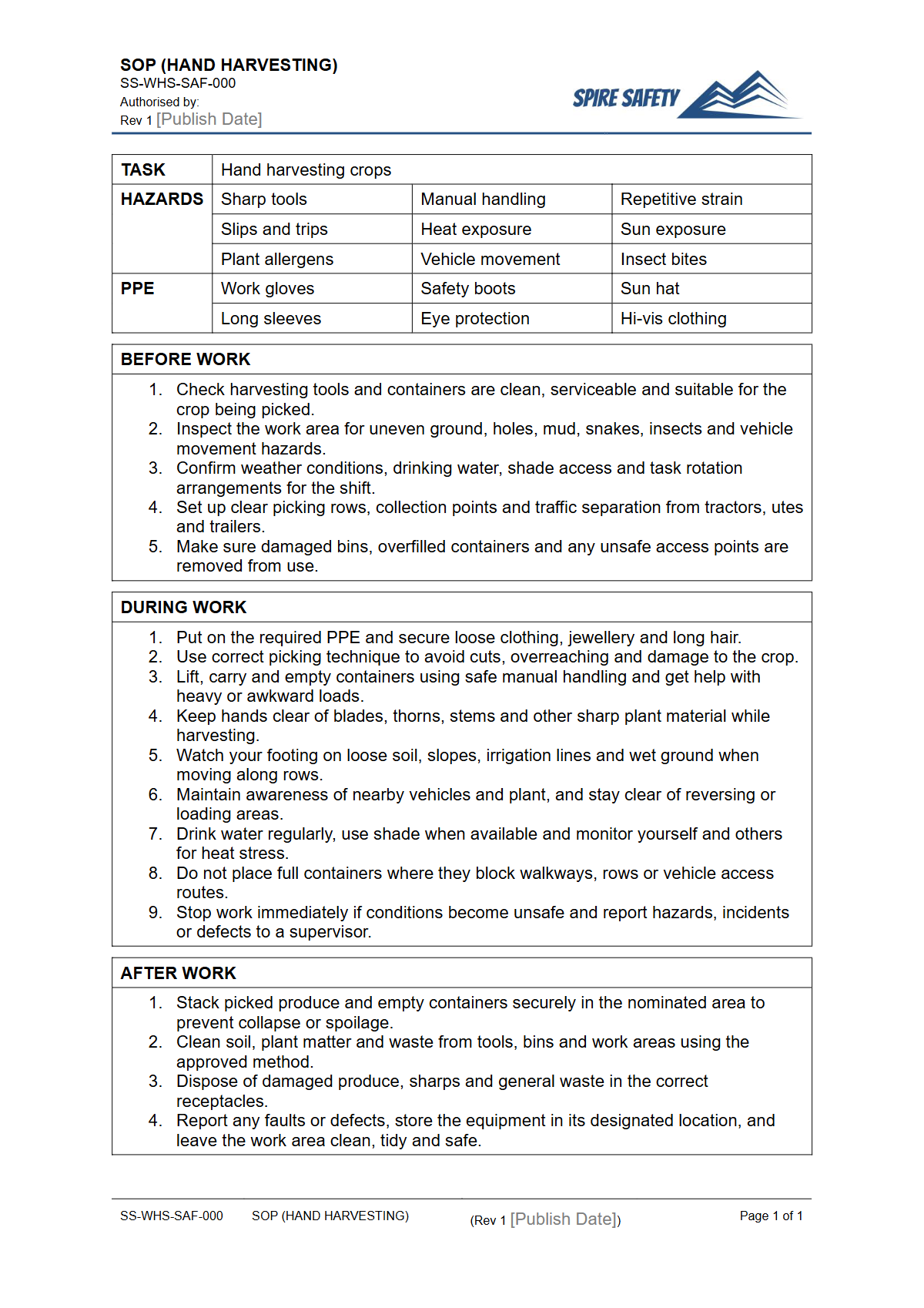
Download our free Safe Operating Procedure (Hand Harvesting) template. This customisable DOCX & PDF helps you document safe manual harvesting work practices.
Free Safe Operating Procedure (Hand Harvesting) Template
DOCX • 126 KB + PDF
Updated Oct 2026
No signup required
Purpose of the Free Safe Operating Procedure (Hand Harvesting) Template
This free Safe Operating Procedure (Hand Harvesting) template provides a structured foundation for documenting the safe work method for manual harvesting tasks in agricultural settings. Hand harvesting, while seemingly straightforward, carries significant risks including musculoskeletal injuries, cuts from tools, heat stress, and dehydration.
A documented SOP is a critical tool for any person conducting a business or undertaking (PCBU) to manage these risks effectively.
By clearly outlining the steps, required personal protective equipment (PPE), and hazard controls, this SOP helps standardise safe work behaviour, reduce the likelihood of incidents, and provide a clear basis for worker training and supervision. It forms a key part of your overall safety management system, ensuring tasks are performed consistently and safely across your entire team. Documenting procedures is essential for all farm activities, from planting to harvest, which is why we also provide resources like our FREE Grain Drill SOP Template.
Video walkthrough
How to use the Free Safe Operating Procedure (Hand Harvesting) Template
This template is provided in both DOCX and PDF formats for your convenience. To use it, download the document and adapt it to your specific operational context.
It is designed as a starting point, outlining common steps and hazards associated with manual harvesting.
You must review and modify the content to reflect your unique workplace. This includes specifying the exact type of crop being harvested, the tools being used (e.g., secateurs, knives, buckets), the terrain, and the specific control measures your site has in place. For instance, if harvesting fruit requires working at height, you will need to incorporate procedures for using equipment safely, as detailed in resources like our FREE Step Ladder SOP Template.
Important: This is a template only. We have not been to your workplace and cannot know your specific risks or operational environment.
You have a duty to ensure this procedure is made specific to your site and tasks before it is used by your workers.
When to use this Safe Operating Procedure
A Hand Harvesting SOP should be a living document, integrated into your daily operations. It is used to:
- Induct and train new workers on the established safe method for harvesting tasks.
- Conduct pre-start meetings or toolbox talks to refresh experienced workers' knowledge of hazards and controls.
- Provide a standard against which to measure worker performance during supervision.
- Investigate any incidents or near misses to identify if the procedure was followed and if it needs improvement.
- Support your overall approach to health and safety, forming a crucial component of broader WHS management systems.
Who should use it
This SOP is intended for a range of personnel within an agricultural business:
- Farm Owners and Managers who are responsible for establishing and implementing safe systems of work.
- Supervisors and Team Leaders who oversee day-to-day harvesting activities and must ensure workers follow procedures.
- WHS Advisors and Officers who integrate operational procedures into the organisation's safety framework.
- Workers and Contractors who must read, understand, and follow the SOP to perform their tasks safely.
On farms, especially in remote locations, being prepared for a medical emergency is critical. An SOP should always include emergency contacts and procedures.
For more serious events, having documented processes and trained personnel can save a life, which is why resources such as our Free Safe Operating Procedure (Defibrillator Operation) Template are also valuable.
Integrating with Other Safety Documents
A Safe Operating Procedure does not exist in isolation. It should be developed in conjunction with a risk assessment for the task and referenced in other key safety documents.
For example, your site induction should confirm that workers have read and understood the relevant SOPs for their assigned tasks. Any equipment used to support harvesting, even if not directly part of the manual task, should also have its own procedures, like those outlined in our FREE Telehandler SOP Template.
Ensuring your documentation is robust, practical, and fit-for-purpose can be challenging. If you need assistance developing or reviewing your safety procedures to ensure they align with best practice, consider engaging professional WHS consulting services for expert guidance.
By investing time in developing a thorough Hand Harvesting SOP, you are taking a proactive step towards protecting your workers and building a stronger safety culture within your organisation. Feel free to browse our complete free WHS resources library for more templates and guides to support your safety efforts.
Common mistakes
Common mistakes to avoid
- Using the template without customising it for the specific crop, terrain, and tools.
- Failing to adequately train workers on the procedure or confirm their understanding before they start work.
- Not including ergonomic advice, such as job rotation or stretching, to prevent musculoskeletal injuries.
- Forgetting to specify site-specific emergency procedures, especially for remote or isolated locations.
Legal references
Legal considerations
The following legal requirements may be relevant to this type of work.
- Work Health and Safety Act (Harmonised) — Provides the primary duties for protecting workers and other people from work health and safety risks.
- Work Health and Safety Regulations (Harmonised) — Sets out requirements supporting the management of workplace hazards and risks.
The following codes may be relevant to this type of work.
- Managing WHS Risks Code of Practice — Provides practical guidance on identifying hazards, assessing risks and applying effective controls.
- Work Health and Safety Consultation, Cooperation and Coordination Code of Practice — Provides practical guidance on consulting workers and coordinating with other duty holders.
- Managing the Work Environment and Facilities Code of Practice — Provides practical guidance on safe work environments, workplace facilities and related controls.
Did you know
Musculoskeletal Risk
The agriculture, forestry, and fishing industry has one of the highest rates of serious claims for musculoskeletal disorders (MSDs) in Australia. Repetitive bending, forceful exertions, and awkward postures during hand harvesting are major contributing factors.
The Hierarchy of Control
A well-written SOP helps apply the hierarchy of control, a key WHS principle for managing risks. It documents the chosen control measures, from PPE to administrative controls like job rotation.
FAQ
Frequently asked questions
01What are the main hazards in hand harvesting?
02Is a Safe Operating Procedure legally required for hand harvesting in Australia?
03How often should we review our Hand Harvesting SOP?
04Can I use this template for harvesting with machinery?
Share this resource
Free Safe Operating Procedure (Hand Harvesting) Template
Browse Categories
How To Use It
- 1Download and open in Word or PDF.
- 2Replace the placeholders with your business details.
- 3Get it reviewed by a WHS specialist before rollout.
Need it customised?
Our WHS consultants can adapt this template to your site, run a gap analysis, or audit what you already have in place.
Book a Free Consultation WHS consulting servicesor call 1300 156 382
Related templates
- Free Safe Operating Procedure (Hand Hedge Trimming) Template
- Free Safe Operating Procedure (Hand Hygiene Station) Template
- Free Safe Operating Procedure (Hand Loading Freight) Template
- Free Safe Operating Procedure (Hand Seed Sowing) Template
- Free Safe Operating Procedure (Hand Unloading Freight) Template
- Free Safe Operating Procedure (Handheld Metal Detector) Template