
Free Safe Operating Procedure (Hair Clipper Cleaning) Template
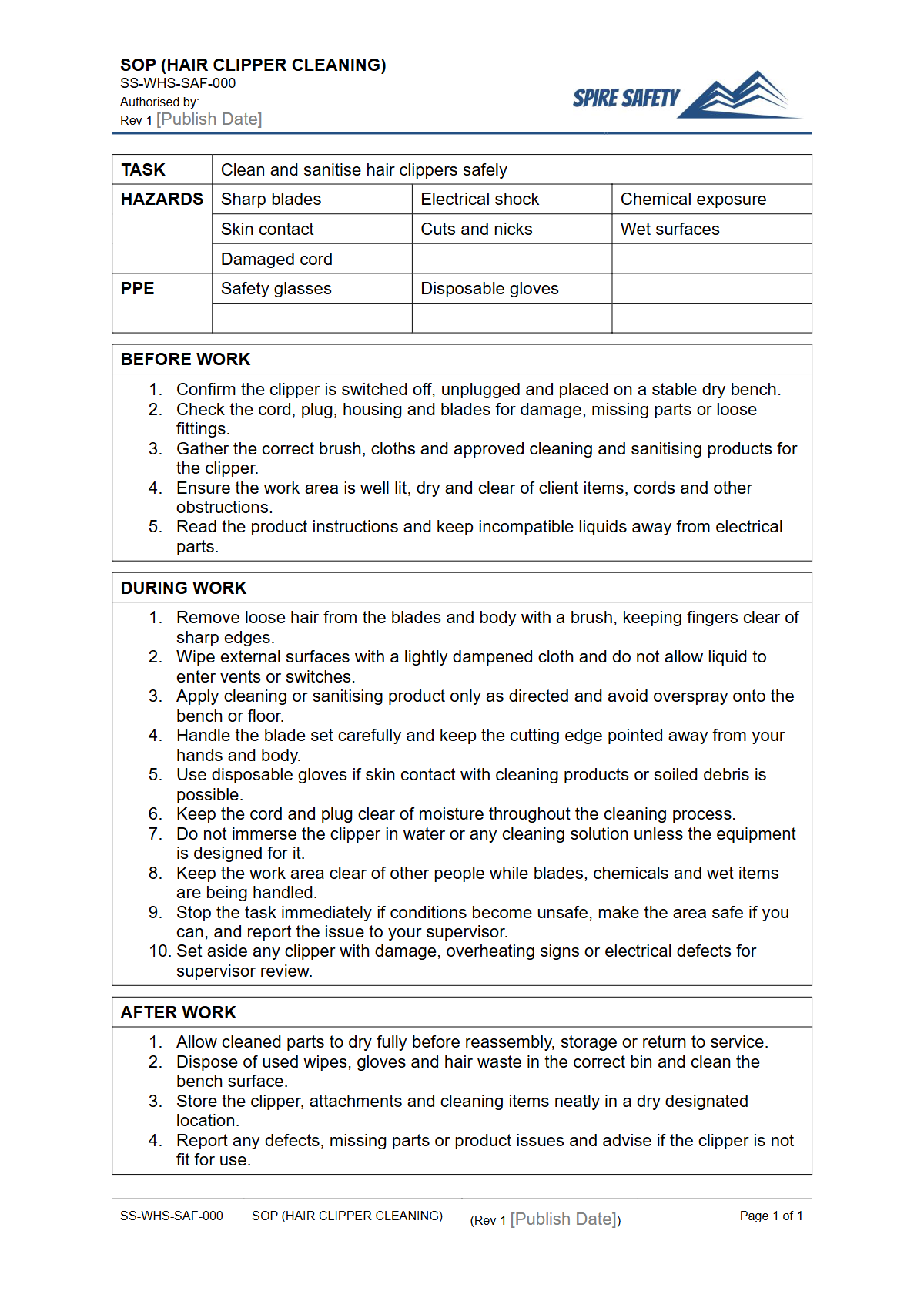
Download our free Safe Operating Procedure for hair clipper cleaning. This customisable template helps barbers and salons document safe cleaning practices.
Free Safe Operating Procedure (Hair Clipper Cleaning) Template
DOCX • 126 KB + PDF
Updated Oct 2026
No signup required
Purpose of the Free Safe Operating Procedure (Hair Clipper Cleaning) Template
Proper cleaning and sanitisation of hair clippers are critical for maintaining hygiene, ensuring client safety, and extending the life of your equipment. This Free Safe Operating Procedure (Hair Clipper Cleaning) Template provides a structured framework for documenting the step-by-step process required to safely and effectively clean, disinfect, and store professional hair clippers.
Using a formal SOP helps prevent the transmission of skin infections and blood-borne pathogens, manage risks from cleaning chemicals, and ensure electrical safety. It standardises the process for all staff, creating a consistent approach to health and safety that protects both employees and clients. Establishing clear, documented processes is a fundamental aspect of workplace safety, whether for personal care equipment or for life-saving devices like those covered in our defibrillator operation SOP.
Video walkthrough
How to use the Free Safe Operating Procedure (Hair Clipper Cleaning) Template
This Safe Operating Procedure template is a comprehensive starting point, designed for easy customisation. To use it effectively, download the DOCX file and adapt it to the specific context of your barbershop, salon, or personal care business.
You should detail the exact models of clippers used, the specific brand of disinfectant and lubricant, and the required Personal Protective Equipment (PPE) like gloves or safety glasses. It is vital that your customised SOP forms a practical part of your broader WHS management system, ensuring it is read, understood, and followed by all relevant personnel.
Important: This is a template only. It must be customised to reflect the specific equipment, chemicals, and processes used in your workplace.
We are not responsible for the outcomes of any document you create from this template. You must consult the manufacturer's instructions for your clippers and the Safety Data Sheets (SDS) for all cleaning products.
Key elements to include
Your customised SOP should clearly outline several key stages of the cleaning process to ensure nothing is missed:
- Pre-cleaning: Safely disconnecting the clippers from power and brushing away all loose hair and debris from the blades and housing.
- Disinfection: The specific method for applying a hospital-grade, EPA-registered disinfectant, including the required contact time to ensure it effectively kills bacteria, viruses, and fungi.
- Rinsing and Drying: Steps to rinse off disinfectant (if required) and thoroughly dry all components to prevent corrosion.
- Lubrication: Applying clipper oil to the blades to maintain performance, reduce friction, and prevent rust.
- Reassembly and Storage: Correctly reassembling the clippers and storing them in a clean, dry, and protected location.
When to use it
The Safe Operating Procedure for hair clipper cleaning should be followed on a strict schedule. This typically includes a full clean and disinfection cycle after every single client to prevent cross-contamination.
A more thorough deep clean, potentially involving further disassembly as per manufacturer guidelines, might be scheduled at the end of each day or week, depending on usage volume. The SOP also serves as a critical training tool for new employees and a refresher for existing staff to ensure standards do not slip over time.
Adherence to these schedules should be regularly verified.
Who should use it
This SOP is intended for all individuals who use professional hair clippers as part of their job. This includes qualified barbers, hairdressers, stylists, apprentices, and salon assistants.
All personnel must be trained on the specific procedures outlined in the finalised document before they are permitted to clean the equipment. It is the responsibility of the Person Conducting a Business or Undertaking (PCBU) to ensure this training occurs and that competency is verified.
The effectiveness of these procedures can be confirmed through regular WHS compliance auditing to maintain high standards.
Managing Associated Risks
Cleaning clippers involves more than just hygiene. Your SOP must address associated hazards.
This includes electrical safety when handling corded clippers, especially around liquids. It also involves chemical safety, requiring an understanding of the Safety Data Sheets (SDS) for your cleaning solutions and the use of appropriate PPE.
The principles of identifying hazards and outlining controls are universal in WHS, whether for small handheld tools or larger machinery covered in a free circular saw SOP. If you require tailored support in developing comprehensive risk management strategies for your business, our WHS consulting services can provide expert guidance. To see other useful templates, you can browse our entire free WHS resources library for a wide range of documents covering various industries and tasks.
Common mistakes
Common mistakes to avoid
- Using a disinfectant spray without waiting for the required contact time, rendering it ineffective.
- Neglecting to fully brush out hair and debris before applying disinfectant, which prevents the chemical from reaching all surfaces.
- Forgetting to oil the blades after cleaning, leading to increased friction, heat, and premature wear.
- Storing clippers in a sealed container or drawer while still damp, which can promote rust and mould growth.
Legal references
Legal considerations
The following legal requirements may be relevant to this type of work.
- Work Health and Safety Act (Harmonised) — Provides the primary duties for protecting workers and other people from work health and safety risks.
- Work Health and Safety Regulations (Harmonised) — Sets out requirements supporting the management of workplace hazards and risks.
The following codes may be relevant to this type of work.
- Managing WHS Risks Code of Practice — Provides practical guidance on identifying hazards, assessing risks and applying effective controls.
- Work Health and Safety Consultation, Cooperation and Coordination Code of Practice — Provides practical guidance on consulting workers and coordinating with other duty holders.
- Managing the Work Environment and Facilities Code of Practice — Provides practical guidance on safe work environments, workplace facilities and related controls.
Did you know
Pathogen Persistence
Bacteria like Staphylococcus aureus can survive on hard surfaces like clipper blades for days or even weeks if not properly disinfected, posing a significant risk of cross-contamination between clients.
State-Based Regulation
In Australia, specific hygiene requirements for personal care services like hairdressing are regulated at the state and territory level. Your procedures must meet the standards set by your local public health authority.
FAQ
Frequently asked questions
01Why is a documented SOP for clipper cleaning better than just verbal instructions?
02What is the difference between cleaning, sanitising, and disinfecting clippers?
03How often should hair clippers be professionally serviced?
04Can I use this template for cleaning other salon equipment like trimmers or shavers?
Share this resource
Free Safe Operating Procedure (Hair Clipper Cleaning) Template
Browse Categories
How To Use It
- 1Download and open in Word or PDF.
- 2Replace the placeholders with your business details.
- 3Get it reviewed by a WHS specialist before rollout.
Need it customised?
Our WHS consultants can adapt this template to your site, run a gap analysis, or audit what you already have in place.
Book a Free Consultation WHS consulting servicesor call 1300 156 382
Related templates
- Free Safe Operating Procedure (Hair Salon Cleanup) Template
- Free Safe Operating Procedure (Hairdressing Room Clean) Template
- Free Safe Operating Procedure (Hand Basin Descaling) Template
- Free Safe Operating Procedure (Hand Harvesting) Template
- Free Safe Operating Procedure (Hand Hedge Trimming) Template
- Free Safe Operating Procedure (Hand Hygiene Station) Template