
Free Safe Operating Procedure (Hair Salon Cleanup) Template
Download our free Safe Operating Procedure (Hair Salon Cleanup) Template. This customisable DOCX & PDF helps Australian salons manage daily cleaning risks.
Free Safe Operating Procedure (Hair Salon Cleanup) Template
DOCX • 126 KB + PDF
Updated Oct 2026
No signup required
Purpose of the Free Safe Operating Procedure (Hair Salon Cleanup) Template
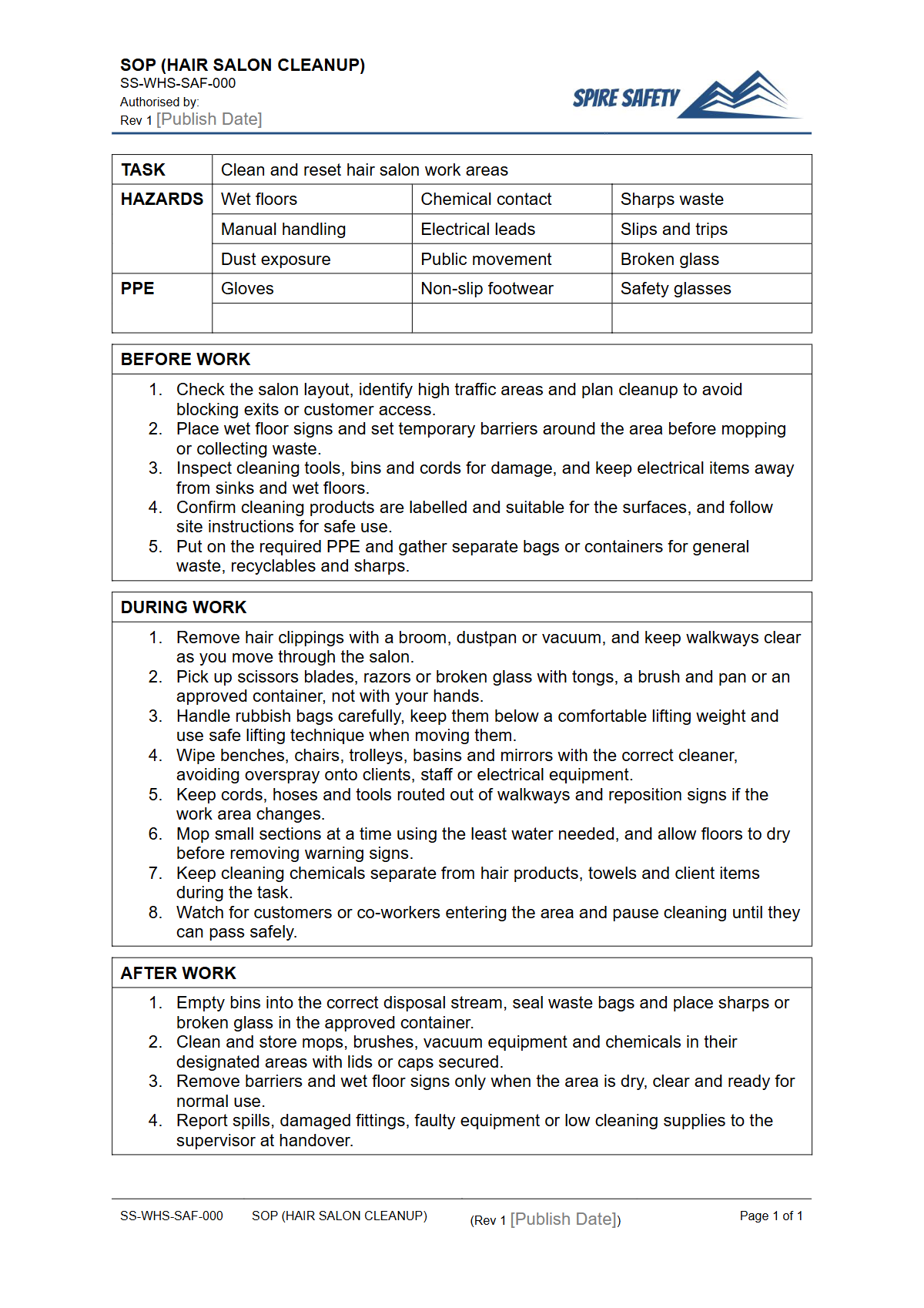
This Safe Operating Procedure (SOP) provides a structured framework for safely conducting cleanup tasks within a hair salon environment. A clean and organised salon is not just about appearances; it's a critical component of workplace health and safety.
This template helps salon owners and managers document clear, step-by-step instructions for tasks like sweeping hair, cleaning spills, handling chemicals, and disposing of waste. Using this free Safe Operating Procedure for hair salon cleanup helps to minimise risks such as slips, trips, falls, and chemical exposure, ensuring a safer workplace for staff and a more professional experience for clients.
It forms a key part of your overall safety management documentation, demonstrating a commitment to proactive risk control.
Properly documented procedures ensure that all team members perform tasks consistently and safely, reducing the chance of incidents. This SOP serves as a foundational document that can be integrated into your broader WHS management system, helping you systematically manage operational risks.
It also provides a valuable tool for training new employees, setting clear expectations for hygiene and safety from day one.
Video walkthrough
How to use the Free Safe Operating Procedure (Hair Salon Cleanup) Template
This document is designed as a starting point. To make it effective, you must customise it to reflect the specific layout, equipment, chemicals, and tasks unique to your salon.
Download the DOCX file and work through each section, adding or removing steps to match your actual processes. Engage with your team during this customisation process; their direct experience is invaluable for identifying practical risks and effective controls.
Important: This is a template only. We have provided a comprehensive starting point, but it is your responsibility to ensure the final document is tailored to your specific workplace risks, state-based regulations, and operational needs.
The final, customised SOP should be reviewed and approved by management, and then made easily accessible to all relevant staff. Regular reviews are essential to keep it current.
When to use this Safe Operating Procedure
This SOP should be used for both routine daily cleanup and in response to specific incidents like spills. It is applicable during end-of-day cleaning, between client appointments, and whenever a potential hazard is created.
For example, it should be referenced immediately after a colour or chemical spill to ensure the correct cleanup method and personal protective equipment (PPE) are used. It's also a vital resource for training and refresher courses to reinforce safe work habits among all staff members.
Beyond daily tasks, this procedure is important during safety inductions for new staff and should be a reference point during internal safety checks. Maintaining a safe environment is an ongoing activity that involves every member of your team.
This also includes being prepared for emergencies; you can supplement your safety documents with a specific Safe Operating Procedure for defibrillator operation if your salon is equipped with one.
Who should use this Safe Operating Procedure
This SOP is intended for all individuals working within the salon, including senior stylists, apprentices, assistants, and cleaning staff. Everyone has a responsibility to maintain a clean and safe environment.
Salon owners and managers are responsible for implementing the SOP, providing the necessary training and resources (like PPE and cleaning supplies), and ensuring compliance. If you require specialised assistance in adapting this template or developing a more comprehensive safety framework for your business, our WHS consulting services can provide expert guidance.
Supervisors should use this document to guide their teams and monitor that cleaning tasks are performed correctly. For tasks that involve working at heights, such as cleaning high shelves or changing light bulbs, a separate procedure like a step ladder SOP may also be required to address specific fall risks.
You can find more templates and guides like these in our complete free WHS resources library to build out your safety system.
Common mistakes
Common mistakes to avoid
- Failing to clean up wet or chemical spills immediately, increasing slip and exposure risks.
- Using incorrect dilution ratios for concentrated cleaning chemicals, making them ineffective or hazardous.
- Not wearing appropriate Personal Protective Equipment (PPE), such as gloves and safety glasses, when handling chemicals.
- Improperly disposing of waste like sharp objects, hair, and chemical-soaked materials.
Legal references
Legal considerations
The following legal requirements may be relevant to this type of work.
- Work Health and Safety Act (Harmonised) — Provides the primary duties for protecting workers and other people from work health and safety risks.
- Work Health and Safety Regulations (Harmonised) — Sets out requirements supporting the management of workplace hazards and risks.
The following codes may be relevant to this type of work.
- Managing WHS Risks Code of Practice — Provides practical guidance on identifying hazards, assessing risks and applying effective controls.
- Work Health and Safety Consultation, Cooperation and Coordination Code of Practice — Provides practical guidance on consulting workers and coordinating with other duty holders.
- Managing the Work Environment and Facilities Code of Practice — Provides practical guidance on safe work environments, workplace facilities and related controls.
Did you know
Slips, Trips, and Falls
Slips, trips, and falls are one of the most common causes of injury in the hairdressing industry. Wet floors, stray power cords, and loose hair clippings are primary culprits, making a structured cleanup procedure essential.
Contact Dermatitis
Contact dermatitis is a significant occupational health issue for hairdressers, often caused by frequent exposure to water, shampoos, and other chemicals. Proper glove use during cleaning is a critical control measure.
FAQ
Frequently asked questions
01What common salon chemicals require specific cleanup procedures?
02How often should our salon's cleanup SOP be reviewed?
03Are Australian salon owners legally required to have an SOP for cleaning?
04What is the difference between an SOP and a SWMS for a hair salon?
Share this resource
Free Safe Operating Procedure (Hair Salon Cleanup) Template
Browse Categories
How To Use It
- 1Download and open in Word or PDF.
- 2Replace the placeholders with your business details.
- 3Get it reviewed by a WHS specialist before rollout.
Need it customised?
Our WHS consultants can adapt this template to your site, run a gap analysis, or audit what you already have in place.
Book a Free Consultation WHS consulting servicesor call 1300 156 382
Related templates
- Free Safe Operating Procedure (Hairdressing Room Clean) Template
- Free Safe Operating Procedure (Hand Basin Descaling) Template
- Free Safe Operating Procedure (Hand Harvesting) Template
- Free Safe Operating Procedure (Hand Hedge Trimming) Template
- Free Safe Operating Procedure (Hand Hygiene Station) Template
- Free Safe Operating Procedure (Hand Loading Freight) Template