
Free Safe Operating Procedure (Grout Mixer) Template
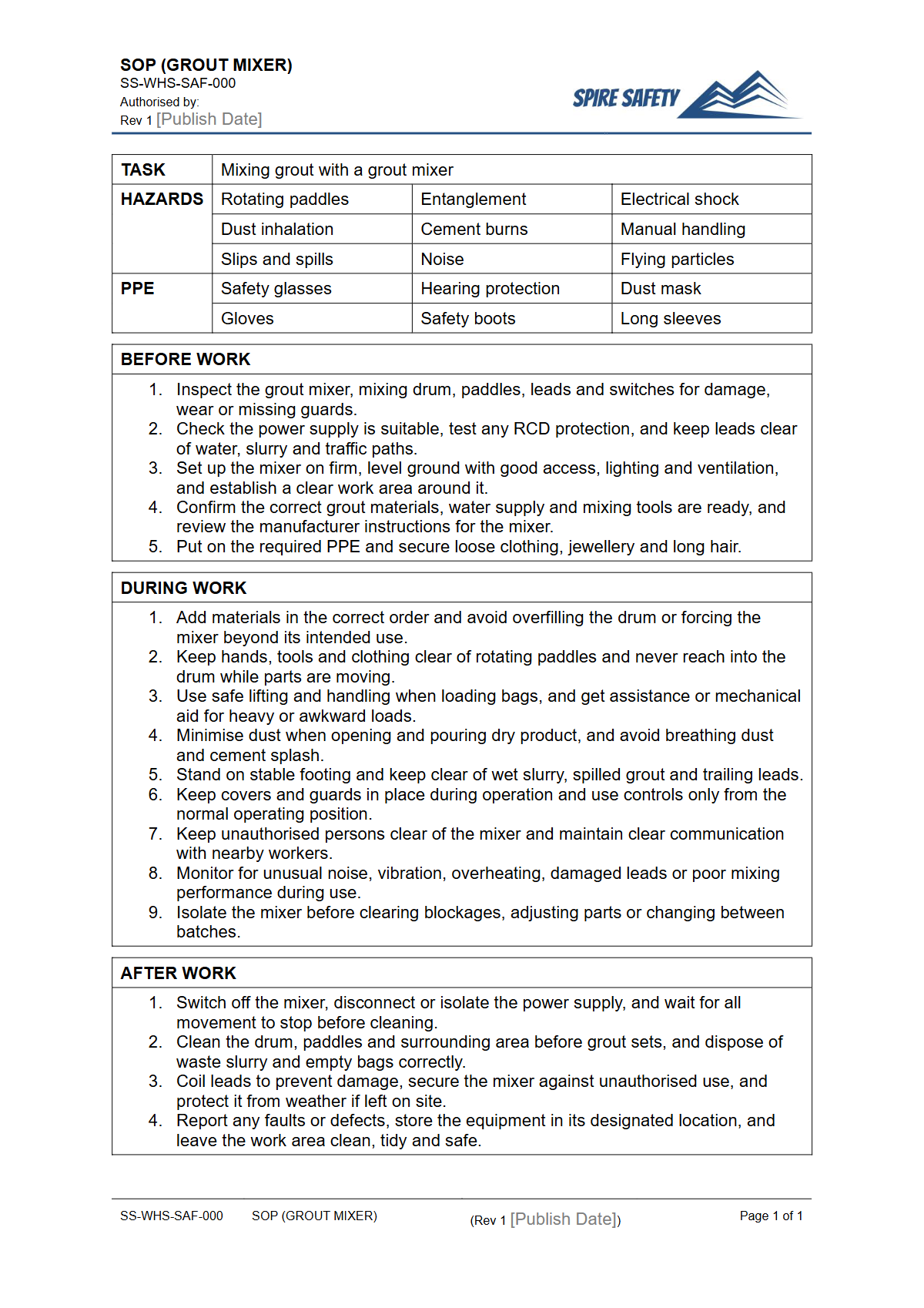
Download our free Grout Mixer SOP template. This customisable DOCX and PDF helps you document safe operating procedures for paddle and colloid grout mixers.
Free Safe Operating Procedure (Grout Mixer) Template
DOCX • 126 KB + PDF
Updated Oct 2026
No signup required
Purpose of the Free Safe Operating Procedure (Grout Mixer) Template
Operating a grout mixer, like any piece of plant, introduces risks into the workplace that must be managed. This free Safe Operating Procedure (Grout Mixer) Template provides a structured framework for documenting the step-by-step process required to use the equipment safely.
An effective SOP is a critical control measure that helps your organisation meet its duties under WHS legislation by clearly defining safe work methods, required personal protective equipment (PPE), and emergency responses.
Key hazards associated with grout mixers include mechanical entanglement with rotating paddles, chemical burns from cementitious products, respiratory irritation from dust (including silica), electric shock, and musculoskeletal injuries from manual handling. A documented SOP helps ensure these risks are consistently controlled. The principles outlined are similar to those found in procedures for other site plant, such as our free Air Compressor SOP template.
What is a Grout Mixer SOP?
A Safe Operating Procedure, or SOP, is a written document that provides clear, sequential instructions on how to perform a specific task safely and efficiently. For a grout mixer, it covers everything from pre-start checks and loading materials to the mixing process, decanting, cleaning, and shutdown.
It serves as a vital tool for worker training, supervision, and incident investigation, forming a key part of your overall safety management system.
Video walkthrough
How to use the Free Safe Operating Procedure (Grout Mixer) Template
Using this template is straightforward. Simply download the DOCX file to edit it or the PDF for immediate reference.
It is designed to be adapted to your specific operational needs and the unique environment of your workplace. An SOP should be a practical, living document that reflects how work is actually done on-site.
IMPORTANT NOTE: This document is a template only. We have provided a structured starting point, but you must customise it to reflect the specific make and model of your grout mixer, the grout products being used, and the unique conditions of your work area.
A generic SOP that hasn't been site-specific is not sufficient to ensure safety or demonstrate compliance. Review and finalise the SOP in consultation with the workers who will be using it. A robust set of SOPs is a cornerstone of effective WHS management systems.
When to use a Grout Mixer SOP
A Safe Operating Procedure for a grout mixer should be used consistently as a primary reference for safe work. It is particularly important in several key situations:
- Worker Training and Induction: Before any employee or contractor is authorised to use the grout mixer for the first time.
- Refresher Training: As part of a regular training schedule to reinforce safe practices and address any complacency.
- Task Planning: Supervisors and workers should review the SOP before starting a new grouting project to ensure all controls are in place.
- Incident Investigation: After a near miss or incident, the SOP should be reviewed to determine if the procedure was followed and if it needs revision.
Using SOPs for high-risk equipment is a fundamental aspect of site safety, similar to the protocols required for other machinery, as detailed in resources like our FREE Trencher SOP Template.
Who should use this SOP
This Safe Operating Procedure is intended for use by multiple roles within an organisation to create a cohesive safety framework.
- PCBUs (Persons Conducting a Business or Undertaking): To help fulfil their primary duty of care to provide and maintain safe systems of work.
- Managers and Supervisors: To train workers, monitor compliance with safe procedures, and enforce safety standards on site.
- Safety Officers/Advisors: As a tool for conducting risk assessments, developing training materials, and auditing workplace practices.
- Workers: As a clear guide on how to perform their tasks safely, protecting themselves and their workmates.
Regular reviews ensure the SOP remains current and effective, a process that can be validated through professional WHS compliance auditing to verify its implementation and adequacy.
Common mistakes
Common mistakes to avoid
- Using a generic template without customising it for the specific mixer and site conditions.
- Failing to adequately train workers on the contents of the finalised SOP.
- Not including specific details on the required Personal Protective Equipment (PPE).
- Forgetting to review and update the SOP after an incident or when new equipment is introduced.
Legal references
Legal considerations
The following legal requirements may be relevant to this type of work.
- Work Health and Safety Act (Harmonised) — Provides the primary duties for protecting workers and other people from work health and safety risks.
- Work Health and Safety Regulations (Harmonised) — Sets out requirements supporting the management of workplace hazards and risks.
The following codes may be relevant to this type of work.
- Managing WHS Risks Code of Practice — Provides practical guidance on identifying hazards, assessing risks and applying effective controls.
- Work Health and Safety Consultation, Cooperation and Coordination Code of Practice — Provides practical guidance on consulting workers and coordinating with other duty holders.
- Managing the Work Environment and Facilities Code of Practice — Provides practical guidance on safe work environments, workplace facilities and related controls.
Did you know
Silica Dust Hazard
Many cement-based grouts contain crystalline silica. Inhaling fine silica dust can lead to serious and irreversible lung diseases like silicosis, making dust control and appropriate respiratory protection critical.
FAQ
Frequently asked questions
01What is an SOP for a grout mixer?
02Is this grout mixer SOP template free to download?
03Who is responsible for creating a Safe Operating Procedure?
04How often should a Grout Mixer SOP be reviewed?
Share this resource
Free Safe Operating Procedure (Grout Mixer) Template
Browse Categories
How To Use It
- 1Download and open in Word or PDF.
- 2Replace the placeholders with your business details.
- 3Get it reviewed by a WHS specialist before rollout.
Need it customised?
Our WHS consultants can adapt this template to your site, run a gap analysis, or audit what you already have in place.
Book a Free Consultation WHS consulting servicesor call 1300 156 382
Related templates
- Free Safe Operating Procedure (Grout Pump) Template
- Free Safe Operating Procedure (Guillotine Shear Operation) Template
- Free Safe Operating Procedure (Gutter Cleaning) Template
- Free Safe Operating Procedure (Hail Net Installation) Template
- Free Safe Operating Procedure (Hair Clipper Cleaning) Template
- Free Safe Operating Procedure (Hair Salon Cleanup) Template