
Free Safe Operating Procedure (Ground Power Unit) Template
Download our free Safe Operating Procedure (Ground Power Unit) template.
Free Safe Operating Procedure (Ground Power Unit) Template
DOCX • 126 KB + PDF
Updated Oct 2026
No signup required
Purpose of the Free Safe Operating Procedure (Ground Power Unit) Template
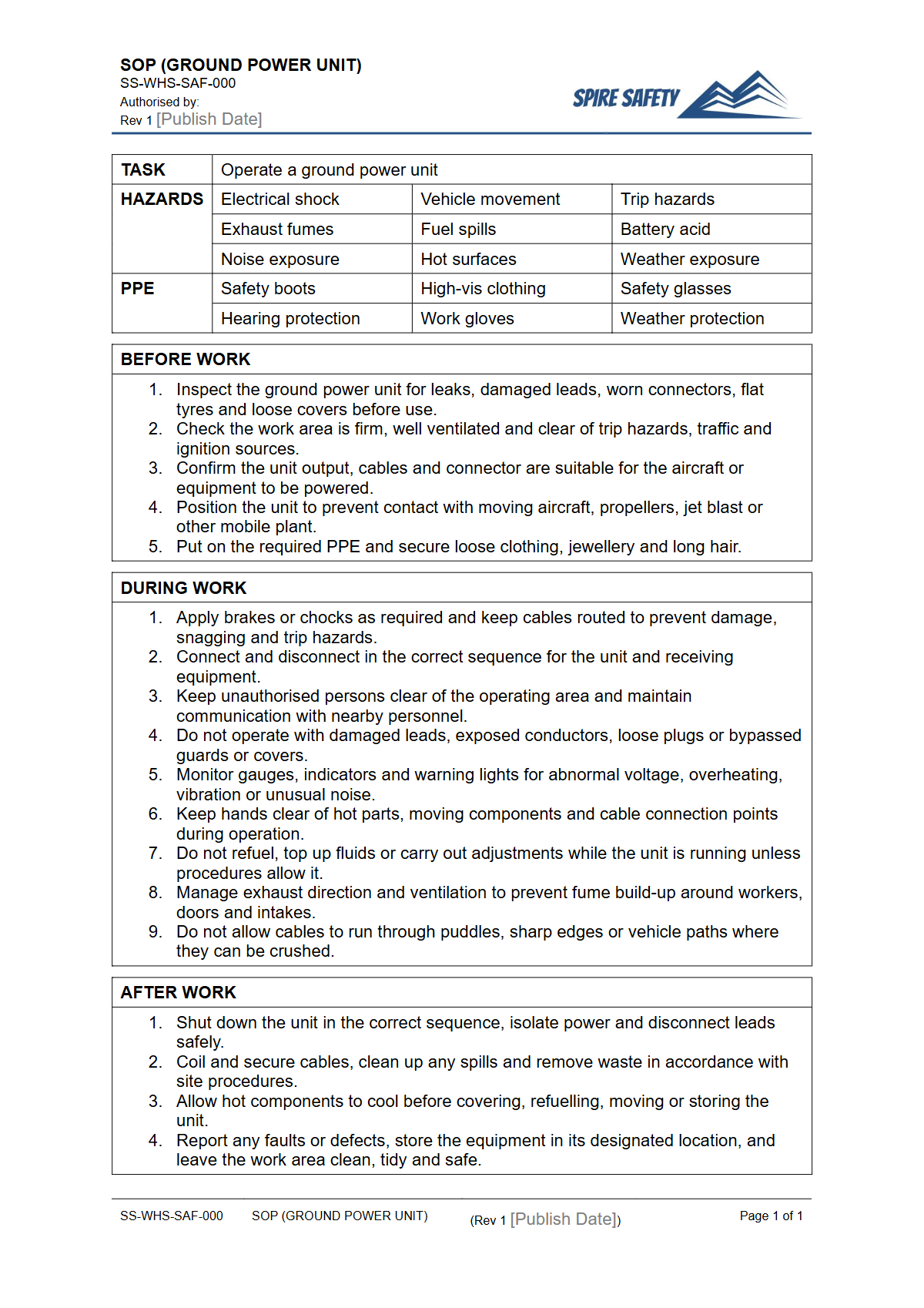
A Safe Operating Procedure (SOP) is a foundational document that provides clear, step-by-step instructions on how to perform a task safely. This Free Safe Operating Procedure (Ground Power Unit) Template is designed to help your organisation formalise the process for operating GPUs, which are common in aviation, heavy vehicle maintenance, and large-scale event industries.
Using this template helps you systematically identify risks associated with GPU use—such as electrical shock, fire, excessive noise, and manual handling—and document the specific control measures required to protect your workers.
Implementing documented procedures is a critical component of a robust safety framework. A well-drafted SOP serves as a key training tool, a reference for workers, and evidence of your commitment to managing workplace risks.
Integrating specific procedures like this into your broader WHS management systems ensures a consistent and structured approach to safety across all operations.
Key elements of a Ground Power Unit SOP
A comprehensive SOP for a Ground Power Unit should detail the entire operational cycle. Our template provides sections for you to customise, including:
- Pre-operational Checks: Inspecting the unit, cables, connectors, and fuel or battery levels before starting work.
- Connection Procedure: The correct sequence for connecting the GPU to an aircraft or vehicle to prevent arcing and electrical damage.
- Operation: Monitoring the unit during use for any faults, fluid leaks, or overheating.
- Disconnection Procedure: The safe sequence for disconnecting power and stowing cables and equipment.
- Emergency Shutdown: Steps to take in case of an emergency, such as a fire, electrical fault, or fuel spill.
- Maintenance and Housekeeping: Requirements for cleaning, refuelling, and storing the unit correctly.
Video walkthrough
How to use the Free Safe Operating Procedure (Ground Power Unit) Template
This document is provided in both DOCX and PDF formats for your convenience. The DOCX file is fully editable, allowing you to tailor the content to your specific equipment and workplace environment.
To use the template effectively, you should consult with operators, supervisors, and maintenance personnel who work directly with the GPUs. Their practical experience is invaluable for identifying all relevant hazards and effective controls.
Important: This is a template only. We are not familiar with your specific worksite, equipment models, or operational context.
You MUST customise this document to reflect your unique workplace risks and control measures, referencing the manufacturer's operating manual for each specific GPU model in use. Just as you would with our Free Air Compressor SOP Template, this document must be adapted to become a site-specific tool.
When to use this Safe Operating Procedure
Once customised and approved, the GPU SOP should be integrated into your daily operations. It is not a document to be filed away and forgotten. Its primary uses include:
- Worker Training: Use it as the basis for inducting and training new operators on the safe use of ground power units.
- Pre-task Reference: Workers can review the SOP before starting a task to refresh their memory on key safety steps and checks.
- Supervision and Monitoring: Supervisors can use the SOP as a benchmark to observe work practices and ensure procedures are being followed correctly.
- Incident Investigation: If an incident occurs, the SOP can be reviewed to determine if procedural gaps contributed to the event.
Procedures should be living documents, subject to regular review. A periodic WHS compliance auditing process can help identify when procedures like this one or your plasma cutter SOP have become outdated and require updating.
A review should be triggered at least annually, or whenever there is a change in equipment, processes, or relevant legislation.
Who should use this Safe Operating Procedure
This SOP is intended for several key roles within an organisation:
- Operators and Workers: The primary users, who must understand and follow the procedure to perform their work safely.
- Supervisors and Team Leaders: Responsible for ensuring their teams are trained on the SOP and adhere to it during operations.
- WHS Managers and Personnel: Responsible for developing, reviewing, and managing the SOP as part of the overall safety management system.
- Trainers: Use the SOP as a core component of their training material for equipment operation.
Competency is crucial. Simply reading an SOP does not make a worker competent.
The procedure should be supported by hands-on training and a verification of competency process. This principle applies to all equipment, whether it's a complex GPU or a simple item covered by a step ladder SOP. You can find many other document templates in our free WHS resources library to support your safety management efforts.
Common mistakes
Common mistakes to avoid
- Failing to perform a pre-use inspection of cables and connectors for damage.
- Incorrectly connecting or disconnecting the power cable, leading to dangerous electrical arcing.
- Leaving cables stretched across active vehicle or pedestrian pathways, creating significant trip hazards.
- Operating the unit in poorly ventilated areas, leading to a build-up of carbon monoxide from diesel engines.
Legal references
Legal considerations
The following legal requirements may be relevant to this type of work.
- Work Health and Safety Act (Harmonised) — Provides the primary duties for protecting workers and other people from work health and safety risks.
- Work Health and Safety Regulations (Harmonised) — Sets out requirements supporting the management of workplace hazards and risks.
The following codes may be relevant to this type of work.
- Managing WHS Risks Code of Practice — Provides practical guidance on identifying hazards, assessing risks and applying effective controls.
- Work Health and Safety Consultation, Cooperation and Coordination Code of Practice — Provides practical guidance on consulting workers and coordinating with other duty holders.
- Managing the Work Environment and Facilities Code of Practice — Provides practical guidance on safe work environments, workplace facilities and related controls.
Did you know
Dual Purpose Units
Some GPUs, particularly for aviation, are combination units. They not only provide 400 Hz electrical power but also deliver high-pressure, high-flow air to start the aircraft's jet engines.
The Rise of eGPUs
To reduce noise, emissions, and fuel costs at airports, many operators are transitioning from diesel-powered GPUs to all-electric units (eGPUs). These are either plugged into the gate's power supply or run on large, rechargeable battery systems.
FAQ
Frequently asked questions
01What is a Ground Power Unit (GPU)?
02What are the main hazards of operating a GPU?
03How often should a Safe Operating Procedure be reviewed?
04Is this template enough for my business to be compliant?
Share this resource
Free Safe Operating Procedure (Ground Power Unit) Template
Browse Categories
How To Use It
- 1Download and open in Word or PDF.
- 2Replace the placeholders with your business details.
- 3Get it reviewed by a WHS specialist before rollout.
Need it customised?
Our WHS consultants can adapt this template to your site, run a gap analysis, or audit what you already have in place.
Book a Free Consultation WHS consulting servicesor call 1300 156 382
Related templates
- Free Safe Operating Procedure (Groundcover Planting) Template
- Free Safe Operating Procedure (Grounds Litter Pickup) Template
- Free Safe Operating Procedure (Grout Injection Pump) Template
- Free Safe Operating Procedure (Grout Mixer) Template
- Free Safe Operating Procedure (Grout Pump) Template
- Free Safe Operating Procedure (Guillotine Shear Operation) Template