
Free Safe Operating Procedure (Grinding Wheel Change) Template
Download our free Safe Operating Procedure for changing grinding wheels.
Free Safe Operating Procedure (Grinding Wheel Change) Template
DOCX • 126 KB + PDF
Updated Oct 2026
No signup required
Purpose of the Free Safe Operating Procedure (Grinding Wheel Change) Template
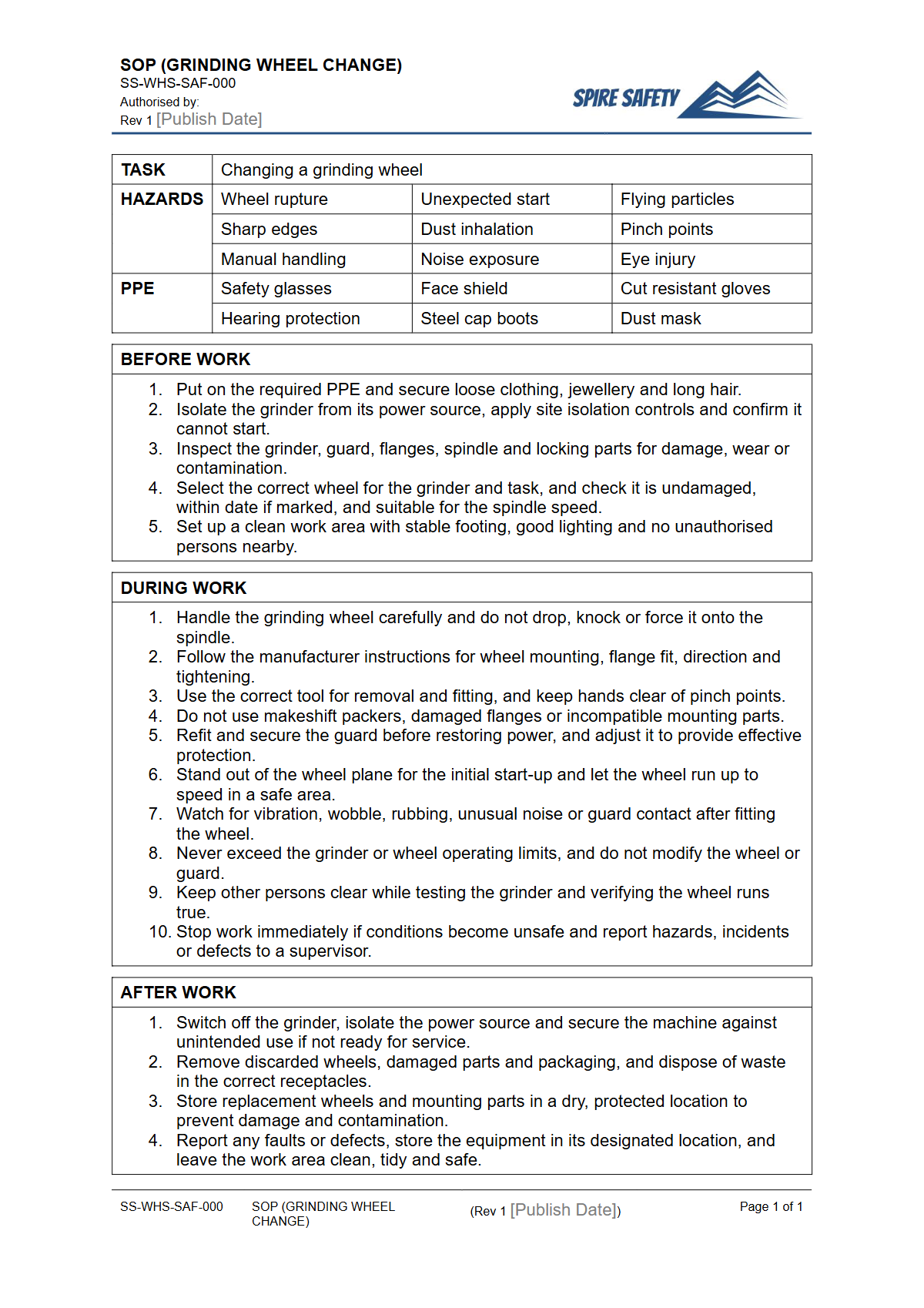
Changing a grinding wheel is a high-risk task that exposes workers to serious hazards, including wheel disintegration, entanglement, and projectile injuries. Our free Safe Operating Procedure (Grinding Wheel Change) template provides a structured starting point for documenting the required steps to perform this task safely.
This Safe Operating Procedure helps a Person Conducting a Business or Undertaking (PCBU) meet their primary duty of care by establishing a formal, repeatable process that minimises risk. Using a clear SOP ensures that every worker follows the same approved method, reducing the chance of error and injury.
A documented procedure is a critical control measure for managing hazards associated with abrasive wheels. It formalises requirements such as pre-start checks, correct tool selection, wheel inspection (the 'ring test'), proper mounting techniques, and the use of Personal Protective Equipment (PPE) like face shields and gloves. This process is just as vital as the procedures for operating the machinery itself, similar to the protocols outlined in our FREE Plasma Cutter SOP (Safe Operating Procedure) Template.
Video walkthrough
How to use the Free Safe Operating Procedure (Grinding Wheel Change) Template
This document is a template, not a finished procedure. To be effective, it must be adapted to the specific context of your workplace.
Start by downloading the DOCX file and adding your company branding. Then, consult with the workers and supervisors who actually perform the task.
Their direct experience is invaluable for ensuring the procedure is practical and reflects the real-world challenges and equipment they use, such as specific bench, pedestal, or angle grinders.
Review each step and modify it to align with your specific types of grinding machines, wheel specifications, and work environment. Add details about the location of isolation points, the tools required for the change, and the specific PPE your risk assessment has deemed necessary.
Integrating this SOP is a key part of developing comprehensive WHS management systems that actively manage risk rather than just documenting it.
Important: This is a template that we have created as a starting point. You MUST customise this document to reflect the specific hazards, risks, and control measures relevant to your workplace, equipment, and personnel.
Consultation with your team is essential. For complex operations, seeking specialist WHS consulting support can provide additional assurance.
What’s included in this Safe Operating Procedure?
This Safe Operating Procedure template provides a comprehensive framework for managing grinding wheel changes. It includes sections for:
- Defining the scope of the procedure.
- Listing necessary PPE based on a risk assessment.
- Detailing the step-by-step process for safely removing an old wheel and installing a new one.
- Outlining pre-operational checks, including the 'ring test' for new wheels.
- Specifying post-change checks, such as ensuring guards are replaced and the wheel runs true.
- Identifying responsibilities for workers, supervisors, and managers.
- A section for training and competency records.
When to use it
A Safe Operating Procedure for changing grinding wheels should be implemented before any worker is authorised to perform the task. It forms the foundation of their training and a benchmark for assessing their competency.
The SOP should be readily accessible in the work area, either as a hard copy or digitally, for easy reference. It's a living document that requires regular review, especially after an incident or near miss, when a new type of grinder or wheel is introduced, or if a periodic safety review identifies a need for improvement. This process ensures the procedure remains relevant and effective over time, much like the procedures needed for other common workshop equipment documented in our Free Air Compressor SOP (Safe Operating Procedure) Template.
Who should use it
This Safe Operating Procedure should be used by several key groups within an organisation:
- Workers: Operators and maintenance staff who are tasked with changing grinding wheels must be trained on and follow the procedure meticulously.
- Supervisors and Team Leaders: They are responsible for ensuring workers are trained, competent, and adhere to the SOP. They also use it as a tool for workplace inspections and incident investigations.
- WHS Managers and Advisors: They use the SOP as a key document within the overall safety management system. They are often responsible for developing, reviewing, and updating the procedure in consultation with others, and it serves as critical evidence during regular WHS compliance auditing.
Proper documentation also supports other safety activities. For example, a worker might need to follow the steps in a FREE Step Ladder SOP Template just to access the grinder safely. To find more templates for other common tasks and equipment, you can browse our complete free WHS resources library.
Common mistakes
Common mistakes to avoid
- Using a wheel that has been dropped or bumped without first performing a 'ring test'.
- Overtightening the flange nut, which induces stress and can cause the wheel to crack.
- Forgetting to replace all safety guards after the new wheel has been mounted.
- Mounting a wheel with a maximum RPM rating that is lower than the grinder's spindle speed.
Legal references
Legal considerations
The following legal requirements may be relevant to this type of work.
- Work Health and Safety Act (Harmonised) — Provides the primary duties for protecting workers and other people from work health and safety risks.
- Work Health and Safety Regulations (Harmonised) — Sets out requirements supporting the management of workplace hazards and risks.
The following codes may be relevant to this type of work.
- Managing WHS Risks Code of Practice — Provides practical guidance on identifying hazards, assessing risks and applying effective controls.
- Work Health and Safety Consultation, Cooperation and Coordination Code of Practice — Provides practical guidance on consulting workers and coordinating with other duty holders.
- Managing the Work Environment and Facilities Code of Practice — Provides practical guidance on safe work environments, workplace facilities and related controls.
Did you know
The 'Ring Test'
A grinding wheel can have hidden cracks from being dropped or mishandled. The 'ring test' involves tapping the wheel gently with a non-metallic object; a clear, metallic ring indicates it's likely safe, while a dull thud suggests it may be damaged and should not be used.
Speed Kills
The peripheral speed of a grinding wheel can exceed 300 km/h. Fitting a wheel with a maximum RPM rating lower than the grinder's speed can cause it to disintegrate catastrophically under centrifugal force.
FAQ
Frequently asked questions
01What are the main hazards when changing a grinding wheel?
02Is a Safe Operating Procedure a legal requirement for changing grinding wheels in Australia?
03How often should a grinding wheel SOP be reviewed?
04Can I use this template for all types of grinders?
Share this resource
Free Safe Operating Procedure (Grinding Wheel Change) Template
Browse Categories
How To Use It
- 1Download and open in Word or PDF.
- 2Replace the placeholders with your business details.
- 3Get it reviewed by a WHS specialist before rollout.
Need it customised?
Our WHS consultants can adapt this template to your site, run a gap analysis, or audit what you already have in place.
Book a Free Consultation WHS consulting servicesor call 1300 156 382
Related templates
- Free Safe Operating Procedure (Grizzly Feeder) Template
- Free Safe Operating Procedure (Ground Crew Handover) Template
- Free Safe Operating Procedure (Ground Equipment Staging) Template
- Free Safe Operating Procedure (Ground Penetrating Radar) Template
- Free Safe Operating Procedure (Ground Power Unit) Template
- Free Safe Operating Procedure (Groundcover Planting) Template