
Free Safe Operating Procedure (Grizzly Feeder) Template
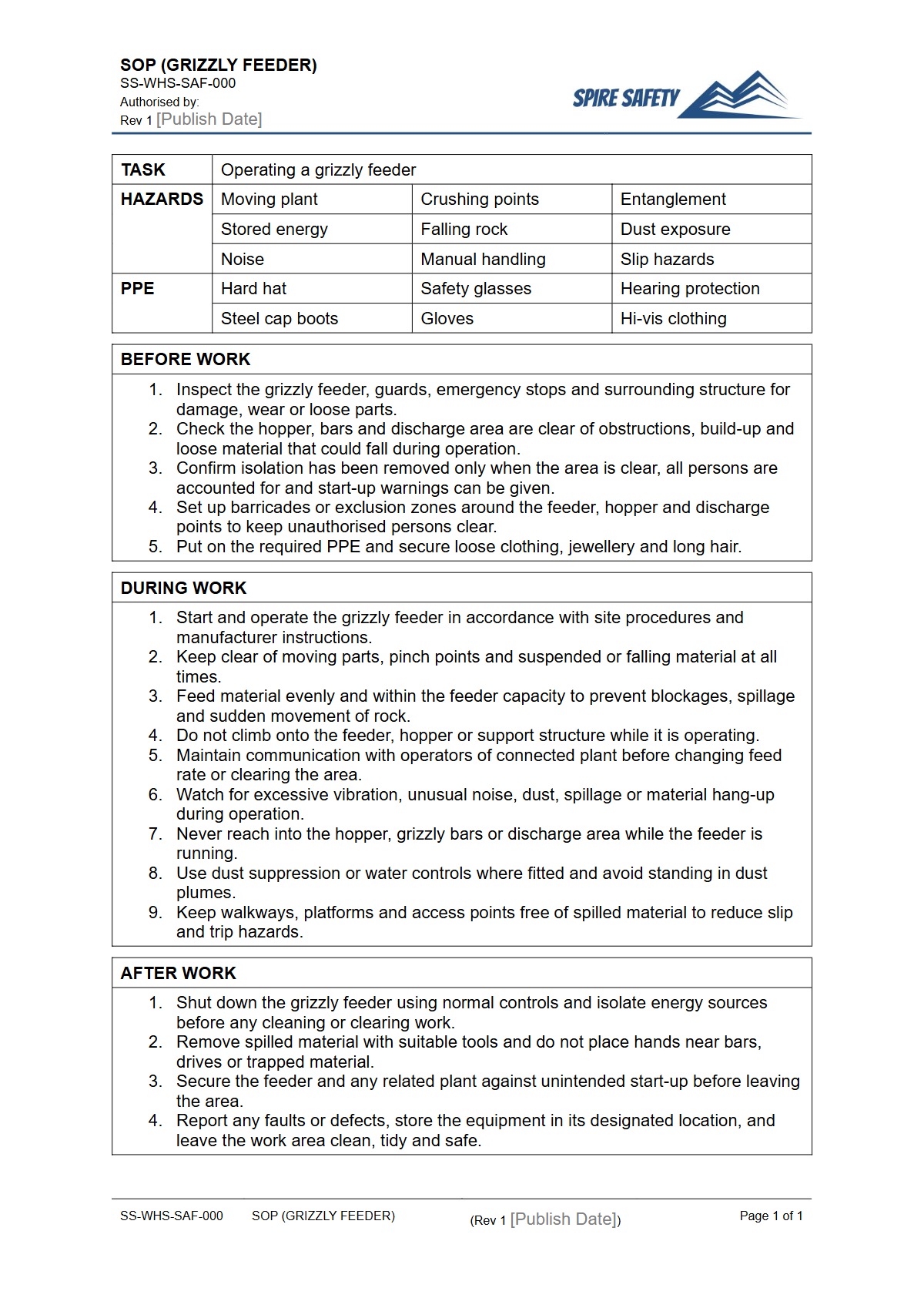
Download our free Safe Operating Procedure (Grizzly Feeder) Template. This customisable DOCX & PDF helps you document safe work methods for grizzly feeders.
Free Safe Operating Procedure (Grizzly Feeder) Template
DOCX • 126 KB + PDF
Updated Oct 2026
No signup required
Purpose of the Free Safe Operating Procedure (Grizzly Feeder) Template
This Free Safe Operating Procedure (Grizzly Feeder) Template provides a structured framework for documenting the essential steps to operate a grizzly feeder safely. Grizzly feeders are powerful pieces of plant used in mining, quarrying, and recycling to separate and feed material into crushers.
Their operation involves significant risks, including entanglement in moving parts, crush injuries, high noise levels, vibration, and airborne dust. Using a standardised SOP helps your organisation manage these risks by outlining clear, step-by-step instructions for pre-start checks, operation, shutdown, and emergency procedures.
By implementing a detailed Safe Operating Procedure (SOP), you create a consistent benchmark for training, competency assessment, and operational performance. This template, available in both DOCX and PDF formats, serves as a critical tool in your risk management process.
A grizzly feeder is a central piece of equipment in material processing operations, often working alongside other heavy machinery. A robust WHS management system helps integrate procedures for all plant, ensuring a consistent approach to safety across your entire site.
What is a Safe Operating Procedure?
A Safe Operating Procedure (SOP) is a written document that provides explicit instructions on how to perform a specific task safely and efficiently. It goes beyond a simple checklist by detailing the sequential steps of a job, identifying associated hazards at each step, and listing the control measures required to eliminate or minimise the risk of injury or illness.
For complex plant like a grizzly feeder, an SOP is a vital administrative control that supports higher-level controls like engineering modifications and guarding.
Video walkthrough
How to use the Free Safe Operating Procedure (Grizzly Feeder) Template
This document is designed as a starting point. To make it effective, you must adapt it to your specific operational context.
The DOCX version is recommended for easy customisation. Begin by consulting with the people who actually operate and maintain the equipment—their practical knowledge is invaluable for creating a procedure that is both safe and workable.
Important: This document is a template and is not a substitute for a site-specific risk assessment. We are not liable for any incidents that may occur from the use of this document.
You must customise this Safe Operating Procedure to reflect the specific equipment, personnel, and conditions of your workplace.
Follow these steps to implement the SOP:
- Download the template and open the DOCX file.
- Enter your company name, site details, and the specific make and model of the grizzly feeder.
- In consultation with operators and supervisors, review and modify the procedures for pre-start checks, operation, and shutdown to match your equipment and processes.
- Incorporate findings from your WHS consulting services or internal risk assessments, ensuring all identified hazards have corresponding control measures listed in the SOP.
- Once finalised, get the SOP approved by relevant management before communicating it to all relevant personnel through training sessions and toolbox talks.
- Ensure a copy is readily accessible to operators at or near the equipment.
Just as a dozer operator requires specific instructions, grizzly feeder operators need clear guidance. This process is similar to customising a safe operating procedure for dozers to match the specific model and work environment.
When to use it
An SOP for a grizzly feeder should be a living document that is integrated into daily operations, not just filed away. It is used in several key situations to reinforce safe work practices and manage risk effectively.
The SOP should be the primary reference during operator training, ensuring all workers learn the same approved method. It is also used for conducting competency assessments before a worker is authorised to operate the plant independently.
Supervisors should refer to the SOP during routine inspections and observations to verify that correct procedures are being followed. Furthermore, in the event of an incident or near-miss involving the grizzly feeder, the SOP should be a key document in the investigation to determine if procedural failures contributed to the event.
Regularly reviewing all operational documents is crucial, and a formal WHS compliance audit can help identify gaps not only in your procedures but also in their practical implementation.
Who should use it
Various roles within an organisation have a responsibility to use and uphold the procedures outlined in the grizzly feeder SOP. This ensures a multi-layered approach to safety, where everyone understands their part in maintaining a safe work environment.
- Operators: To guide their daily work, from pre-start inspections to safe shutdown, ensuring they follow a consistent, low-risk method.
- Supervisors and Managers: To train workers, conduct competency assessments, and enforce safe work standards on the job.
- WHS/HSE Professionals: To develop, review, and integrate the SOP into the broader workplace health and safety management system.
- Maintenance Personnel: As a reference for correct isolation, lockout/tagout (LOTO), and other safety protocols before commencing any repair or servicing work.
This SOP template provides a solid foundation for one piece of critical plant. For other earthmoving equipment, you might also need a specific scraper SOP template to ensure comprehensive coverage of your fleet's operational risks.
You can explore our complete collection of procedural documents and checklists in our free WHS resources library to build out your safety system.
Common mistakes
Common mistakes to avoid
- Failing to customise the template with site-specific details, plant models, and unique hazards.
- Using the SOP as a 'tick-and-flick' exercise without providing adequate hands-on training and competency assessment.
- Neglecting to include detailed, safe procedures for clearing blockages, which is a high-risk maintenance activity.
- Forgetting to review and update the SOP after an incident, a near-miss, or when a new hazard is identified.
Legal references
Legal considerations
The following legal requirements may be relevant to this type of work.
- Work Health and Safety Act (Harmonised) — Provides the primary duties for protecting workers and other people from work health and safety risks.
- Work Health and Safety Regulations (Harmonised) — Sets out requirements supporting the management of workplace hazards and risks.
The following codes may be relevant to this type of work.
- Managing WHS Risks Code of Practice — Provides practical guidance on identifying hazards, assessing risks and applying effective controls.
- Work Health and Safety Consultation, Cooperation and Coordination Code of Practice — Provides practical guidance on consulting workers and coordinating with other duty holders.
- Managing the Work Environment and Facilities Code of Practice — Provides practical guidance on safe work environments, workplace facilities and related controls.
Did you know
Material Scalping
Grizzly feeders get their name from the parallel bars (the 'grizzly') that resemble a grate. These bars 'scalp' or separate coarse material from finer material before it enters a primary crusher, improving the efficiency of the crushing circuit.
Vibration Hazards
The intense vibration of a grizzly feeder is essential for material flow but also presents a significant risk of Hand-Arm Vibration Syndrome (HAVS) and Whole-Body Vibration (WBV) for operators and maintenance staff if controls are inadequate.
FAQ
Frequently asked questions
01What is a Safe Operating Procedure for a grizzly feeder?
02Is this grizzly feeder SOP template ready to use immediately?
03What hazards should a grizzly feeder SOP cover?
04How often should a grizzly feeder SOP be reviewed?
Share this resource
Free Safe Operating Procedure (Grizzly Feeder) Template
Browse Categories
How To Use It
- 1Download and open in Word or PDF.
- 2Replace the placeholders with your business details.
- 3Get it reviewed by a WHS specialist before rollout.
Need it customised?
Our WHS consultants can adapt this template to your site, run a gap analysis, or audit what you already have in place.
Book a Free Consultation WHS consulting servicesor call 1300 156 382
Related templates
- Free Safe Operating Procedure (Ground Crew Handover) Template
- Free Safe Operating Procedure (Ground Equipment Staging) Template
- Free Safe Operating Procedure (Ground Penetrating Radar) Template
- Free Safe Operating Procedure (Ground Power Unit) Template
- Free Safe Operating Procedure (Groundcover Planting) Template
- Free Safe Operating Procedure (Grounds Litter Pickup) Template